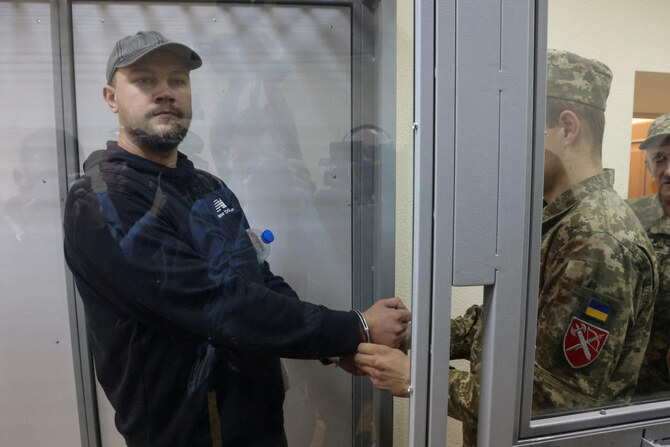
KYIV: Ukrainian military recruitment officers raided restaurants, bars and a concert hall in Kyiv, checking military registration documents and detaining men who were not in compliance, local media reported Saturday.
Officers reportedly descended on Kyiv’s Palace of Sports venue after a concert Friday night by Ukrainian rock band Okean Elzy. Video footage aired by local media outlets appears to show officers stationed outside the doors of the concert hall intercepting men as they exit. In the footage, officers appear to be forcibly detaining some men.
Checks were also conducted at Goodwine, an upscale shopping center, and Avalon, a popular restaurant.
It is unusual for such raids to take place in the capital, and reflects Ukraine’s dire need for fresh recruits. All Ukrainian men aged 25-60 are eligible for conscription, and men aged 18-60 are not allowed to leave the country.
Local reports said raids were also conducted in clubs and restaurants across other Ukrainian cities, including Kharkiv and Dnipro in eastern and central Ukraine.
Ukraine has intensified its mobilization drive this year. A new law came into effect this spring stipulating that those eligible for military service must input their information into an online system or face penalties.
Meanwhile, Ukraine’s military said on Saturday that it struck a Russian-controlled oil terminal in the partially occupied Luhansk region that provides fuel for Russia’s war effort.
“Oil and oil products were stored at this base, which were supplied, in particular, for the needs of the Russian army,” Ukraine’s General Staff wrote on Telegram.
Russian state media reported that the terminal close to the city of Rovenky had come under attack from a Ukrainian drone and said there were no casualties and that the fire had been extinguished, but did not comment on the extent of any damage.
On Monday, Ukrainian forces said they struck a major oil terminal on the south coast of the Russia-occupied Crimea Peninsula.
Both sides are facing the issue of how to sustain their costly war of attrition — a conflict that started with Russia’s full-scale invasion of Ukraine in February 2022 and that shows no signs of a resolution.
Ukraine’s aim is to impair Russia’s ability to support its front-line units, especially in the eastern Donetsk region where the main Russian battlefield effort is stretching weary Ukrainian forces.
Kyiv is still awaiting word from its Western partners on its repeated requests to use the long-range weapons they provide to hit targets on Russian soil.
Meanwhile, Russia’s Defense Ministry said 47 Ukrainian drones had been intercepted and destroyed by its air defense systems overnight into Saturday: 17 over the Krasnodar region, 16 over the Sea of Azov, 12 over the Kursk region and two over the Belgorod region, all of which border Ukraine.
Belgorod regional Gov. Vyacheslav Gladkov said Saturday that one person had been killed and 14 wounded in Ukrainian shelling and drone attacks over the previous 24 hours.
In Ukraine, the country’s Air Force said air defenses had shot down 24 of 28 drones launched overnight against Ukraine.
Zaporizhzhia regional Gov. Ivan Fedorov said two women were wounded Saturday in Russian attacks on the capital of the southern Ukrainian region, also called Zaporizhzhia.


![]()


Ukrainian recruiters descend on Kyiv’s nightlife in search of men not registered for conscription
Short Url
https://arab.news/8nyzg
Ukrainian recruiters descend on Kyiv’s nightlife in search of men not registered for conscription
- It is unusual for such raids to take place in the capital, and reflects Ukraine’s dire need for fresh recruits
- All Ukrainian men aged 25-60 are eligible for conscription, and men aged 18-60 are not allowed to leave the country


Ukraine will be technically ready to join EU in 2027, Zelensky says
KYIV: Ukraine will be technically ready to join the European Union in 2027, President Volodymyr Zelensky said, adding that securing ‘fast track’ accession to the bloc was an important part of security guarantees after the war with Russia ends.
“Technically, we will be ready in 2027,” Zelensky told reporters in remarks released by his office on Friday, adding that by the end of 2026 Ukraine will have implemented the main steps required for membership.
“I would like Ukraine to receive a clear timeline,” he said, adding that his government was committed to the necessary reforms.


Latest updates


© 2026 SAUDI RESEARCH & PUBLISHING COMPANY, All Rights Reserved And subject to Terms of Use Agreement.