ISLAMABAD: Pakistan’s ambassador to the UAE, Faisal Niaz Tirmizi, has called for UAE chambers of commerce to increase collaboration with Pakistani counterparts and set up business-to-business joint ventures for the enhancement of trade and investment between the two countries, Islamabad’s embassy in Abu Dhabi said on Wednesday.
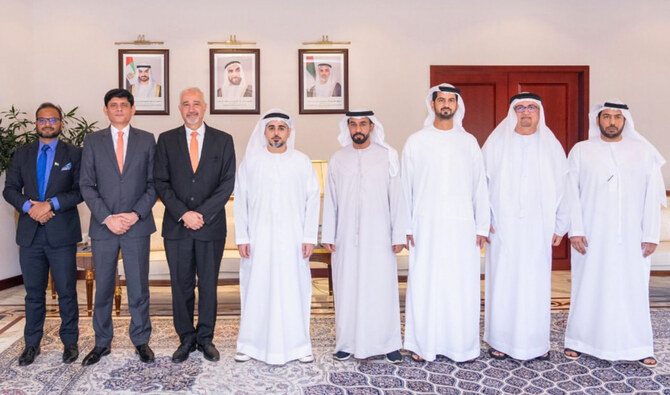
The issues were discussed during a meeting between Tirmizi and Ahmed Jasim Al Zaabi, the chairman of the Federation of UAE Chambers of Commerce and Industry (UAE Chambers) and the Abu Dhabi Chamber of Commerce & Industry (ADCCI). Zaabi is also the chairman of the Abu Dhabi Department of Economic Development (ADDED) and the Abu Dhabi Global Market (ADGM).
“Enhancement of collaboration between UAE Chambers with Pakistani Chambers of Commerce and Industries and establishment of B2B joint ventures for enhancement of trade between the two brotherly countries were also discussed during the meeting,” the Pakistani embassy said after the meeting between the two officials.
“Tirmizi briefed Zaabi regarding Pakistan’s investment regime and initiatives of the government for facilitation of foreign investors.”
The envy also briefed the UAE official about potential investment sectors in Pakistan including IT, food and agriculture, textile, leather, tourism, and infrastructure. He also reiterated the invitation to a business delegation from the UAE Chambers to visit Pakistan.
“Both the sides agreed on the enhancement of economic and commercial cooperation between the two brotherly countries through trade facilitation, B2B engagements and mutual exchange of delegations and participation in trade fairs and exhibitions including GITEX and TEXPO,” the Pakistan embassy said.
Last year, Pakistan set up the Special Investment Facilitation Council, a body comprising Pakistani civilian and military leaders and specially tasked to promote investment in Pakistan. The council is so far focusing on investments in the energy, agriculture, mining, information technology and aviation sectors and specifically targeting Gulf nations.

Pakistan’s UAE envoy calls for collaboration between commerce chambers, B2B joint ventures
https://arab.news/rxaa6
Pakistan’s UAE envoy calls for collaboration between commerce chambers, B2B joint ventures
- Pakistani ambassador Faisal Niaz Tirmizi meets Ahmed Jasim Al Zaabi, chairman Federation of UAE Chambers of Commerce
- Tirmizi briefed Zaabi regarding Pakistan’s investment regime and initiatives by the government for facilitation of foreign investors
Pakistan says inflation to remain within 5-6 percent range in January
- Current account projected to remain in deficit, says Finance Division in monthly economic outlook
- Pakistan suffered a financial crisis in 2023, marked by inflation of 38 percent, depleted forex reserves
KARACHI: Inflation is expected to remain within the 5-6 percent range in January, Pakistan’s Finance Division said in its monthly economic outlook report on Tuesday, saying that the country’s economy is well positioned to sustain growth momentum in FY2026.
Consumer Price Index (CPI) inflation was recorded at 5.6 percent year-on-year (YoY) basis in December 2025 as compared to 6.1 percent in November 2025 and 4.1 percent in December 2024.
“Inflation is expected to remain within the range of 5.0-6.0 percent in January,” the Finance Division said.
“On the external front, the current account is projected to remain in a deficit; however, robust remittance inflows and steady performance in IT and services exports are likely to cushion external pressures.”
The report said that the “positive trajectory” of the economy reflects the impact of the government’s prudent policies, ongoing structural reforms and easing of monetary conditions due to subsiding inflationary pressures.
Earlier, Pakistan’s finance ministry adviser Khurram Schehzad said S&P Global Market Intelligence’s latest macroeconomic forecast for Pakistan broadly aligns with projections issued by the State Bank of Pakistan, signaling easing inflation, manageable external balances and a gradual recovery in economic growth.
The assessment came amid stabilizing macroeconomic indicators after Pakistan went through a prolonged financial crisis marked by record inflation of 38 percent, depleted foreign exchange reserves and repeated balance-of-payments pressures, culminating in emergency support from the International Monetary Fund.
Tighter monetary policy, fiscal consolidation and external financing have since helped stabilize prices and ease pressure on the external account, prompting more measured assessments from international credit rating agencies.
“S&P’s projections broadly align with SBP’s outlook, with slight differences on growth and the current account but a shared assessment of easing inflation and gradual economic improvement,” Schehzad said in a statement.
According to S&P, inflation is expected to average 5.1 percent in 2026 and edge up slightly to 5.6 percent in 2027, staying within the SBP’s projected range of 5 percent to 7 percent over the next two years.
On the external front, S&P forecast a current account deficit of 0.5 percent of gross domestic product in 2026, broadly in line with the central bank’s expectation that the deficit will remain between 0 percent and 1 percent of GDP in the fiscal year.
Economic growth is projected to strengthen gradually, with S&P forecasting real GDP growth of 3.5 percent in fiscal year 2026, rising to 4.4 percent the following year. The SBP has projected growth of 3.75 percent to 4.75 percent for FY26.
Both S&P and SBP projections echo the government’s assessment that macroeconomic conditions are stabilizing, as Pakistan seeks to attract foreign investment and push toward export-led growth.


