ACWA Power secures $150m deal to finance wind power plants in Uzbekistan 

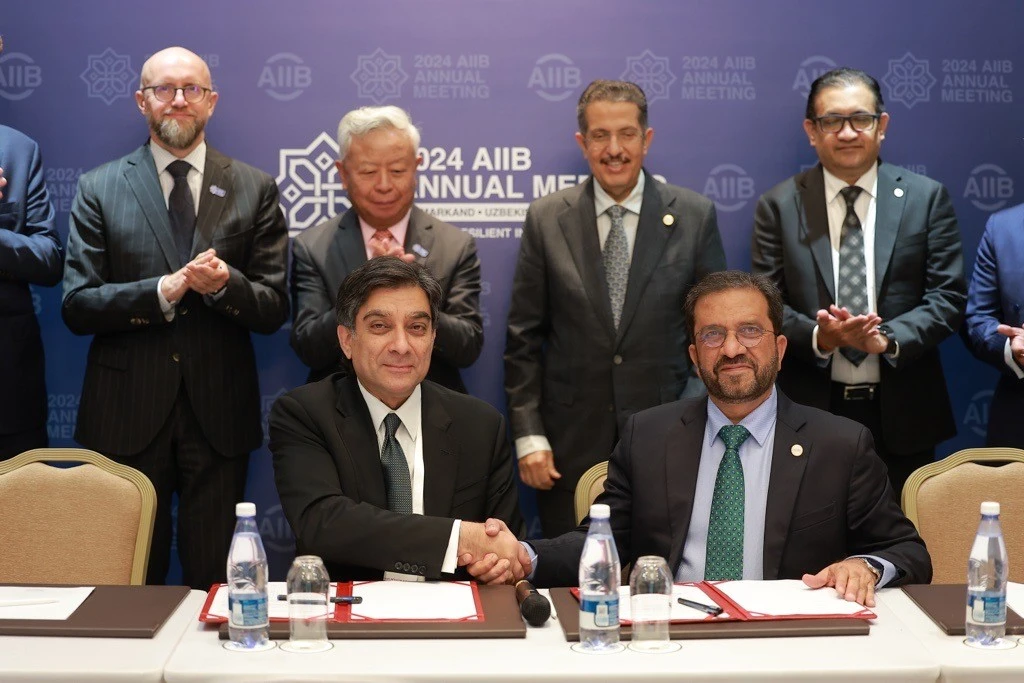
The signing took place during the annual meeting of the AIIB Board of Governors in Samarkand. Supplied
Short Url
Updated 08 October 2024
Follow

ACWA Power secures $150m deal to finance wind power plants in Uzbekistan 

  • Fnancing covers the Kongrad 1, 2, and 3 facilities, each with a capacity of 500 megawatts
  • Uzbekistan is one of the key foreign markets for the utility firm

RIYADH: Saudi utility giant ACWA Power has signed a letter of intent with the Asian Infrastructure Investment Bank to provide $150 million for three wind power plants in Uzbekistan. 

According to a press statement, the financing covers the Kongrad 1, 2, and 3 facilities, each with a capacity of 500 megawatts. 

The Tadawul-listed firm added that the financing term is four years and will be backed by an institutional guarantee provided by ACWA Power. 

Uzbekistan is one of the key foreign markets for the utility firm, with the company significantly involved in the Central Asian nation’s renewable energy sector in recent years. 

Its current portfolio in Uzbekistan comprises 11.6 gigawatts of power, of which 10.1 GW is renewable, as well as the country’s first green hydrogen project, with a capacity of 3,000 tonnes per year. 

“This announcement marks an important step forward in our commitment to delivering clean, reliable and affordable energy in Uzbekistan,” said Mohammad Abunayyan, founder and chairman of ACWA Power. 

He added: “The Kungrad wind projects are expected to significantly contribute to Uzbekistan’s renewable energy goals, and we look forward to working with our long-standing partner AIIB to bring this vision to life.” 

Jin Liqun, president of AIIB, stated that the Kungrad wind project is expected to catalyze Uzbekistan’s energy transition journey. 

The country aims to produce 40 percent, or 27 GW, of its overall electricity demand from renewable sources such as wind and solar photovoltaic. 

“By enhancing energy efficiency and transitioning to renewable energy resources, these climate mitigation projects support Uzbekistan’s ambitious renewable energy targets and align with AIIB’s commitment to sustainable infrastructure,” added Liqun. 

In July, ACWA Power signed financing deals worth $373.1 million for Tashkent’s Riverside power plant, which aims to generate 200 MW of solar photovoltaic energy and store 500 MW per hour using batteries. 

In March, the Saudi company also secured a $255.12 million power purchase agreement with Uzbekistan’s National Electric Grid for the Nukus 2 200-MW wind project. 

Established in 2004, ACWA Power currently operates in 13 countries across the Middle East, Africa, Central Asia, and Southeast Asia. 

The company stated that it currently manages a portfolio of 90 projects valued at $94.3 billion, capable of generating 65.6 GW of power.


Saudi Arabia’s cultural sector is a new economic engine between Riyadh and Paris, says ambassador

Updated 25 January 2026
Follow

Saudi Arabia’s cultural sector is a new economic engine between Riyadh and Paris, says ambassador

RIYADH: Culture has become a fundamental pillar in bilateral relations between France and Saudi Arabia, according to the French Ambassador to the Kingdom, Patrick Maisonnave.

Maisonnave noted its connection to the entertainment and tourism sectors, which makes it a new engine for economic cooperation between Riyadh and Paris.

He told Al-Eqtisadiah during the opening ceremony of La Fabrique in the Jax district of Diriyah that cultural cooperation with Saudi Arabia is an important element for its attractiveness in the coming decades.

La Fabrique is a space dedicated to artistic creativity and cultural exchange, launched as part of a partnership between the Riyadh Art program and the French Institute in Riyadh. 

Running from Jan. 22 until Feb 14, the initiative will provide an open workspace that allows artists to develop and work on their ideas within a collaborative framework.

Launching La Fabrique as a space dedicated to artistic creativity

The ambassador highlighted that the transformation journey in the Kingdom under Vision 2030 has contributed to the emergence of a new generation of young artists and creators, alongside a growing desire in Saudi society to connect with culture and to embrace what is happening globally. 

He affirmed that the relationship between the two countries is “profound, even cultural par excellence,” with interest from the Saudi side in French culture, matched by increasing interest from the French public and cultural institutions unfolding in the Kingdom.

Latest estimates indicate that the culture-based economy represents about 2.3 percent of France’s gross domestic product, equivalent to more than 90 billion euros ($106.4 billion) in annual revenues, according to government data. The sector directly employs more than 600,000 people, making it one of the largest job-creating sectors in the fields of creativity, publishing, cinema, and visual arts.

Saudi Arabia benefiting from French experience in the cultural field

Maisonnave explained that France possesses established cultural institutions, while Saudi Arabia is building a strong cultural sector, which opens the door for cooperation opportunities.

This comes as an extension of the signing of 10 major cultural agreements a year ago between French and Saudi institutions, aiming to enhance cooperation and transfer French expertise and knowledge to contribute to the development of the cultural system in the Kingdom.

He added that experiences like La Fabrique provide an opportunity to meet the new generation of Saudi creators, who have expressed interest in connecting with French institutions and artists in Paris and France.

La Fabrique encompasses a space for multiple contemporary artistic practices, including performance arts, digital and interactive arts, photography, music, and cinema, while providing the public with an opportunity to witness the stages of producing artistic works and interact with the creative process.