

Two Chinese nationals among three killed in attack near airport in Pakistan’s Karachi

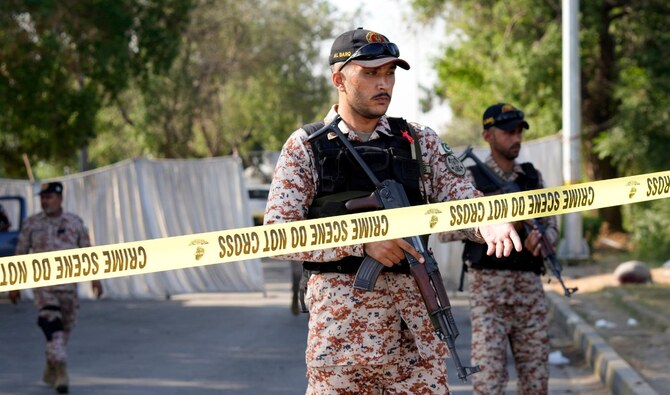
Security officials stand guard at the site of an explosion that caused injures and destroyed vehicles outside the Karachi airport, Pakistan, Monday, Oct. 7, 2024. (AP)
Short Url
Updated 07 October 2024
Follow

Two Chinese nationals among three killed in attack near airport in Pakistan’s Karachi

  • Convoy carrying Chinese staff of Port Qasim Electric Power Company targeted, Beijing confirms
  • Separatist BLA says used vehicle-borne improvised explosive device to target Chinese nationals

KARACHI: Two Chinese nationals were among three people killed and 10 injured late on Sunday night in a “terrorist attack” near the airport in Pakistan’s southern port city of Karachi, the Chinese embassy and local officials said on Monday.

The separatist militant group, the Baloch Liberation Army (BLA), claimed the attack in a statement sent to media, saying a vehicle-borne improvised explosive device had targeted the Chinese nationals.

China is a major ally and investor in Pakistan, having pledged over $65 billion in road, infrastructure and development projects under the China-Pakistan Economic Corridor (CPEC) project. 

“We have received the dead body of two Chinese nationals and the mutilated remains of an unidentified body,” chief surgeon for Karachi police, Dr. Sumaiyya Syed, told Arab News. “We have performed the autopsy of all three.”

Syed said 10 people were being treated for injuries at the Jinnah Hospital in Karachi, which included one child.


A Pakistani security official, who was injured in an explosion receives treatment inside an ambulance outside the Karachi airport, Pakistan, early Monday, Oct. 7, 2024. (AP)

The Chinese Embassy in Pakistan said in a statement a convoy of the Port Qasim Electric Power Company was targeted in an attack near the Karachi airport around 11:00pm on Sunday night. Two Chinese nationals were killed and one was injured, the statement said, adding that the Chinese side was working with Pakistani authorities in the aftermath.

“The Chinese Embassy and Consulates General in Pakistan remind Chinese citizens, enterprises and projects in Pakistan to be vigilant, pay close attention to the security situation, strengthen security measures, and make every effort to take safety precautions,” the statement concluded.

The Pakistani foreign office condemned the attack and said the country’s security and law enforcement agencies would make every effort to arrest the perpetrators and their facilitators. 

“This barbaric act will not go unpunished,” the foreign office warned. 

Sunday night’s attack is the latest by the BLA, the most prominent of a number of separatist groups fighting for independence for Pakistan’s gas-and-mineral-rich Balochistan province, where a low-lying insurgency has been ongoing for the past two decades. Baloch militants blame Pakistan’s state for exploiting the province’s resources, a charge the Pakistani state denies.



Security officials stand at the site of an explosion occured near Karachi airport in Karachi, on late October 6, 2024. (AFP)

The BLA also accuses Beijing of helping Islamabad exploit the province and has attacked Chinese interests and projects in the past, in particular the strategic port of Gwadar on the Arabian Sea. It has previously killed Chinese citizens working in the region and attacked Beijing’s consulate in Karachi. 

In March this year, a suicide bombing killed five Chinese engineers and a Pakistani driver in northwestern Pakistan as they headed to the Dasu Dam, the biggest hydropower project in the country. In 2022, three Chinese educators and their Pakistani driver were killed when an explosion ripped through a van at the University of Karachi.

Sunday’s airport attack followed a deadly day of coordinated attacks in August, most claimed by the BLA, that killed more than 50 people in Balochistan and which Prime Minister Shehbaz Sharif and other leaders had said sought to harm Chinese-funded investment and development projects.


Pakistan to provide Hajj pilgrims high-speed train service in Kingdom this year

Updated 5 sec ago
Follow

Pakistan to provide Hajj pilgrims high-speed train service in Kingdom this year

  • Several thousand Pakistani pilgrims will use Haramain High-Speed Railway which will reduce Makkah, Madinah travel times
  • Pakistan will send 179,210 pilgrims for Hajj 2026 as training, accommodation and logistical arrangements enter final phase

ISLAMABAD: Pakistan will provide Hajj pilgrims high-speed train service between the holy cities of Makkah and Madinah this year, the country’s religion ministry said on Sunday, as Islamabad’s preparations for Hajj 2026 enter their final phase.

The Haramain High-Speed Railway connects Makkah and Madinah via Jeddah and King Abdullah Economic City along a 453-kilometer railway line and operates some of the world’s fastest passenger trains, with speeds of up to 300 kilometers an hour.

This year 179,210 pilgrims from Pakistan will perform Hajj, according to the religious affairs ministry. Of these, 119,210 pilgrims will travel under the government scheme, while 60,000 will go through private tour operators, with applications processed on a first-come, first-served basis.

“This year the Haramain High-Speed Railway will be offered for the first time to several thousand Pakistani pilgrims on trial basis,” Muhammad Umar Butt, a Pakistani religious affairs ministry spokesman, told Arab News.

“The exact number will be released later.”

The pilot project will also include travel from hotel to train stations and luggage service, according to the official. Pakistani pilgrims are usually provided buses to commute between the two holy cities, which takes six to eight hours. The train service will reduce this duration to less than 2 and half hours.

Butt said Pakistan’s preparations for the annual pilgrimage were in final stages and the first Hajj flight will leave for the Kingdom in the mid of April.

He urged pilgrims to join the second phase of mandatory trainings which will begin after Eid Al-Fitr.

Pakistan sends one of the world’s largest Hajj contingents each year, requiring months of logistical coordination between Islamabad and Saudi authorities to manage housing in Makkah and Madinah, transport to holy sites and training in religious rites.

Authorities say these trainings are essential because many Pakistani pilgrims travel abroad for the first time and must learn both rituals and administrative procedures before departure.

“A total of 183 training workshops have been conducted [so far] in 107 cities to educate pilgrims about Hajj rituals and administrative matters,” Religious Affairs Secretary Dr. Sajid Mahmood Chauhan said last week, after a meeting to review accommodation, transport, vaccinations and travel documentation for Hajj pilgrims.

Officials said preparations for accommodation and transport in Mina and Arafat as well as food services had entered the final phase, while vaccination, air tickets and visa issuance for Hajj pilgrims would begin soon.

“Makkah and Madinah accommodation has been secured better than last year,” Hajj Director-General Abdul Wahab Soomro told the meeting.