

Pakistan to provide Hajj pilgrims high-speed train service in Kingdom this year

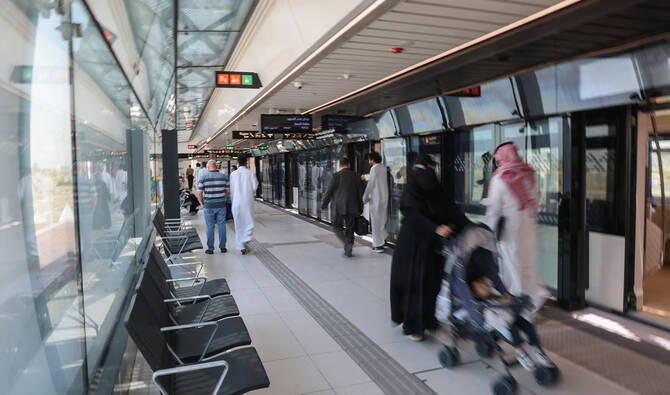
People exit a metro train at King Saud University station in Riyadh on April 27, 2025. (AFP/ file)
Short Url
Updated 22 February 2026
Follow

Pakistan to provide Hajj pilgrims high-speed train service in Kingdom this year

  • Several thousand Pakistani pilgrims will use Haramain High-Speed Railway which will reduce Makkah, Madinah travel times
  • Pakistan will send 179,210 pilgrims for Hajj 2026 as training, accommodation and logistical arrangements enter final phase

ISLAMABAD: Pakistan will provide Hajj pilgrims high-speed train service between the holy cities of Makkah and Madinah this year, the country’s religion ministry said on Sunday, as Islamabad’s preparations for Hajj 2026 enter their final phase.

The Haramain High-Speed Railway connects Makkah and Madinah via Jeddah and King Abdullah Economic City along a 453-kilometer railway line and operates some of the world’s fastest passenger trains, with speeds of up to 300 kilometers an hour.

This year 179,210 pilgrims from Pakistan will perform Hajj, according to the religious affairs ministry. Of these, 119,210 pilgrims will travel under the government scheme, while 60,000 will go through private tour operators, with applications processed on a first-come, first-served basis.

“This year the Haramain High-Speed Railway will be offered for the first time to several thousand Pakistani pilgrims on trial basis,” Muhammad Umar Butt, a Pakistani religious affairs ministry spokesman, told Arab News.

“The exact number will be released later.”

The pilot project will also include travel from hotel to train stations and luggage service, according to the official. Pakistani pilgrims are usually provided buses to commute between the two holy cities, which takes six to eight hours. The train service will reduce this duration to less than 2 and half hours.

Butt said Pakistan’s preparations for the annual pilgrimage were in final stages and the first Hajj flight will leave for the Kingdom in the mid of April.

He urged pilgrims to join the second phase of mandatory trainings which will begin after Eid Al-Fitr.

Pakistan sends one of the world’s largest Hajj contingents each year, requiring months of logistical coordination between Islamabad and Saudi authorities to manage housing in Makkah and Madinah, transport to holy sites and training in religious rites.

Authorities say these trainings are essential because many Pakistani pilgrims travel abroad for the first time and must learn both rituals and administrative procedures before departure.

“A total of 183 training workshops have been conducted [so far] in 107 cities to educate pilgrims about Hajj rituals and administrative matters,” Religious Affairs Secretary Dr. Sajid Mahmood Chauhan said last week, after a meeting to review accommodation, transport, vaccinations and travel documentation for Hajj pilgrims.

Officials said preparations for accommodation and transport in Mina and Arafat as well as food services had entered the final phase, while vaccination, air tickets and visa issuance for Hajj pilgrims would begin soon.

“Makkah and Madinah accommodation has been secured better than last year,” Hajj Director-General Abdul Wahab Soomro told the meeting.


Pakistan army hits Afghan Taliban drone storage facility, ammunition depot in Jalalabad

Updated 5 sec ago
Follow

Pakistan army hits Afghan Taliban drone storage facility, ammunition depot in Jalalabad

  • Around 435 Afghan Taliban fighters killed, over 630 injured in Pakistani military offensive, minister says
  • Several countries, global bodies have urged both sides to exercise restraint since the conflict began last week

ISLAMABAD: Pakistan’s army struck a drone storage facility and ammunition depot of Afghan Taliban in Jalalabad, a Pakistani security official said on Monday, following Pakistani strikes on more than 50 locations in Afghanistan amid ongoing hostilities between the neighbors.

Pakistan launched Operation ‘Ghazb lil Haq’ against Afghanistan on the night of Feb. 26 following an attack by Afghanistan on Pakistani military installations along their shared border.

The worst fighting between the two neighbors in years erupted after Pakistani airstrikes targeted what Islamabad called militant hideouts inside Afghanistan on Feb. 21-22, accusing Kabul of harboring Tehreek-e-Taliban Pakistan (TTP) militants behind the attacks on its soil. Afghanistan denies the charge.

A Pakistani security official, who requested anonymity, said the army was continuing “strong retaliatory action” against the Afghan Taliban and blew up multiple border posts, forcing them to abandon their positions.

“Pakistan forces are effectively targeting the bases and military installations of the Fitna Al-Khawarij and the Afghan Taliban,” he said.

“During the effective counter-operation of the Pakistani forces, the ammunition depot and drone storage site of Fitna Al-Khawarij (TTP) and the Afghan Taliban in Jalalabad was destroyed.”

Separately, Pakistan’s Information Minister Attaullah Tarar said more than 400 Afghan Taliban fighters had been killed and over 630 wounded in the Pakistani military offensive so far.

Pakistan destroyed around 188 check posts and captured 31, according to a post on X by Tarar. Over 180 tanks, armored vehicles and artillery guns were also destroyed in Pakistani air raids at 51 locations across Afghanistan.

On Sunday, Pakistani state media shared a video of what it said were Pakistani soldiers crossing into Afghanistan in the northwest to capture an Afghan post. Pakistan has seized a 32-square-kilometer area of Afghanistan, another Pakistani security official said.

Afghan officials earlier said that dozens of Pakistani soldiers had been killed and several Pakistan posts had been captured by their forces. None of the casualty figures or battlefield claims from either side could be independently verified.

Since the conflict began last week, diplomatic efforts have intensified, with several countries and international bodies calling on both sides to exercise restraint.

The United Nations, along with China and Russia, has called for calm, while US President Donald Trump said Pakistan has the right to defend itself against cross-border militancy.