

St. Francis relics go on public show for first time in Italy

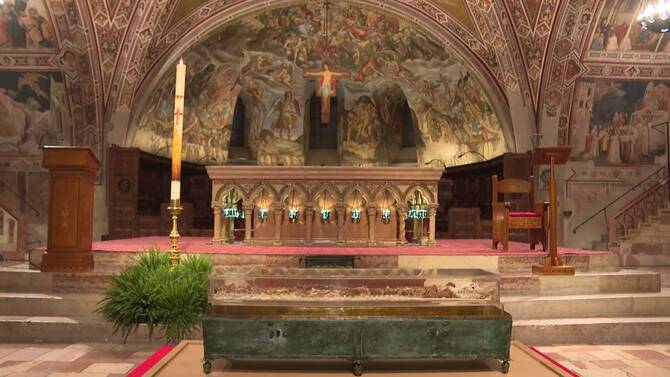
This video grab taken from an AFP shooting shows the remains of St. Francis of Assisi on display in a glass case inside the Basilica of St. Francis of Assisi during a press preview, in Assisi on February 21, 2026. The exposition to the public of the remains will begin on February 22 to mark the 800th anniversary of his death in 1226. ( AFP)
Short Url
Updated 22 February 2026
Follow

St. Francis relics go on public show for first time in Italy

Assisi, Italy: Saint Francis of Assisi’s skeleton is going on public display from Sunday for the first time for the 800th anniversary of his death, drawing hundreds of thousands of visitors.
Inside a nitrogen-filled plexiglass case with the Latin inscription “Corpus Sancti Francisci” (The Body of St. Francis), the remains are being shown in the Italian hill town’s Basilica of St. Francis of Assisi.
St. Francis, who died on October 3, 1226, founded the Franciscan order after renouncing his wealth and devoting his life to the poor.
Giulio Cesareo, director of communications for the Franciscan convent in Assisi said he hoped the display could be “a meaningful experience” for believers and non-believers alike.
Cesareo, a Franciscan friar, said the “damaged” and “consumed” state of the bones showed that St. Francis “gave himself completely” to his life’s work.
His remains, which will be on display until March 22, were transferred to the basilica built in the saint’s honor in 1230.
But it was only in 1818, after excavations carried out in utmost secrecy, that his tomb was rediscovered.
Apart from previous exhumations for inspection and scientific examination, the bones of Saint Francis have only been displayed once, in 1978, to a very limited public and for just one day.
Usually hidden from view, the transparent case containing the relics since 1978 was brought out on Saturday from the metal coffer in which it is kept, inside his stone tomb in the crypt of the basilica.
The case is itself inside another bullet-proof and anti-burglary glass case.
Surveillance cameras will operate 24 hours a day for added protection of the remains.
St. Francis is Italy’s patron saint and the 800th anniversary commemorations of his death will also see the restoration of an October 4 public holiday in his honor.
The holiday had been scrapped nearly 50 years ago for budget reasons.
Its revival is also a tribute to late pope Francis who took on the saint’s name.
Pope Francis died last year at the age of 88.

‘Not a movie set’

Reservations to see the saint’s remains already amount to “almost 400,000 (people) coming from all parts of the world, with of course a clear predominance from Italy,” said Marco Moroni, guardian of the Franciscan convent.
“But we also have Brazilians, North Americans, Africans,” he added.
During this rather quiet time of year, the basilica usually sees 1,000 visitors per day on weekdays, rising to 4,000 on weekends.
The Franciscans said they were expecting 15,000 visitors per day on weekdays and up to 19,000 on Saturdays and Sundays for the month-long display of the remains.
“From the very beginning, since the time of the catacombs, Christians have venerated the bones of martyrs, the relics of martyrs, and they have never really experienced it as something macabre,” Cesareo said.
What “Christians still venerate today, in 2026, in the relics of a saint is the presence of the Holy Spirit,” he said.
Another church in Assisi holds the remains of Carlo Acutis, an Italian teenager who died in 2006 and who was canonized in September by Pope Leo XIV.
Experts said the extended display of St. Francis’s remains should not affect their state of preservation.
“The display case is sealed, so there is no contact with the outside air. In reality, it remains in the same conditions as when it was in the tomb,” Cesareo said.
The light, which will remain subdued in the church, should also not have an effect.
“The basilica will not be lit up like a stadium,” Cesareo said. “This is not a movie set.”


Turkish-language drama ‘Yellow Letters’ wins Berlin Film Festival’s top prize

Updated 22 February 2026
Follow

Turkish-language drama ‘Yellow Letters’ wins Berlin Film Festival’s top prize

  • The report ⁠did ⁠not say who was to blame for the attacks

BERLIN: “Yellow Letters,” a Turkish-language drama about what happens to a marriage put under extraordinary political pressure, ​won the Berlin Film Festival’s Golden Bear top prize on Saturday night.
The drama filmed in Germany but set in Turkiye follows a married actor and playwright who have to leave behind their comfortable lives after the husband is targeted by the state for posting critical content online.
“I know what (this win) means to my cast and crew who came from Turkiye, who now are getting a visibility that is on an international scale,” Turkish-German director Ilker Catak told Reuters after the award ceremony.
The director, whose previous Berlin entry “The Teachers’ Lounge” was nominated for an Oscar, said it was important that the film was not just about Turkiye, but Germany as well.
“There is a ‌sign that says ‌1933 and what we’ve seen in this country before, we must never ​forget,” ‌he ⁠said, referring ​to ⁠the year that Adolf Hitler came to power.
This year’s jury president, legendary German director Wim Wenders, praised the winner as “a movie that speaks up very clearly about the political language of totalitarianism.”
In total, 22 films had been in the running.

POLITICAL FESTIVAL
The festival maintained its reputation as the most overtly political of its peers, Venice and Cannes, with the war in Gaza in particular dominating public discussions about the films.
“If this Berlinale has been emotionally charged, that’s not a failure of the Berlinale, and it’s not a failure of cinema,” said festival director Tricia Tuttle at the opening ⁠ceremony, using the festival’s nickname.
Wenders used his final appearance as jury president to ‌urge filmmakers and activists to act as allies, not rivals, after ‌his comment that filmmakers should not be political caused Indian novelist Arundhati Roy ​to pull out.
Several award winners used their speech ‌to express solidarity with the Palestinians and other oppressed peoples.
“The least we can do here is to ‌break the silence and remind them that they are not really alone,” said Turkish filmmaker Emin Alper, whose film “Salvation” took the second-place Silver Bear Grand Jury Prize.
Palestinian-Syrian director Abdallah Al-Khatib, whose “Chronicles From the Siege” won the Perspectives section for emerging filmmakers, criticized the German government for its stance on Gaza despite concerns about crossing a red line.
“I was under a lot of ‌pressure to participate in Berlinale for one reason only, to stand here and say: ‘The Palestinians will be free,’” he said.

SANDRA HUELLER WINS AGAIN
German actor Sandra Hueller, ⁠who starred in 2024 Oscar-winning ⁠films “Anatomy of a Fall” and “Zone of Interest,” continued her winning streak by taking home best actor for the period piece “Rose,” in which she dresses as a man.
“To me, it’s special because I won my first-ever recognition as an actor in a film at this festival 20 years ago,” Hueller told Reuters, who won best actress in 2006 for “Requiem.”
“Queen at Sea,” a drama that follows French star Juliette Binoche as she deals with her mother’s advanced dementia and its effects on her marriage, won two prizes: the third-place jury prize and best supporting actor, shared by its two elderly performers, Anna Calder-Marshall and Tom Courtenay.
Director Lance Hammer, who last competed at the festival in 2008, said he hoped that maybe “people will see this and feel some comfort or relief that they’re not alone.”
Director Grant Gee won best director for “Everybody Digs Bill Evans,” a black-and-white biographical drama starring Norwegian actor ​Anders Danielsen Lie as the US jazz pianist.
“Nina ​Roza,” about an art curator who returns to Bulgaria to verify whether a child painting prodigy is genuine, won best screenplay while “Yo (Love is a Rebellious Bird)” took the prize for outstanding artistic contribution.