

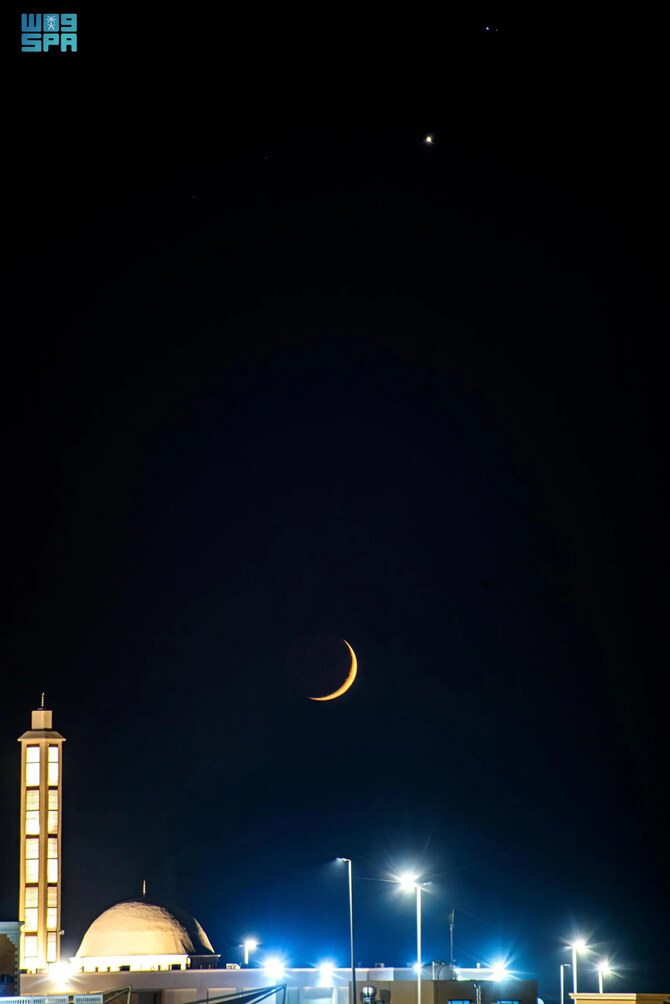
Moon-Venus conjunction visible in northern Saudi Arabia

The phenomenon occurred in the sky after sunset over the Northern Border region and was visible to the naked eye. (SPA)
Short Url
Updated 06 October 2024
Follow

Moon-Venus conjunction visible in northern Saudi Arabia

  • Celestial show after sunset over the Northern Border region was visible to the naked eye

RAFHA: A spectacular celestial event occurred over Saudi Arabia’s northern skies on Saturday night, with the moon and Venus in conjunction, the Saudi Press Agency reported on Sunday.

Known as a conjunction, the phenomenon in the sky after sunset in the Northern Border region was visible to the naked eye, with the moon and the planet separated by just three degrees.

A conjunction occurs when two celestial objects appear close to each other in the sky and share the same celestial longitude, according to astronomer Berjis Al-Fulaih.

Al-Fulaih, an official with the AFAQ Society for Astronomy in Taif, noted that Venus is often referred to as the “Evening Star” or the “Morning Star,” depending on its position in the west or east.

The alignment marks the beginning of the moon’s monthly journey past the bright planets.


The phenomenon occurred in the sky after sunset over the Northern Border region and was visible to the naked eye. (SPA)

In an interview with SPA before the celestial event, Jeddah Astronomy Society chief Majed Abu Zahra said the appearance of the crescent moon and Venus together shortly after sunset, before the sky darkened fully, created the spectacular view.

“As the second and third brightest objects in the night sky, after the sun, they will present a striking view,” he said.

A faint glow, caused by sunlight reflecting off Earth (known as Earthshine), will softly illuminate the unlit part of the moon’s disk, he explained.

Abu Zahra said there will be another astronomical event in mid-October: the arrival of Comet Tsuchinshan-ATLAS, which will appear 20 to 25 degrees northwest of Venus on Oct. 13 and 14. The comet may even be visible to the naked eye, although comets are notoriously unpredictable.

By Oct. 25, Venus will appear three degrees north of the star Antares. Toward the end of the month, Venus will draw closer to Earth, with its disk measuring 14 arcseconds and being 77 percent illuminated, Abu Zahra told SPA.


Saudi Arabia targets 50 wildlife breeding programs within 5 years

Updated 5 sec ago
Follow

Saudi Arabia targets 50 wildlife breeding programs within 5 years

  • Strategy follows surging interest in protecting prized native species

RIYADH: Saudi Arabia’s top wildlife protection body has launched a plan to operate 50 breeding programs by 2030 and improve environmental balance, its CEO has said.

Mohammed Ali Qurban, head of the National Center for Wildlife, said the number of programs has already surged from seven to 21 in recent years, amid renewed interest in the protection of valued native species.

The breeding programs are based on precise scientific principles, starting with the selection of suitable species at research centers, followed by veterinary care and specialized nutrition programs, he added.

At the final stage, protected species are rehabilitated for release and monitored using the latest tracking and data analysis technologies.

The relocation of more than 10,000 animals in Saudi Arabia is “an important step in restoring ecosystems and enhancing environmental balance in the Kingdom,” Qurban said.

Veterinary scientists at work at the National Center for Wildlife's laboratory. (Supplied)

“Releasing wildlife into the wild contributes to forming new populations capable of self-reproduction; these releases support the genetic diversity of wild populations and enhance their ability to resist disease and adapt to environmental changes,” he added.

Releases have so far included more than 80 priority species, most notably reem antelopes, Arabian oryx, idmi gazelles, mountain ibex, houbara bustards, ostriches and sandgrouses. The animals were released within their historical and ecological ranges.

Qurban said that the plans take into account the carrying capacity of natural habitats and the importance of safe ecological corridors that connect protected areas to facilitate species movement and population sustainability.

Release sites are spread across more than 60 diverse environmental locations, including natural reserves, royal reserves and national parks, as well as strategic sites within the Kingdom’s giga-projects, ensuring the dispersal of animals across their targeted geographical ranges.

The efforts are part of a national integrated framework to support the goals of the Saudi Green Initiative, Vision 2030 and the National Environment Strategy, aiming to achieve thriving and sustainable wildlife and ecosystems, Qurban said.