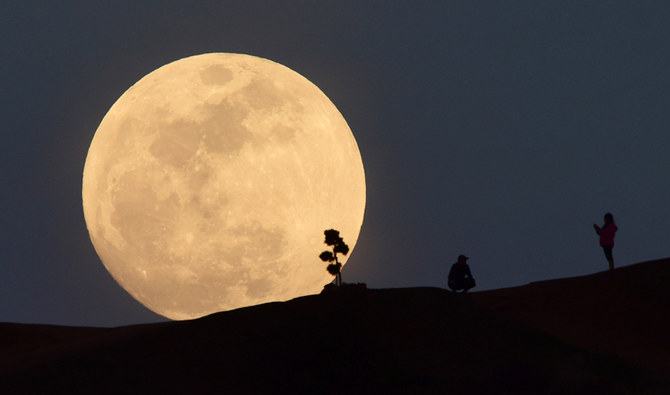
JEDDAH: We’ve all heard the expression “once in a blue moon” to denote something rare — and Saturday night was one of those special occasions, when the skies above the Kingdom were lit up with the spectacular full moon.
What makes it a blue moon is not its color, however, but the fact that it is the second full moon to appear in this calendar month, a phenomenon that occurs every 2.5-three years.
The term is also used for the third of four full moons in the season a blue moon, as each season contains three months.
With Saudi Arabian skies mostly clear and the full moon rising around sunset on a weekend, residents were able to take the chance to venture out in the desert and stargaze as evening temperatures drop.
Sky observers might also have noticed a reddish star nearby: Mars is vibrant and clear at present, and it is a good time to get a glimpse at the planet. The moon does really turn a blue color on very rare occasions, when “Earth’s atmosphere contains dust or smoke particles of a certain size, slightly wider than 900 nanometers,” according to EarthSky.
This happened when the volcano Krakatoa erupted in Indonesia in 1883, and the particles of ash in the air gave the moon a blue hue. People watched blue moons and purple sunsets for years, according to NASA.

Blue moon offers Saudi Arabia stargazers a celestial treat
https://arab.news/zg28n
Blue moon offers Saudi Arabia stargazers a celestial treat
- What makes it a blue moon is not its color, however, but the fact that it is the second full moon to appear in this calendar month
Saudi inventor wins two gold medals at Mideast International Invention Fair
- Khudry was recognized for inventing a device designed to filter materials and recycle used liquids
- The innovation aims to improve efficiency in liquid purification and reuse
RIYADH: Saudi inventor Duaa Nizar Khudry won two gold medals at the 16th International Invention Fair in the Middle East (IIFME), held in Kuwait from February 8 to 11, the Saudi Press Agency (SPA) reported.
Khudry was recognized for inventing a device designed to filter materials and recycle used liquids, an innovation aimed at improving efficiency in liquid purification and reuse. The technology has potential applications in environmental protection, industrial processing, and water conservation, particularly in regions where sustainable resource management is critical.
A member of the Mawhiba Alumni Program, Khudry represented Saudi Arabia with the support and nomination of the King Abdulaziz and His Companions Foundation for Giftedness and Creativity (Mawhiba), which was participating in the fair for the third time.
She received her first gold medal from the fair’s organizers and was also awarded the IFIA Best Invention Award by the International Federation of Inventors’ Associations, recognizing her innovation as one of the most outstanding entries in the exhibition.
The IIFME, organized annually by the Kuwait Science Club since its launch in 2007, is regarded as one of the region’s largest specialized invention exhibitions and a major platform for inventors to present their work to international audiences.
As a student, Khudry won first place nationwide at the National Olympiad for Scientific Creativity (Ibdaa) in 2013 for the same recycling device, competing against tens of thousands of students across the Kingdom. She later obtained an official patent for the invention in 2024, strengthening its scientific and commercial potential.
She studied chemistry and is currently pursuing graduate studies in materials science and engineering under the Custodian of the Two Holy Mosques Scholarship Program. Her research focuses on environmental sustainability, advanced materials, and liquid purification technologies.


