

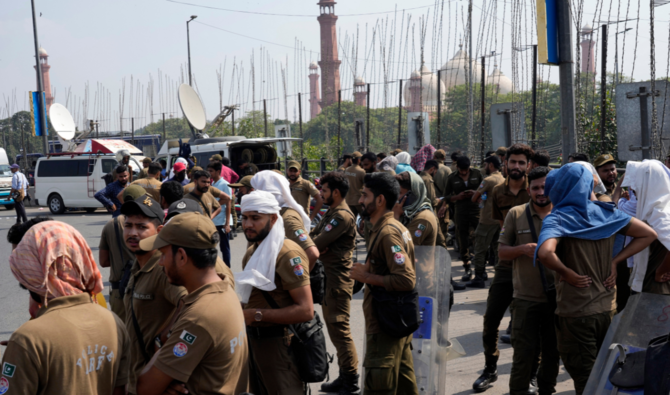

ISLAMABAD: Around 80 policemen have been injured as mobile phone services remained suspended and all roads leading to the Pakistani capital of Islamabad were blocked for a second consecutive day on Saturday amid a protest by former prime minister Imran Khan’s party, with Interior Minister Mohsin Naqvi ruling out any talks with the protesters.
Khan’s Pakistan Tehreek-e-Insaf (PTI) party has been holding protests across several Pakistani cities on Saturday against proposed constitutional amendments that it claims are aimed at curtailing the independence of the judiciary, a charge the government denies. The Pakistani opposition party is also trying to mobilize supporters through protests and large public gatherings to put pressure for the release of Khan, who has been in prison since August last year and faces a slew of legal challenges.
Speaking to reporters in Islamabad on Saturday, Naqvi said the protesters had fired upon police personnel on their way to Islamabad from the Khyber Pakhtunkhwa (KP) province and injured 80-85 police, reiterating that the motive behind the PTI’s protest was to sabotage a summit of the Shanghai Cooperation Organization (SCO) Heads of Government that is scheduled to take place in the Pakistani capital on October 15 and 16. He blamed KP Chief Minister Ali Amin Gandapur for the violence.
“We will not allow the SCO conference to be sabotaged in any case. We have an idea what exactly is their motive and how they plan to do all this,” Naqvi told reporters. “CM KPK is responsible for all this situation, because he is marching on Islamabad together with this horde, CM KPK is leading it.”
The interior minister said at least 120 Afghan nationals, who were part of the protest, had been arrested in the last 48 hours.
“Police was fired upon in Pathar Garh, where we had set up a blockade and from where CM KPK has moved ahead now, and they were constantly tear-gassing the police,” he said, warning the opposition party of not to force the government “to go to extreme steps.”
The PTI initially announced a protest at Islamabad’s D-Chowk square on Friday, but caravans of its supporters led by Gandapur failed to reach the capital the same day due to blockades of all roads and highways leading to Islamabad. Clashes erupted in Islamabad and nearby areas on Friday evening as Khan supporters tried to march toward the venue of the protest but were stopped by the police.
“CM KP Ali Amin’s convoy is currently being attacked with heavy tear-gas shelling,” the PTI said on X on Saturday noon.
Mobile phone and metro bus services remained suspended and schools and markets were closed in the capital for a second consecutive day on Saturday. The federal government also deployed army troops in the capital on Saturday to ensure security of the SCO summit.
Residents complained of immense difficulties in navigating the twin cities of Islamabad and Rawalpindi as all roads were blocked off with shipping containers.
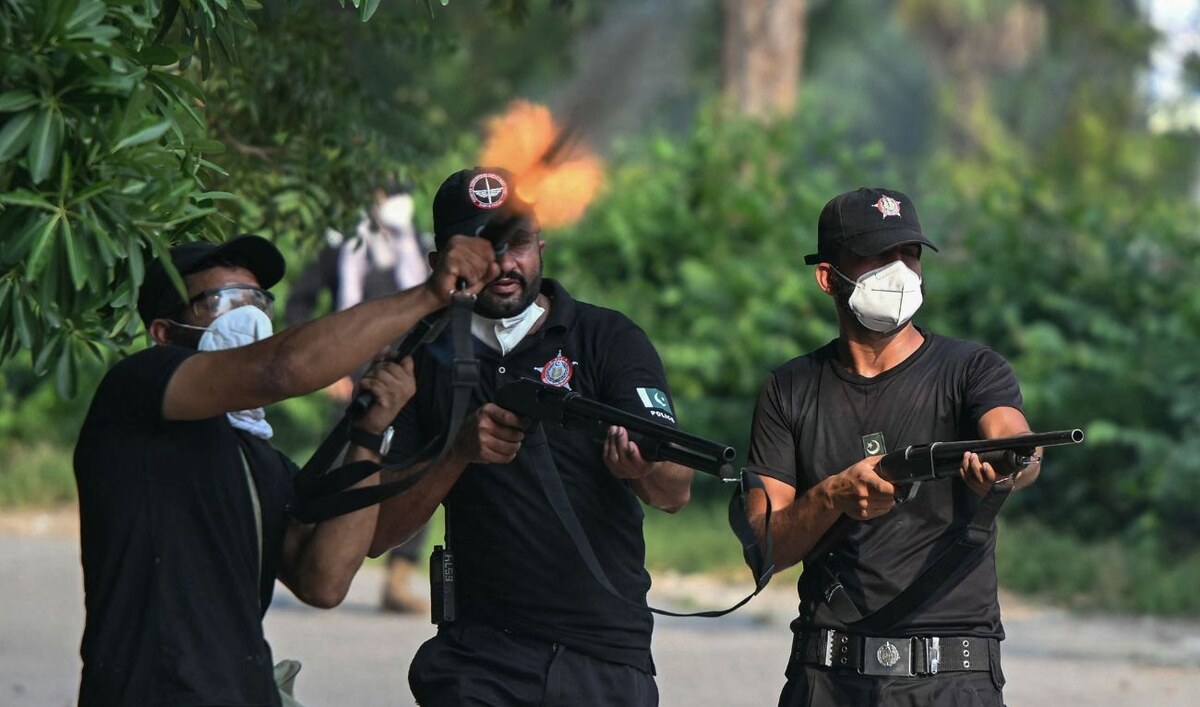
Policemen fire tear gas shells and rubber bullets to disperse supporters of jailed former prime minister Imran Khan's Pakistan Tehreek-e-Insaf (PTI) party during a protest in Islamabad on October 5, 2024. (AFP
)
“You don’t want people to come into the city [Islamabad] and get to D-Chowk where the protest is but at least let people go outside the city,” taxi driver Arshad Shad, who was on foot, told Arab News. “Buses can’t move, there is no Internet, no mobile phone service. Families are stuck, they can’t come or go. So I don’t understand what the government is doing, they are only making life more difficult for the public.”
Zafar Iqbal, who deals in the sale and purchase of property, lamented frequent protests and their impact on businesses in the twin cities.
“Every fourth day there is a protest. This is very wrong. This shouldn’t happen. People’s businesses are getting affected and the public is being humiliated,” he told Arab News. “This is a curse for the public, for businessmen. There is already no business and people are worried.”
Protests in Punjab
The PTI also announced a protest in Lahore on Saturday, but Hammad Azhar, a key member of the party, announced on X that demonstrations would be held in all districts across Pakistan’s most populous province.
“Islamabad protest will continue,” he said on Saturday. “Apart from this, it is announced that protests will begin in all districts of Punjab from today. People from Lahore and its surroundings will join the protest in Lahore. There is a call for peaceful protests from today in all the rest of the districts of Punjab.”
Local news channels reported authorities had placed shipping containers on roads leading to the Minar-e-Pakistan monument in Lahore, where the PTI plans to hold the protest. The government has imposed Section 144 of the Code of Criminal Procedure, which allows the district administration to outlaw gatherings of more than four people on account of security threats, in various cities.


