

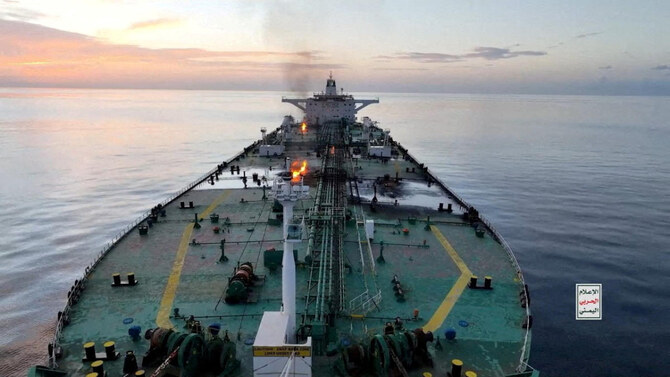

ATHENS/LONDON: On a warm spring night in Athens, shortly before midnight, a senior executive at a Greek shipping company noticed an unusual email had landed in his personal inbox.
The message, which was also sent to the manager’s business email address, warned that one of the company’s vessels traveling through the Red Sea was at risk of being attacked by Yemen’s Iranian-backed Houthi militia.
The Greek-managed ship had violated a Houthi-imposed transit ban by docking at an Israeli port and would be “directly targeted by the Yemeni Armed Forces in any area they deem appropriate,” read the message, written in English and reviewed by Reuters.
“You bear the responsibility and consequences of including the vessel in the ban list,” said the email, signed by the Yemen-based Humanitarian Operations Coordination Center (HOCC), a body set up in February to liaise between Houthi forces and commercial shipping operators.
The Houthis have carried out nearly 100 attacks on ships crossing the Red Sea since November, acting in solidarity with Palestinians in Israel’s year-long war in Gaza. They have sunk two vessels, seized another and killed at least four seafarers.
The email, received at the end of May, warned of “sanctions” for the entire company’s fleet if the vessel continued “to violate the ban criteria and enter the ports of the usurping Israeli entity.”
The executive and the company declined to be named for safety reasons.
The warning message was the first of more than a dozen increasingly menacing emails sent to at least six Greek shipping companies since May amid rising geopolitical tension in the Middle East, according to six industry sources with direct knowledge of the emails and two with indirect knowledge.
Since last year, the Houthis have been firing missiles, sending armed drones and launching boats laden with explosives at commercial ships with ties to Israeli, US and UK entities.
The email campaign, which has not been previously reported, indicates that Houthi rebels are casting their net wider and targeting Greek merchant ships with little or no connection to Israel.
The threats were also, for the first time in recent months, directed at entire fleets, increasing the risks for those vessels still trying to cross the Red Sea.
“Your ships breached the decision of Yemen Armed Forces,” read a separate email sent in June from a Yemeni government web domain to the first company weeks later and to another Greek shipping company, which also declined to be named. “Therefore, punishments will be imposed on all vessels of your company ... Best Regards, Yemen Navy.”
Yemen, which lies at the entrance to the Red Sea, has been embroiled in years of civil war. In 2014, the Houthis took control of the capital, Sanaa, and ousted the internationally recognized government. In January, the United States put the Houthis back on its list of terrorist groups.
Contacted by Reuters, Houthi officials declined to confirm they had sent the emails or provide any additional comment, saying that was classified military information.
Reuters could not determine whether the emails had been also sent to other foreign shipping companies.
Greek-owned ships, which represent one of the largest fleets in the world, comprise nearly 30 percent of the attacks carried out by Houthi forces to early September, according to Lloyd’s List Intelligence data that did not specify whether those ships had any ties with Israel.
In August, the Houthi militia — which is part of Iran’s Axis of Resistance alliance of anti-Israel irregular armed groups — attacked the Sounion tanker leaving it on fire for weeks before it could be towed to a safer area.
The strikes have prompted many cargoes to take a much longer route around Africa. Traffic through the Suez Canal has fallen from around 2,000 transits per month before November 2023 to around 800 in August, Lloyd’s List Intelligence data showed.
Tensions in the Middle East reached a new peak on Tuesday as Iran hit Israel with more than 180 missiles in retaliation for the killing of militant leaders in Lebanon, including Hezbollah leader Sayyed Hassan Nasrallah on Friday.
New Phase
The European Union’s naval force Aspides, which has helped more than 200 ships to sail safely through the Red Sea, confirmed the evolution of Houthis’ tactics in a closed door meeting with shipping companies in early September, according to a document reviewed by Reuters.
In the document, shared with shipping companies, Aspides said the Houthis’ decision to extend warnings to entire fleets marked the beginning of the “fourth phase” of their military campaign in the Red Sea.
Aspides also urged ship owners to switch off their Automatic Identification System (AIS) transponders, which shows a vessel’s position and acts as a navigational aid to nearby ships, saying they had to “shut it off or be shot.”
Aspides said the Houthis’ missile strikes had 75 percent accuracy when aimed at vessels operating with the AIS tracking system on. But 96 percent of attacks missed when AIS was off, according to the same briefing.
Aspides did not immediately respond to a Reuters request for comment.
The Houthis’ email campaign began in February with messages sent to shipowners, insurance companies and the main seafarers union from HOCC.
These initial emails, two of which were seen by Reuters, alerted the industry the Houthis had imposed a Red Sea travel ban on certain vessels, although they did not explicitly warn companies of an imminent attack.
The messages sent after May were more menacing.
At least two Greek-operated shipping companies that received email threats have decided to end such journeys via the Red Sea, two sources with direct knowledge told Reuters, declining to identify the companies for security reasons.
An executive at a third shipping company, which has also received a letter, said they decided to end business with Israel in order to be able to continue to use the Red Sea route.
“If safe transit through the Red Sea cannot be guaranteed, companies have a duty to act – even if that means delaying their delivery windows,” said Stephen Cotton, General Secretary of the International Transport Workers’ Federation, the leading union organization for seafarers, which received an email from HOCC in February. “The lives of the seafarers depend on it.”
The email campaign has increased alarm among shipping companies. Insurance costs for Western ship owners’ have already jumped because of the Houthi’s attacks, with some insurers suspending cover altogether, the sources told Reuters.
Greece-based Conbulk Shipmanagement Corporation stopped Red Sea voyages after its vessel MV Groton was attacked twice in August.
“No (Conbulk) vessel is trading in the Red Sea. It mainly has to do with the crew safety. Once the crew is in danger, all the discussion stops,” Conbulk Shipmanagement CEO Dimitris Dalakouras told a Capital Link shipping conference in London on Sept. 10.
Torben Kolln, managing director of German-based container shipping group Leonhardt & Blumberg, said the Red Sea and wider Gulf of Aden was a “no go” area for their fleet.
Contacted by Reuters, the companies did not respond to a request for comment on whether they had been targeted by the Houthi email campaign.
Some companies continue to cross the Red Sea due to binding long-term agreements with charterers or because they need to transfer goods in that particular area.
The Red Sea remains the fastest way to bring goods to consumers in Europe and Asia.
The Houthis have not stopped all traffic and the majority of Chinese and Russian-owned ships — which they do not see as affiliated with Israel — are able to sail through unhindered with lower insurance costs.
“We are re-assuring the ships belonging to companies that have no connection with the Israeli enemy that they are safe and have freedom (of movement) and (to) keep the AIS devices going on all the time,” according to an audio recording of a Houthi message broadcast to ships in the Red Sea in September shared with Reuters.
“Thank you for your cooperation. Out.”


