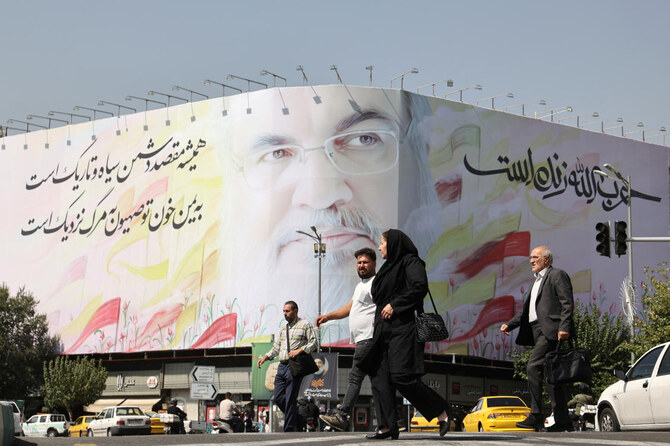
TEHRAN: On the streets of Tehran, a small crowd celebrated Iran’s missile attack on Israel while others are worried about the consequences of the Islamic Republic’s boldest move yet in a year of escalating Middle East conflict.
Local media carried footage of what Iran said were 200 missiles as they were fired toward Israel on Tuesday evening, while state television played upbeat music over the images and showed crowds of a few hundred people celebrating the attacks in the capital and other cities across the country.
Some carried the yellow flag of Hezbollah, Iran’s ally in Lebanon, as well as portraits of its chief Hassan Nasrallah who was killed in an Israeli air strike last week.
Speaking at a gathering in Palestine Square in central Tehran late Tuesday, Hedyeh Gholizadeh, 29, said she felt “a sense of pride” by Iran’s retaliation, which analysts said reflected pressure on the country to react to a series of Israeli-inflicted humiliations.
“We are ready to accept all the consequences, whatever they may be, and we are ready to pay the penalty and we have no fear,” said Gholizadeh.
There was little sign of the previous evening’s celebrations on Wednesday morning in Tehran, with traffic humming along as usual while cafes and restaurants buzzed with customers.
Israel’s vow to avenge the missile attacks, backed by similar threats from the United States, has unsettled some people who fear the country stumbling into a full-blown war through tit-for-tat reactions.
“I am really worried because if Israel wants to take retaliatory measures, it will lead to an expansion of the war,” said Mansour Firouzabadi, a 45-year-old nurse in Tehran. “Everyone is worried about it.”
Analysts see the Iranian missile strike as a consequence of a string of setbacks suffered by Tehran and its strategy of building up allies across the region in Lebanon, Iraq, Yemen, Syria and the Palestinian territories.
Lebanon’s Iran-backed Hezbollah chief Nasrallah was killed alongside Iranian Revolutionary Guards commander Abbas Nilforoushan, while Palestinian Hamas leader Ismail Haniyeh was assassinated in Tehran on July 31.
Ali Vaez from the International Crisis Group, a Brussels-based think-tank, said Iran took “a calculated risk in April” when it fired missiles and drones at Israel, most of which were intercepted, in its first ever direct attack.
The barrage was ordered after an Israeli air strike on Iran’s consulate in the Syrian capital Damascus which killed two Iranian generals.
“Now, with an even bolder move (on Tuesday), the regime’s actions reflect the deepening challenges it faces as its most critical partners have been weakened on multiple fronts,” Vaez said.
“Failing to respond might have further eroded its credibility with these allies, giving the impression that Tehran was content to remain passive,” he said.
Iranian Supreme Leader Ayatollah Ali Khamenei is due to deliver a rare speech at Friday prayers this week, according to local media, during which he is widely expected to set the tone for the way forward.
The last time Khamenei led Friday prayers was after Iran launched ballistic missiles on air bases of US forces in Iraq following the 2020 killing of revered Revolutionary Guards commander Qasem Soleimani in a US drone strike near the Iraqi capital, Baghdad.
Speaking at a gathering of Iranian students on Wednesday, Khamenei said he was still in mourning for Nasrallah and that his death was “not a small matter.”
Iranian President Masoud Pezeshkian said Iran had refrained from responding to Haniyeh’s killing in Tehran during his inauguration in July, fearing that it could derail US-backed efforts for a ceasefire in the Gaza war.
But the promises the United States and its allies of a “ceasefire in exchange for Iran’s non-reaction to Haniyeh’s killing were completely false,” he said on Sunday.
Israel’s military campaign continues there even as it steps up its war with Hezbollah in neighboring Lebanon.
Following Tuesday’s attack by Iran, Israeli Prime Minister Benjamin Netanyahu said that Tehran “made a big mistake tonight and will pay for it,” while the United States warned of “severe consequences.”
Former Israeli prime minister Naftali Bennett called on Wednesday for a decisive strike to destroy Iran’s nuclear facilities.
Iran’s Islamic Revolutionary Guard Corps meanwhile threatened a “crushing attack” if Israel responded, and warned against any direct military intervention in support of Israel.
Vaez from the International Crisis Group says while Tehran has signalled “the chapter is closed ... the reality is far from that.”
“The final word on this conflict lies, not with Iran, but with Israel and the United States,” he said.
“And if the latest developments in Gaza, Lebanon, and even Yemen’s Houthi movements are any indication, this confrontation is far from over.”

Pride and fear in Iran after missile attack on Israel
Short Url
https://arab.news/vgucm
Pride and fear in Iran after missile attack on Israel
- Analysts see the Iranian missile strike as a consequence of a string of setbacks suffered by Tehran
- Iranian Supreme Leader Ayatollah Ali Khamenei is due to deliver a rare speech at Friday prayers this week
Israel bars some aid workers from Gaza as groups face suspension
- NGOs ordered to cease operations unless they give employee details to Israel
- MSF and others denied entry, impacting key medical services in Gaza
GENEVA/CAIRO/JERUSALEM: Israel said on Thursday it had barred entry to Gaza of foreign medical and humanitarian staff whose organizations were ordered to cease operations unless they register employee details with Israeli authorities and meet other new rules.
Fearing a renewed humanitarian crisis if medical and aid services can suddenly no longer access war-shattered Gaza, some of the 37 international nongovernmental organizations that were ordered to halt work are weighing whether to submit staff names to Israeli authorities, two aid sources told Reuters.
Three of the aid groups said their foreign staff were told by Israeli authorities this week they could not enter Gaza.
Israel’s diaspora ministry, which manages the registration process, says the measures are meant to prevent diversions of aid by Palestinian armed groups. NGOs say sharing staff details poses too much of a risk, pointing to the hundreds of aid workers who were killed or injured during the two-year Gaza war.
Israel has shared little evidence of aid being diverted in the Palestinian enclave, an allegation that was disputed in a US government analysis.
The diaspora ministry said that while the NGOs had been granted 60 days to conclude operations, “the entry of foreign personnel into Gaza is not approved.” It said international staff with “approved organizations” including the United Nations could continue work as usual.
Three prominent global NGOs — Medecins Sans Frontieres (MSF), Medecins du Monde Suisse and the Danish Refugee Council — said their international staff were refused entry to Gaza this week. Foreign aid staff had generally been permitted to rotate in and out of Gaza since the start of the war.
“If we don’t have somebody in a key position, such as the emergency coordinator in charge of operations, then we either have to compensate, or we have a gap” in aid service, said Anna Halford, Gaza emergency coordinator at MSF.
'System breaks down'
Israel’s government said some 23 aid groups had agreed to the new registration rules, meaning humanitarian goods will continue to get into Gaza.
But a UN-led coordination body has said the international groups that have registered could meet only a fraction of the required humanitarian response in the devastated Gaza Strip, where homelessness and hunger remain rife.
Some of the 37 banned groups operate specialized services like field hospitals, aid officials say. MSF bolsters six Gaza health ministry hospitals and runs two field hospitals. The Medicos del Mundo NGO screens Gaza residents for malnutrition and provides mental health services.
“Without nutritional staff doing the screening and primary health care centers doing the therapeutic feeding and referral of patients with severe malnutrition to in-patient care — the whole system breaks down,” an aid source told Reuters.
Fearing the loss of those essential services for Gaza’s two million residents, some aid groups are considering reversing course and agreeing to the new registration rules.
“The essence of the debate (for aid groups) is how to safeguard their principles, humanitarian standards, and the safety of the local staff while being able to continue the services,” a senior aid source said.
COGAT, the Israeli defense ministry unit that controls access to Gaza, said the NGOs’ conduct “raises suspicion regarding the parties with whom they operate” in Gaza, but they remained free to register with the diaspora ministry.
'Everything is missing'
Samira Al-Ashqar, 40, who fled her Beit Lahia home to Al-Ansar camp in north Gaza with her disabled husband and nine others during the war, depends on Oxfam — one of the aid groups facing an Israeli ban — for food and financial support.
“Now, after the war, everything is missing, and things have become dire ... If these institutions were to stop, the people of Gaza would face complete devastation,” Al-Ashqar said.
Mohamed Abu Selmia, head of Gaza’s Al Shifa Hospital, told Reuters the banning of groups like MSF could affect hundreds of thousands of people.
“The Israeli occupation’s decision comes at a time of unprecedented deterioration in health conditions. We suffer acute shortages of medication that reach 100 percent in some areas, and 55 percent overall,” he said.
MSF said an Israeli ban could also mean that foreign aid groups would no longer be able to pay local staff in Gaza because Israel could block bank transfers.
Fearing a renewed humanitarian crisis if medical and aid services can suddenly no longer access war-shattered Gaza, some of the 37 international nongovernmental organizations that were ordered to halt work are weighing whether to submit staff names to Israeli authorities, two aid sources told Reuters.
Three of the aid groups said their foreign staff were told by Israeli authorities this week they could not enter Gaza.
Israel’s diaspora ministry, which manages the registration process, says the measures are meant to prevent diversions of aid by Palestinian armed groups. NGOs say sharing staff details poses too much of a risk, pointing to the hundreds of aid workers who were killed or injured during the two-year Gaza war.
Israel has shared little evidence of aid being diverted in the Palestinian enclave, an allegation that was disputed in a US government analysis.
The diaspora ministry said that while the NGOs had been granted 60 days to conclude operations, “the entry of foreign personnel into Gaza is not approved.” It said international staff with “approved organizations” including the United Nations could continue work as usual.
Three prominent global NGOs — Medecins Sans Frontieres (MSF), Medecins du Monde Suisse and the Danish Refugee Council — said their international staff were refused entry to Gaza this week. Foreign aid staff had generally been permitted to rotate in and out of Gaza since the start of the war.
“If we don’t have somebody in a key position, such as the emergency coordinator in charge of operations, then we either have to compensate, or we have a gap” in aid service, said Anna Halford, Gaza emergency coordinator at MSF.
'System breaks down'
Israel’s government said some 23 aid groups had agreed to the new registration rules, meaning humanitarian goods will continue to get into Gaza.
But a UN-led coordination body has said the international groups that have registered could meet only a fraction of the required humanitarian response in the devastated Gaza Strip, where homelessness and hunger remain rife.
Some of the 37 banned groups operate specialized services like field hospitals, aid officials say. MSF bolsters six Gaza health ministry hospitals and runs two field hospitals. The Medicos del Mundo NGO screens Gaza residents for malnutrition and provides mental health services.
“Without nutritional staff doing the screening and primary health care centers doing the therapeutic feeding and referral of patients with severe malnutrition to in-patient care — the whole system breaks down,” an aid source told Reuters.
Fearing the loss of those essential services for Gaza’s two million residents, some aid groups are considering reversing course and agreeing to the new registration rules.
“The essence of the debate (for aid groups) is how to safeguard their principles, humanitarian standards, and the safety of the local staff while being able to continue the services,” a senior aid source said.
COGAT, the Israeli defense ministry unit that controls access to Gaza, said the NGOs’ conduct “raises suspicion regarding the parties with whom they operate” in Gaza, but they remained free to register with the diaspora ministry.
'Everything is missing'
Samira Al-Ashqar, 40, who fled her Beit Lahia home to Al-Ansar camp in north Gaza with her disabled husband and nine others during the war, depends on Oxfam — one of the aid groups facing an Israeli ban — for food and financial support.
“Now, after the war, everything is missing, and things have become dire ... If these institutions were to stop, the people of Gaza would face complete devastation,” Al-Ashqar said.
Mohamed Abu Selmia, head of Gaza’s Al Shifa Hospital, told Reuters the banning of groups like MSF could affect hundreds of thousands of people.
“The Israeli occupation’s decision comes at a time of unprecedented deterioration in health conditions. We suffer acute shortages of medication that reach 100 percent in some areas, and 55 percent overall,” he said.
MSF said an Israeli ban could also mean that foreign aid groups would no longer be able to pay local staff in Gaza because Israel could block bank transfers.
© 2026 SAUDI RESEARCH & PUBLISHING COMPANY, All Rights Reserved And subject to Terms of Use Agreement.


