

Iran says attack on Israel is over as fears grow of wider conflict

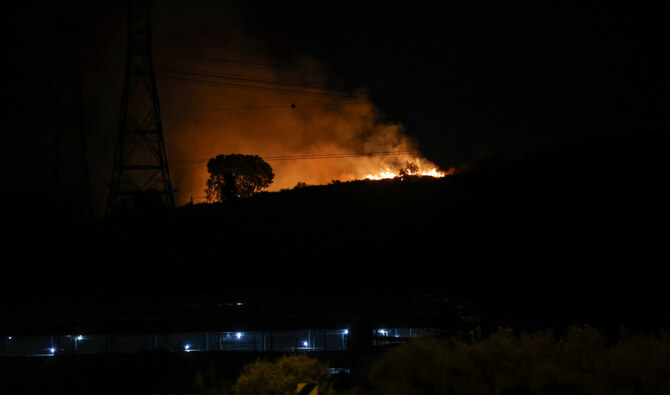
Fire erupts between Ben Gurion International Airport near Tel Aviv and the city of Modiin following an Iranian missile attack, on October 1, 2024. (AFP)
Short Url
Updated 02 October 2024
Follow

Iran says attack on Israel is over as fears grow of wider conflict

  • Iran described Tuesday’s assault on Israel as defensive and solely aimed at its military facilities
  • US Navy warships fired about a dozen interceptors against Iranian missiles headed toward Israel, the Pentagon said

JERUSALEM/BEIRUT: Iran said on Wednesday its missile attack on Israel, its biggest military assault on the Jewish state, was over, barring further provocation, while Israel and the United States promised to retaliate against Tehran as fears of a wider war intensified.

Despite calls for a ceasefire from the United Nations, the United States and the European Union, fighting between Israel and Hezbollah continued on Wednesday.

Israel renewed its bombardment of Beirut’s southern suburbs, a stronghold of the Iran-backed armed Hezbollah group, with at least a dozen airstrikes against what it said were targets belonging the group.

Large plumes of smoke were seen rising from parts of the suburbs. Israel issued new evacuation orders for the area, which has largely emptied after days of heavy strikes.

Hezbollah said it confronted Israeli forces infiltrating the Lebanese town of Adaisseh early on Wednesday and forced them to retreat.

Iran described Tuesday’s assault on Israel as defensive and solely aimed at its military facilities. Iran’s state news agency said three Israeli military bases had been targeted.

Tehran said its assault was a response to Israeli killings of militant leaders and aggression in Lebanon against Hezbollah and in Gaza.

“Our action is concluded unless the Israeli regime decides to invite further retaliation. In that scenario, our response will be stronger and more powerful,” Iranian Foreign Minister Abbas Araqchi said in a post on X early on Wednesday.

Israeli Prime Minister Benjamin Netanyahu has vowed to hit back. “Iran made a big mistake tonight — and it will pay for it,” he said at the outset of an emergency political security cabinet meeting late on Tuesday, according to a statement.

Washington said it would work with longtime ally Israel to ensure Iran faced “severe consequences” for Tuesday’s attack, which Israel said involved more than 180 ballistic missiles.

US Secretary of Defense Lloyd Austin spoke to Israeli Defense Minister Yoav Gallant late on Tuesday and said Washington was “well-postured” to defend its interests in the Middle East, the Pentagon said in a statement.

“The minister and I expressed mutual appreciation for the coordinated defense of Israel against nearly 200 ballistic missiles launched by Iran and committed to remain in close contact,” Austin said separately in a post on X.

US Navy warships fired about a dozen interceptors against Iranian missiles headed toward Israel, the Pentagon said. Britain said its forces played a part “in attempts to prevent further escalation in the Middle East,” without elaborating.

The Pentagon said Tuesday’s airstrikes by Iran were about twice the size of April’s assault by Iran on Israel.

“THE RESPONSE WILL BE PAINFUL“

Israel activated air defenses against Iran’s bombardment on Tuesday and most missiles were intercepted “by Israel and a defensive coalition led by the United States,” Israeli Rear Admiral Daniel Hagari said in a video on X, adding: “Iran’s attack is a severe and dangerous escalation.”

Iran’s forces on Tuesday used hypersonic Fattah missiles for the first time, and 90 percent of its missiles successfully hit their targets in Israel, the Revolutionary Guards said.

In a statement on state media, the general staff of Iran’s armed forces said any Israeli response would be met with “vast destruction” of the latter’s infrastructure.

It also said it would target the regional assets of any Israeli ally that got involved.

Fears that Iran and the US could be drawn into a regional war have risen with Israel’s growing assault on Lebanon in the past two weeks, including the start of a ground operation there on Monday, while its conflict in the Gaza Strip is a year old.

US President Joe Biden expressed full US support for Israel and described Iran’s attack as “ineffective.” Vice President Kamala Harris, the Democratic presidential candidate, backed Biden’s stance and said the United States would not hesitate to defend its interests against Iran.

“We will act. Iran will soon feel the consequences of their actions. The response will be painful,” Israel’s UN Ambassador Danny Danon told reporters.

The White House similarly promised “severe consequences” for Iran and spokesman Jake Sullivan told a Washington briefing the United States would “work with Israel to make that the case.”

Sullivan did not specify what those consequences might be.

In a statement, French President Emmanuel Macron said he strongly condemns Iran’s new attacks on Israel, adding that in a sign of its commitment to Israel’s security France mobilized its military resources in the Middle East on Wednesday.

The United Nations Security Council scheduled a meeting about the Middle East conflict for Wednesday, and the European Union called for an immediate ceasefire.

Nearly 1,900 people have been killed and more than 9,000 wounded in Lebanon in almost a year of cross-border fighting, most in the past two weeks, Lebanese government statistics showed on Tuesday.


Syria’s Kurdish fighters agree to leave Aleppo after deadly clashes

Updated 3 sec ago
Follow

Syria’s Kurdish fighters agree to leave Aleppo after deadly clashes

  • Syria’s official SANA news agency reported that “buses carrying the last batch of members of the SDF organization have left the Sheikh Maqsud neighborhood in Aleppo, heading toward northeastern Syria”

ALEPPO: Syria’s Kurdish fighters said Sunday that they agreed under a ceasefire to withdraw from Aleppo after days of fighting government forces in the city.
Hours earlier, Syria’s military said it had finished operations in the Kurdish-held Sheikh Maqsud neighborhood with state television reporting that Kurdish fighters who surrendered were being bused to the north.
The military had already announced its seizure of Aleppo’s other Kurdish-held neighborhood, Ashrafiyeh.
Kurdish forces had controlled pockets of Syria’s second city Aleppo and operate a de facto autonomous administration across swathes of the north and northeast, much of it captured during the 14-year civil war.
The latest clashes erupted after negotiations to integrate the Kurds into the country’s new government stalled.
“We reached an understanding that led to a ceasefire and secured the evacuation of the martyrs, the wounded, the trapped civilians and the fighters from Ashrafiyeh and Sheikh Maqsud neighborhoods to northern and eastern Syria,” the Kurdish-led Syrian Democratic Forces (SDF) wrote in a statement.
Syria’s official SANA news agency reported that “buses carrying the last batch of members of the SDF organization have left the Sheikh Maqsud neighborhood in Aleppo, heading toward northeastern Syria.”
The SDF initially denied its fighters were leaving, describing the bus transfers as forced displacement of civilians.
An AFP correspondent saw at least five buses on Saturday carrying men out of Sheikh Maqsud, but could not independently verify their identities.
According to the SDF statement, the ceasefire was reached “through the mediation of international parties to stop the attacks and violations against our people in Aleppo.”
The United States and European Union both called for the Syrian government and Kurdish authorities to return to political dialogue.
The fighting, some of the most intense since the ousting of long-time ruler Bashar Assad in December 2024, has killed at least 21 civilians, according to figures from both sides, while Aleppo’s governor said 155,000 people fled their homes.
Both sides blamed the other for starting the clashes on Tuesday.

Children ‘still inside’

On the outskirts of Sheikh Maqsud, families who had been trapped by the fighting were leaving, accompanied by Syrian security forces.
An AFP correspondent saw men carrying children on their backs board buses headed to shelters.
Dozens of young men in civilian clothing were separated from the crowd, with security forces making them sit on the ground before transporting them to an unknown destination, according to the correspondent.
A Syrian security official told AFP on condition of anonymity that the young men were “fighters” being “transferred to Syrian detention centers.”
At the entrance to the district, 60-year-old Imad Al-Ahmad was heading in the opposite direction, trying to seek permission to return home.
“I left four days ago...I took refuge at my sister’s house,” he told AFP. “I don’t know if we’ll be able to return today.”
Nahed Mohammad Qassab, a 40-year-old widow also waiting to return, said she left before the fighting to attend a funeral.
“My three children are still inside, at my neighbor’s house. I want to get them out,” she said.
A flight suspension at Aleppo airport was extended until further notice.

‘Return to dialogue’

US envoy Tom Barrack met Syrian President Ahmed Al-Sharaa on Saturday, and afterwards called for a “return to dialogue” with the Kurds in accordance with the integration framework agreed in March.
The deal was meant to be implemented last year, but differences, including Kurdish demands for decentralized rule, stymied progress as Damascus repeatedly rejected the idea.
The fighting in Aleppo raised fears of a regional escalation, with neighboring Turkiye, a close ally of Syria’s new Islamist authorities, saying it was ready to intervene. Israel has sided with the Kurdish forces.
The clashes have also tested the Syrian authorities’ ability to reunify the country after the brutal civil war and commitment to protecting minorities, after sectarian bloodshed rocked the country’s Alawite and Druze communities last year.