



RIYADH: Israel vowed to retaliate after Iran fired missiles toward Tel Aviv on Tuesday as regional tensions grew a day after Israel said it started a ground invasion in southern Lebanon to counter the threat from Hezbollah.
Iran said they had fired 200 missiles and that 90 percent of them successfully hit their target. Most of the missiles were shot down, but some landed in central and southern Israel, according to the military.
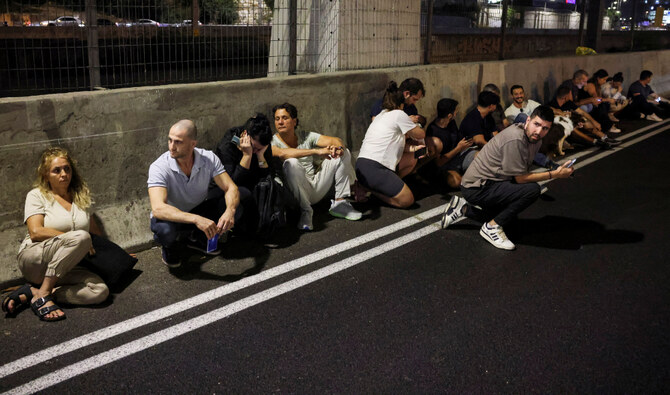
Explosions were heard in Jerusalem with many Israelis piling into bomb shelters as sirens rang out across the country.
The Revolutionary Guard said it targeted three military bases in the Tel Aviv area and promised a “more crushing and ruinous” response if Israel retaliated.
Israeli Prime Minister Benjamin Netanyahu said that Tehran had made a “a big mistake” and vowed to make them pay. “Whoever attacks us, we attack them,” he said.
Iran said the attacks targeted security apparatus, including radar bases, which were used in the planning of assassinations of senior Hezbollah and Hamas figures.
The Iranian forces used hypersonic Fattah missiles for the first time, the IRGC said, describing a weapon that could travel at least five times faster than the speed of sound.
US President Joe Biden said the attack had been “defeated and ineffective”. The president, a staunch ally of Israel, said: “Make no mistake, the United States is fully, fully, fully supportive of Israel.”
The White House also promised “severe consequences” for the Iranian action and said it would work with Israel to make that happen.
Two US naval destroyers launched around a dozen interceptors against the Iranian missiles, the defense department said. The UK said that its personnel were also involved in “attempts to prevent further escalation,” without elaborating on what role the forces played.
Iranian President Masoud Pezeshkian said Tehran had used its “legitimate rights” and dealt “a decisive response... to the Zionist regime’s aggression”.
At the UN General Assembly last week, Pezeshkian rebuked Israel for its actions in Gaza and Lebanon. “It is imperative that the international community should immediately ... secure a permanent ceasefire in Gaza and bring an end to the desperate barbarism of Israel in Lebanon, before it engulfs the region and the world,” he said.
The Israeli military published a video late on Tuesday that showed a damaged building in Gadera and said it was caused by an Iranian missile.
Israel continued its attacks in Lebanon throughout the day Tuesday and issued a new call to resident’s in the Lebanese capital to evacuate. “You are located near dangerous Hezbollah facilities, which the IDF (Israeli military) will act against with force in the near future,” military spokesman Avichay Adraee said on X.
Shortly after that message, Israel began striking south Beirut. “At least five Israeli strikes targeted Beirut’s southern suburbs,” a security source told AFP.
Lebanese health officials said that 55 people had been killed and 156 others injured in Israel strikes across the country on Tuesday.
Israel has not provided detailed information of its ground incursion into southern Lebanon and Hezbollah has denied that Israel troops had crossed the border.
The group said images released by Israel of the invasion are “very old and have no relationship to any current military action on the Lebanese border,” adding that the images are part of a “psychological and propaganda war” by their regional foe.
UN Secretary-General Antonio Guterres condemned what he called “escalation after escalation”. And he reiterated that a suspension of hostilities was needed immediately. “This must stop. We absolutely need a ceasefire, ” he said.
Tensions have become inflamed since Israel killed Hezbollah’s longtime leader, Hassan Nasrallah, in a targeted airstrike on Friday.
Two weeks earlier, Israel carried out an unexpected attack involving exploding pagers used by the group, disrupting their command and communications systems. The shocking incident indicated that Israel was preparing for a ground invasion and left the Iran-backed group reeling.
In Lebanon, reactions to the latest escalation are divided. Hezbollah supporters have welcomed the confrontation, while many others oppose being dragged into a war not of their making. For Karine, a 37-year-old mathematics teacher, the country is being held hostage by Hezbollah.
“I sympathize with the Palestinian cause. I even sympathize with Nasrallah’s supporters. But reason says you cannot drag the whole country into war due to the decisions of a few,” she told Arab News.
“Israel, while I consider it an abomination before God, has demonstrated incredible military might. We have been dealing with crisis after crisis since 2019, and we are not up for this fight. We are too exhausted.”
US Vice President Kamala Harris, the Democratic presidential candidate, said: “I’m clear-eyed Iran is a destabilizing, dangerous force in the Middle East”.
“I will always ensure Israel has the ability to defend itself against Iran and Iran-backed terrorist militias.”
“I fully support President (Joe) Biden’s order for the US military to shoot down Iranian missiles targeting Israel,” Harris said. “Initial indications are that Israel, with our assistance, was able to defeat this attack.”
Harris is running against Donald Trump, the Republican nominee, for the White House in November elections. Trump has criticized the Biden administration for mishandling the situation and has urged Israel to “finish the problem” in Gaza.
British Prime Minister Keir Starmer expressed the UK’s “steadfast commitment” to the security of Israel and condemned the Iranian attack. The prime minister will work “alongside partners and do everything possible to push for de-escalation and push for a diplomatic solution,” a spokesman said.
In a letter late on Tuesday to the UN Security Council, Israel’s UN ambassador, Danny Danon, said the attack “demonstrates that the charm offensive conducted by Iran and its new president is a mirage and the decision-making in Iran lies with the Supreme Leader and the Revolutionary Guards.”
The Iranian president told reporters in New York last month: “We do not wish to be the cause of instability in the Middle East as its consequences would be irreversible”.
Iran’s US Ambassador Amir Saeid Iravani, in a letter to Guterres on Tuesday, said the IRGC actions were “in accordance with the inherent right to self-defense” in contrast to Israel consistently considering “civilians and civilian infrastructure as legitimate targets”.
The Security Council is set to hold an emergency meeting on Wednesday in the wake of the escalating situation in the region.
Old tensions in the Middle East exploded last year when Hamas militants surged across the Gaza border and attacked Israeli settlements, killing nearly 1,200 people and capturing around 200 others. Israel has since killed around 40,000 Palestinians in Gaza in an effort to eradicate Hamas and regain its hostages.
Peace negotiations between the sides have not been fruitful with Israel allies blaming Netanyahu and Hamas of being an obstacles to a ceasefire and hostage-return deal.


