

Pakistan slashes petrol price by Rs2.07 per liter till next fortnight 

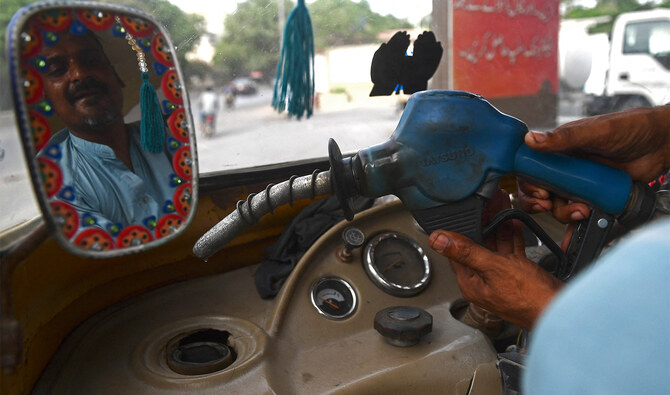
A man fills petrol in his rickshaw at a fuel station in Karachi on August 16, 2023. (AFP/File)
Short Url
Updated 01 October 2024
Follow

Pakistan slashes petrol price by Rs2.07 per liter till next fortnight 

  • New price of petrol is Rs247.03 per liter while that of diesel has been reduced to Rs246.29 per liter
  • Pakistan’s government has reduced price of petrol by Rs28.57 and diesel by Rs37.51 in past two months

ISLAMABAD: Pakistan’s Finance Division announced this week it had slashed the price of petrol by Rs2.07 per liter till the next fortnight due to the fluctuating global prices of petroleum products, with the move expected to ease inflation further in the South Asian country. 

Petroleum and electricity prices have been the key drivers of high inflation in Pakistan over the past two years. Inflation averaged close to 30% in FY23 and 23.4% in FY24, which ended on June 30, 2024. According to official figures, it eased to 9.6% in August this year. 

“Government has reduced the prices of petrol by Rs2.07 per liter and high speed diesel by Rs3.40 per liter for next fortnight,” state broadcaster Radio Pakistan reported on Monday. As per the Finance Division’s notification, a copy of which is available with Arab News, the new price of petrol is Rs247.03 per liter and diesel Rs246.29 per liter. 

The price of kerosene oil was also slashed by Rs3.57 per liter and light diesel by Rs1.03 per liter, with the new prices coming into effect from Oct. 1. 

“On the directions of Prime Minister Shehbaz Sharif, the government has reduced the price of petrol by 28.57 rupees and diesel by 37.51 rupees during last two months,” the state broadcaster said. 

Pakistan revises the price of petroleum products fortnightly, with the latest reduction following the government’s move to slash the price of petrol by Rs10 per liter on Sept. 15. In Pakistan, petrol is mostly used in private transport, small vehicles, rickshaws and two-wheelers, while any increase in the price of diesel is considered highly inflationary as it is mostly used to power heavy transport vehicles and particularly adds to the prices of vegetables and other eatables.

The latest fuel price adjustment takes place after the International Monetary Fund (IMF) formally approved a $7 billion loan program for Pakistan last week. The government says the development will further improve Pakistan’s macroeconomic indicators as it will strengthen its foreign reserves and allow Islamabad to meet is external financing obligations. 


Pakistan, China to sign multiple MoUs at major agriculture investment conference today

Updated 18 January 2026
Follow

Pakistan, China to sign multiple MoUs at major agriculture investment conference today

  • Hundreds of Chinese and Pakistani firms to attend Islamabad event
  • Conference seen as part of expanding CPEC ties into agriculture, trade

KARACHI: Islamabad and Beijing are set to sign multiple memorandums of understanding (MoUs) to boost agricultural investment and cooperation at a major conference taking place in the capital today, Monday, with hundreds of Chinese and Pakistani companies expected to participate.

The conference is being billed by Pakistan’s Ministry of National Food Security and Research as a platform for deepening bilateral agricultural ties and supporting broader economic engagement between the two countries.

“Multiple memorandums of understanding will be signed at the Pakistan–China Agricultural Conference,” the Ministry of National Food Security said in a statement. “115 Chinese and 165 Pakistani companies will participate.”

The conference reflects a growing emphasis on expanding Pakistan-China economic cooperation beyond the transport and energy foundations of the flagship China-Pakistan Economic Corridor (CPEC) into agriculture, industry and technology.

Under its first phase launched in 2015, CPEC, a core component of China’s Belt and Road Initiative, focused primarily on transportation infrastructure, energy generation and connectivity projects linking western China to the Arabian Sea via Pakistan. That phase included motorways, power plants and the development of the Gwadar Port in the country's southwest, aimed at helping Pakistan address chronic power shortages and enhance transport connectivity.

In recent years, both governments have formally moved toward a “CPEC 2.0” phase aimed at diversifying the corridor’s impact into areas such as special economic zones, innovation, digital cooperation and agriculture. Second-phase discussions have highlighted Pakistan’s goal of modernizing its agricultural sector, attracting Chinese technology and investment, and boosting export potential, with high-level talks taking place between planning officials and investors in Beijing.

Agri-sector cooperation has also seen practical collaboration, with joint initiatives examining technology transfer, export protocols and value-chain development, including partnerships in livestock, mechanization and horticulture.

Organizers say the Islamabad conference will bring together government policymakers, private sector investors, industry associations and multinational agribusiness firms from both nations. Discussions will center on investment opportunities, technology adoption, export expansion and building linkages with global buyers within the framework of Pakistan-China economic cooperation.