

Pakistan top court rejects Lahore High Court’s appointments to Punjab election tribunals

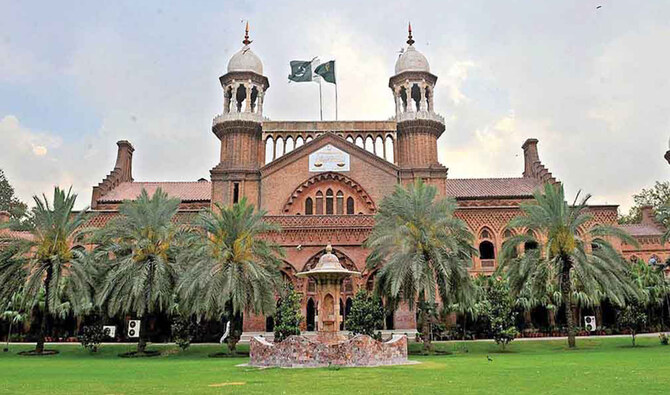
The picture shared by state-run media, APP, on May 3, 2024, shows the Lahore High Court building in Lahore, Pakistan. (APP/File)
Short Url
Updated 30 September 2024
Follow

Pakistan top court rejects Lahore High Court’s appointments to Punjab election tribunals

  • Pakistan’s ECP had asked top court to determine whether authority to appoint election tribunals wrests with it or Lahore High Court
  • Former prime minister Imran Khan’s party, which accuses Election Commission of being pro-government, criticizes the verdict

ISLAMABAD: The Supreme Court of Pakistan on Monday declared an earlier decision by the Lahore High Court (LHC) to appoint judges to eight election tribunals in Punjab to hear petitions related to the February 8 polls as null and void, ruling in favor of the country’s electoral watchdog. 

The Election Commission of Pakistan (ECP) had appealed against the LHC’s decision and sought clarity from the top court on whether the commission or the LHC chief justice has pre-eminence when it came to appointing election tribunals under Section 140 of the Elections Act 2017.

The controversy began in February when the commission asked the LHC for names of serving judges to be appointed to election tribunals in Punjab. The LHC provided the commission the names of two judges which were notified by the ECP. On April 4, the LHC chief justice nominated six more judges for their appointment to election tribunals out of which only two were notified by the ECP. The electoral watchdog sought more names from the high court for appointment to election tribunals in Rawalpindi and Bahawalpur. 

In reply, the LHC chief justice objected to the ECP’s demand, stating that the commission never sought names of judges for their appointment to election tribunals in the past. In its July 12 verdict, the LHC ruled that a high court chief justice has pre-eminence or dominance in matters of appointment of election tribunals under Section 140 of the Elections Act 2017. 

“The Supreme Court has set aside the June 12 verdict of the single bench of Lahore High Court and accepted the Election Commission’s review regarding the matter of constitution of election tribunals,” state-owned Pakistan Television News (PTV News) reported, adding that a five-member bench of the apex court headed by Chief Justice Qazi Faez Isa announced the verdict. 

“The Supreme Court cited in its decision that the verdict given by the Lahore High Court cannot be quoted as a precedent in the future,” PTV News added. 

Former prime minister Imran Khan’s Pakistan Tehreek-e-Insaf (PTI) party, which has leveled rigging allegations against the ECP in the past, criticized the judgment. 

“The judgment given by Justice Qazi Faez Isa regarding the election tribunals seems as if he is in a hurry to pave the way for his extension,” PTI lawyer Shoaib Shaheen told reporters outside the Supreme Court. 

 Khan’s party has accused the government of attempting to grant an extension in tenure to Isa, who is widely viewed to be aligned with the ruling coalition and in opposition to its chief rival, the PTI, through a set of proposed constitutional amendments that it is yet to produce in parliament. 

The government denies these allegations and says the amendments— expected to establish a federal constitutional court, raise the retirement age of superior judges by three years and modify the process for the top judge’s appointment— are aimed at providing speedy justice to thousands of litigants in the country. 


Pakistan, Canada explore deeper trade, mining and agriculture cooperation

Updated 31 January 2026
Follow

Pakistan, Canada explore deeper trade, mining and agriculture cooperation

  • The development comes as Pakistan seeks to boost trade, foreign investment to strengthen its more than $400 billion economy
  • Both sides reviewed the evolving global economic landscape, underscored the need for adaptive trade strategies, Islamabad says

KARACHI: Pakistani and Canadian officials have discussed ways to deepen cooperation in trade, mining and agriculture, the Pakistani commerce ministry said on Saturday, with both sides seeking to expand economic ties.

The statement came after Pakistani Commerce Minister Jam Kamal Khan’s meeting with Canadian High Commissioner to Pakistan Tarik Ali Khan that focused on expanding bilateral cooperation in trade, investment, mining, agriculture, energy and emerging sectors.

Pakistan, which is recovering from a prolonged economic meltdown under a $7 billion International Monetary Fund (IMF) program, has sought to boost trade, foreign investment to strengthen its more than $400 billion economy.

“During the meeting, both sides reviewed the evolving global economic landscape and underscored the need for adaptive trade strategies amid shifting supply chains and geopolitical realignments,” the Pakistani commerce ministry said in a statement.

“The federal minister emphasized Pakistan’s intent to diversify partnerships and attract quality foreign investment, particularly in value-adding and export-oriented sectors.”

A major focus of discussions was cooperation in the mining and minerals sector. Pakistan has vast mineral resources, including Reko Diq copper-gold mine, which is one of the world’s largest undeveloped mines.

The Reko Diq project, located in the Balochistan province, is also being developed by Canadian mining giant Barrick Gold in partnership with Pakistan’s federal and provincial governments.

Commerce Minister Khan highlighted Pakistan’s growing interest in developing small and medium-scale mining projects and stressed the importance of modern exploration techniques, surveying expertise and responsible mining governance.

“The Canadian high commissioner noted Canada’s global leadership in mining services and exploration technologies and expressed willingness to support Pakistan through capacity-building initiatives, technical assistance and business-to-business matchmaking,” the commerce ministry said.

“In this context, both sides discussed Pakistan’s participation in the Prospectors & Developers Association of Canada (PDAC) conference in Toronto, with an emphasis on linking Pakistani miners with reputable Canadian exploration companies and service providers.”

The meeting also covered agricultural cooperation, with particular reference to the recent resumption of Canadian canola exports to Pakistan, according to the statement. The two sides acknowledged the successful arrival of initial shipments and agreed to work closely on addressing regulatory and procedural bottlenecks to ensure smooth and timely imports.

“Discussions further explored potential cooperation in dairy and livestock development, including animal genetics, modern dairy farming technologies and disease-control mechanisms, aimed at enhancing productivity and quality standards in Pakistan,” the commerce ministry added.

“On the energy front, the Canadian High Commissioner raised issues related to Canadian investments in renewable energy projects in Pakistan and stressed the importance of regulatory predictability and timely approvals to sustain investor confidence. Both sides also reviewed progress on the Pakistan–Canada Bilateral Investment Treaty (BIT) and agreed on the need to maintain momentum in negotiations to encourage greater Canadian investment.”