

Qatar private sector exports surge 3.5% in Q2 

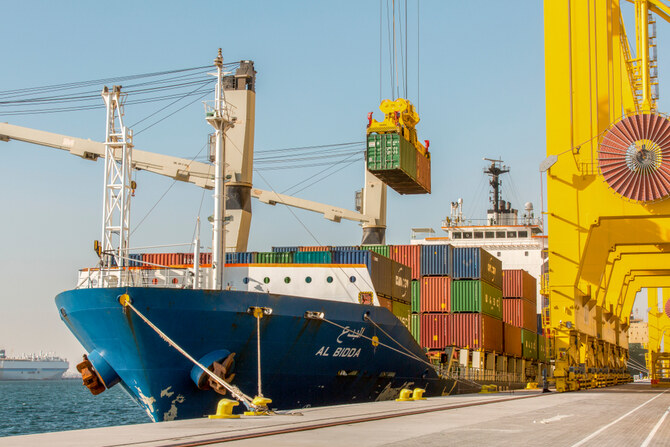
A recent report from the Qatar Chamber highlighted varied performance among exports based on the type of certificates of origin, with shipments under the General Model rising by 2.2 percent and those through the Unified Gulf Cooperation Council Model increasing by 15.3 percent. Shutterstock
Short Url
Updated 29 September 2024
Follow

Qatar private sector exports surge 3.5% in Q2 

RIYADH: Qatar’s private sector exports increased by 3.5 percent quarter-on-quarter, reaching 2.62 billion Qatari riyals ($719 million) in the second quarter of 2024, the latest industry data showed.  

A recent report from the Qatar Chamber highlighted varied performance among exports based on the type of certificates of origin, with shipments under the General Model rising by 2.2 percent and those through the Unified Gulf Cooperation Council Model increasing by 15.3 percent. In contrast, exports via the Unified Arab Model experienced a decline of 24 percent compared to the previous quarter. 

These models serve as frameworks to enhance understanding of economic integration and cooperation among countries, analyzing trade based on various monetary theories, including trade barriers, tariffs, and financial synergies among member states. 

The increase aligns with the goals of the Third National Development Plan 2024-2030, which aims to boost private sector growth and raise the share of Qataris in the private workforce to 20 percent. 

The report also indicated that fuel exports in the second quarter totaled 435 million riyals, marking a 17.7 percent drop from the first quarter. Aluminum exports similarly declined by 31 percent, reaching 302 million riyals. 

Additionally, essential and industrial oils amounted to 427.6 million riyals, reflecting a year-on-year increase of 9 percent. However, steel exports fell by 20.8 percent to 218.18 million riyals. 

Exports of industrial gases and lotrene recorded declines of 20.6 percent and 66.1 percent, respectively, reaching 200.3 million riyals and 44.42 million riyals. 

Chemical substance exports reached 90.1 million riyals in the second quarter, reflecting a decrease of 3.4 percent, while petrochemical exports totaled 52.9 million riyals, down 41.7 percent on a quarterly basis.  

Paraffin exports amounted to 29.5 million riyals, a 4.9 percent decline compared to the fourth quarter of 2023, whereas chemical fertilizers surged to 339.5 million riyals, a significant increase of 3,139 percent compared to the first quarter. 

These ten commodities accounted for 81.6 percent of the total value of private sector exports, according to the certificates of origin issued by the Qatar Chamber during the second quarter. 

In terms of economic blocs, Asian countries, excluding the Gulf Cooperation Council and Arab nations, topped the list, receiving exports worth 1.2 billion riyals, or 45.6 percent of total exports.  

GCC countries followed with 625.62 million riyals, or 23.9 percent, while the EU received 543.43 million riyals, or 20.7 percent.  

Arab countries, excluding GCC, received 145.96 million riyals, and other European countries accounted for 76.82 million riyals. African countries collectively received 21.06 million riyals, or 0.8 percent of total exports. 

The report indicated that Qatar exported to 105 countries in the second quarter, with the African grouping comprising 27 nations. 

India emerged as the leading destination for private sector exports, totaling 475.5 million riyals, or 18.1 percent, followed by the Netherlands with 354.5 million riyals, a share of 13.6 percent, and the UAE with 251.55 million riyals, or 9.6 percent.  


Lebanese social entrepreneur Omar Itani recognized by Schwab Foundation

Updated 23 January 2026
Follow

Lebanese social entrepreneur Omar Itani recognized by Schwab Foundation

  • FabricAID co-founder among 21 global recipients recognized for social innovation

DAVOS: Lebanon’s Omar Itani is one of 21 recipients of the Social Entrepreneurs and Innovators of the Year Award by the Schwab Foundation for Social Entrepreneurship.

Itani is the co-founder of social enterprise FabricAID, which aims to “eradicate symptoms of poverty” by collecting and sanitizing secondhand clothing before placing items in stores in “extremely marginalized areas,” he told Arab News on the sidelines of the World Economic Forum in Davos, Switzerland.

With prices ranging from $0.25 to $4, the goal is for people to have a “dignified shopping experience” at affordable prices, he added.

FabricAID operates a network of clothing collection bins across key locations in Lebanon and Jordan, allowing people to donate pre-loved items. The garments are cleaned and sorted before being sold through the organization’s stores, while items that cannot be resold due to damage or heavy wear are repurposed for other uses, including corporate merchandise.

Since its launch, FabricAID has sold more than 1 million items, reached 200,000 beneficiaries and is preparing to expand into the Egyptian market.

Amid uncertainty in the Middle East, Itani advised young entrepreneurs to reframe challenges as opportunities.

“In Lebanon and the Arab world, we complain a lot,” he said. Understandably so, as “there are a lot of issues” in the region, resulting in people feeling frustrated and wanting to move away. But, he added, “a good portion of the challenges” facing the Middle East are “great economic and commercial opportunities.”

Over the past year, social innovators raised a combined $970 million in funding and secured a further $89 million in non-cash contributions, according to the Schwab Foundation’s recent report, “Built to Last: Social Innovation in Transition.”

This is particularly significant in an environment of geopolitical uncertainty and at a time when 82 percent report being affected by shrinking resources, triggering delays in program rollout (70 percent) and disruptions to scaling plans (72 percent).

Francois Bonnici, director of the Schwab Foundation for Social Entrepreneurship and a member of the World Economic Forum’s Executive Committee, said: “The next decade must move the models of social innovation decisively from the margins to the mainstream, transforming not only markets but mindsets.”

Award recipients take part in a structured three-year engagement with the Schwab Foundation, after which they join its global network as lifelong members. The program connects social entrepreneurs with international peers, collaborative initiatives, and capacity-building support aimed at strengthening and scaling their work.