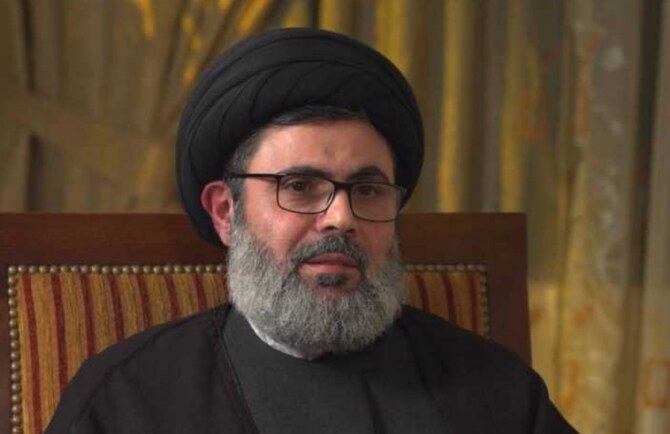
BEIRUT: Hashem Safieddine, a potential successor to his slain cousin Hassan Nasrallah, is one of Hezbollah’s most prominent figures and has deep religious and family ties to the Shiite Muslim movement’s patron Iran.
Safieddine bears a striking resemblance to his charismatic maternal cousin Nasrallah but is several years his junior, aged in his late 50s or early 60s.
A source close to Hezbollah, requesting anonymity as they were not authorized to speak to the media, said the grey-bearded, bespectacled Safieddine was the “most likely” candidate for party’s top job.
The United States and Saudi Arabia put Safieddine, who is a member of Hezbollah’s powerful decision-making Shoura Council, on their respective lists of designated “terrorists” in 2017.
The US Treasury described him as “a senior leader” in Hezbollah and “a key member” of its executive.
While Hezbollah deputy chief Naim Qassem automatically takes over the Hezbollah leadership after Nasrallah’s death, the Shoura Council must meet to elect a new secretary-general.
Safieddine has strong ties with Iran after undertaking religious studies in the holy city of Qom.
His son is married to the daughter of General Qasem Soleimani, the commander of Iran’s Revolutionary Guards’ foreign operations arm who was killed in a 2020 US strike in Iraq.
Safieddine has the title of Sayyed, his black turban marking him, like Nasrallah, as a descendant of the Prophet Muhammad.
Unlike Nasrallah, who lived in hiding for years, Safieddine has appeared openly at recent political and religious events.
Usually presenting a calm demeanour, he has upped the fiery rhetoric during the funerals of Hezbollah fighters killed in nearly a year of cross-border clashes with Israel.
Nasrallah said his forces were acting in support of Palestinian Hamas militants fighting Israel in Gaza.
Amal Saad, a Lebanese researcher on Hezbollah based at Cardiff University, said that for years people have been saying that Safieddine was “the most likely successor” to Nasrallah.
“The next leader has to be on the Shoura Council, which has a handful of members, and he has to be a religious figure,” she said.
Safieddine “has a lot of authority... he’s the strongest contender” she added.
Hezbollah was created at the initiative of Iran’s Revolutionary Guards and gained its moniker as “the Resistance” by fighting Israeli troops who occupied southern Lebanon until 2000.
The movement was founded during the Lebanese civil war after Israel besieged the capital Beirut in 1982.
In July in a speech in Beirut’s southern suburbs, Safieddine alluded to how Hezbollah views its leadership succession.
“In our resistance... when any leader is martyred, another takes up the flag and goes on with new, certain, strong determination,” he said.


![]()

Hashem Safieddine: possible successor to Hezbollah chief Nasrallah
Short Url
https://arab.news/b9vj5
Hashem Safieddine: possible successor to Hezbollah chief Nasrallah
- Safieddine bears a striking resemblance to his charismatic maternal cousin Nasrallah
- Safieddine has strong ties with Iran after undertaking religious studies in the holy city of Qom.


Latest updates




© 2026 SAUDI RESEARCH & PUBLISHING COMPANY, All Rights Reserved And subject to Terms of Use Agreement.