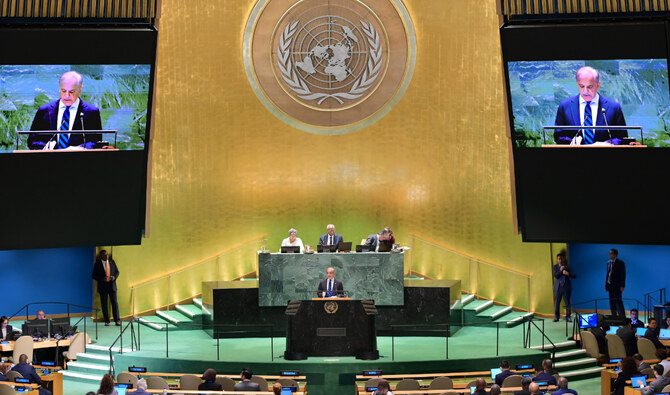

ISLAMABAD: Pakistani Prime Minister Shehbaz Sharif said on Friday a failure to implement United Nations resolutions concerning Palestine had emboldened Israel and it was threatening to drag the entire Middle East into war.
Sharif was addressing the UN General Assembly, where he spoke about the war in Gaza, India’s ‘occupation’ of Kashmir, Pakistan’s fight against militancy and its struggle to shore up its economy, among other issues.
Gaza health authorities list more than 41,000 Palestinians confirmed killed in Israel’s air and ground assault, launched after Hamas fighters attacked Israeli towns on Oct. 7 last year, killing 1,200 people and capturing around 250 hostages. Israel’s airstrikes in recent days in Lebanon have killed hundreds of people and heightened fears of a regional war.
“In a span of a few days, Israel’s unrelenting bombing of Lebanon, has killed over 500 people, including women, and even small children,” Sharif told the UNGA.
“The failure to implement UN resolutions has emboldened Israel. It threatens to drag the entire Middle East into a war, whose consequences could be grave and beyond imagination.”
Sharif called for “durable peace” through a two-state solution.
“We must seek a viable, secure, contiguous and sovereign State of Palestine, based on the pre-1967 borders, with Al-Quds Al-Sharif as its eternal capital. And to advance these goals, Palestine must also be immediately admitted as a full member of the United Nations,” Sharif said.
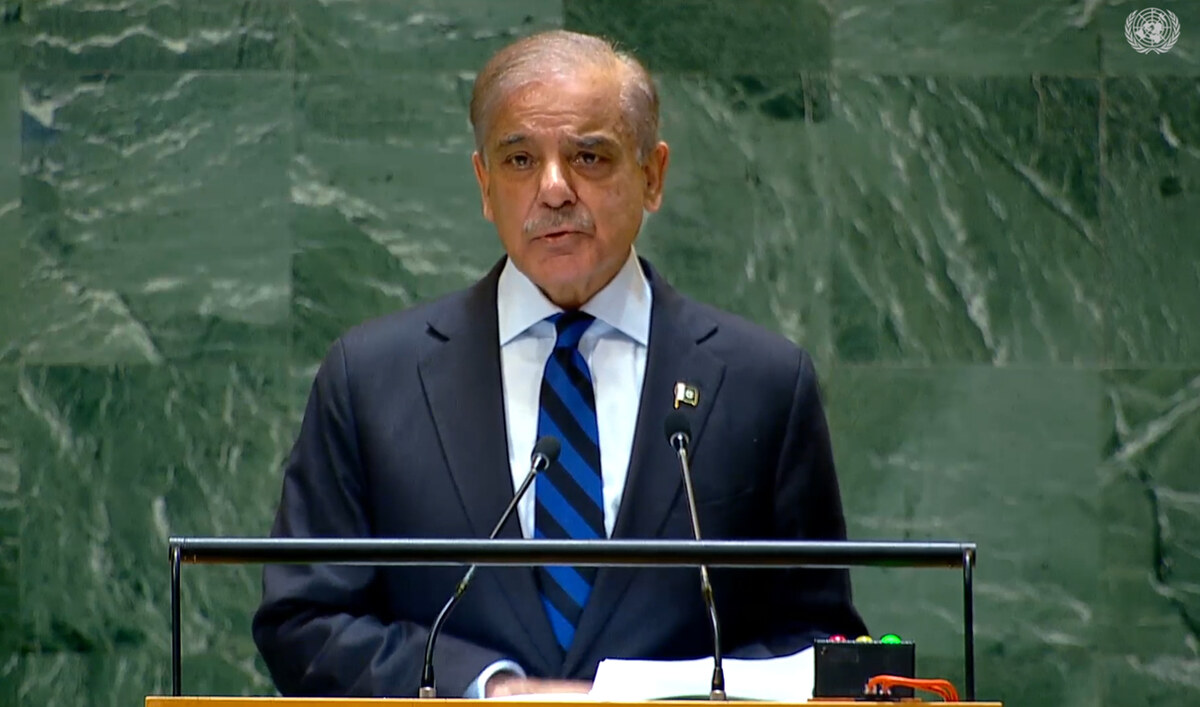
Pakistan Prime Minister Shehbaz Sharif speaks during the 79th UN General Assembly meeting in New York on September 27, 2024. (UN/Screengrab)
Sharif also lamented that UN Security Council Resolutions on Jammu and Kashmir had not been implemented. The Council has adopted several resolutions in 1948 and in the 1950s on the dispute between India and Pakistan over the region, including one which says a plebiscite should be held to determine the future of the mostly Muslim Kashmir.
Another resolution also calls upon both sides to “refrain from making any statements and from doing or causing to be done or permitting any acts which might aggravate the situation.”
UN peacekeepers have been deployed since 1949 to observe a ceasefire between India and Pakistan in Jammu and Kashmir.
“Instead of moving toward peace, India has resiled from commitments to implement the Security Council resolutions on Jammu and Kashmir. These resolutions mandate a plebiscite to enable the people of Jammu and Kashmir to exercise their fundamental right to self- determination,” Sharif said.
The Himalayan region has long been a flashpoint in ties between the nuclear-armed neighbors India and Pakistan, who both claim it in full and rule it in part.
In August 2019, India stripped the part of Kashmir it administers of its special status, blocked the right of the state to frame its own laws and allowed non-residents to buy property there. Telephone lines, Internet and television networks were blocked and there were heavy restrictions on movement and assembly.
“Day in and day out, nine hundred thousand Indian troops terrorize the people of occupied Jammu and Kashmir, with draconian measures, including prolonged curfews, extra-judicial killings and the abduction of thousands of young Kashmiris,” Sharif said.
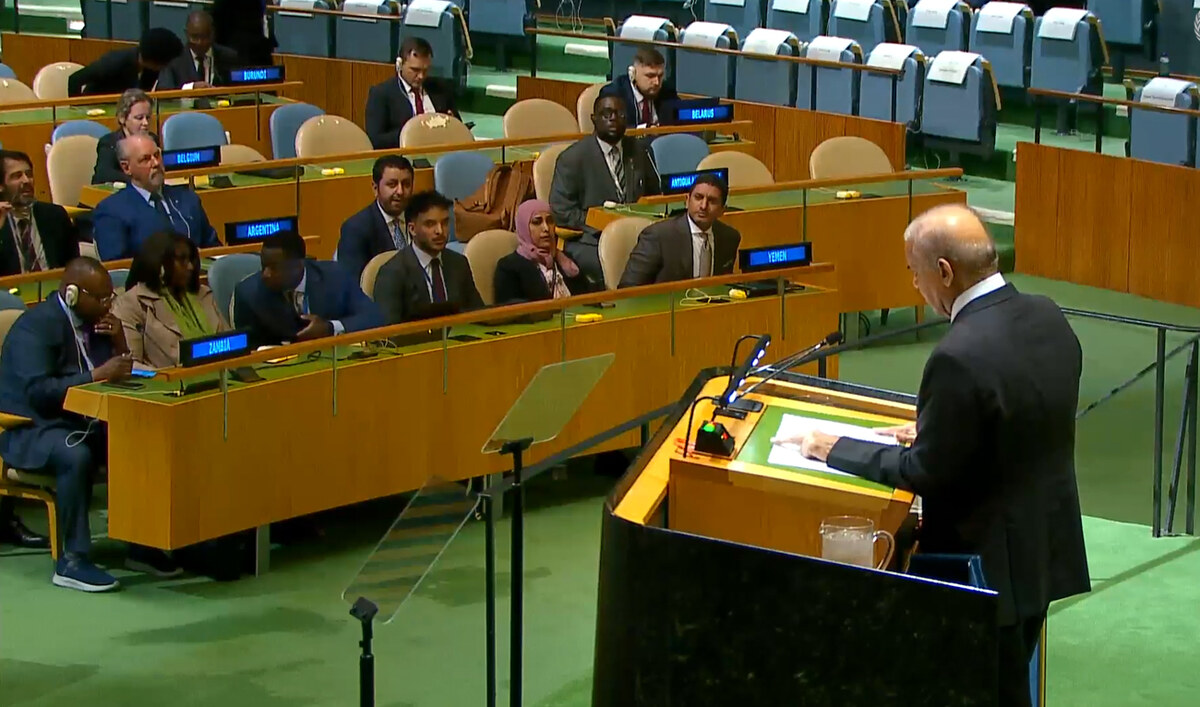
Pakistan Prime Minister Shehbaz Sharif speaks during the 79th UN General Assembly meeting in New York on September 27, 2024. (UN/Screengrab)
“At the same time, in a classic settler-colonial project, India is seizing Kashmiri lands and properties, and settling outsiders into occupied Jammu and Kashmir, to transform the Muslim- majority into a minority. This hackneyed tactic is employed by all occupying powers, but it has always failed. In Jammu and Kashmir too, it shall fail.”
Sharif said it was also “worrying” that India was engaged in a “massive expansion” of its military capabilities, which were essentially deployed against Pakistan:
“Its war doctrines, envisage a surprise attack and a ‘limited war under the nuclear overhang’. Thoughtlessly, India has spurned Pakistan’s proposals for a mutual “Strategic Restraint Regime”. Its leadership has often threatened to cross the Line of Control and “take-over” Azad Kashmir. Let me state in no uncertain terms that Pakistan will respond most decisively to any Indian aggression.”