Over 30,000 crossed into Syria from Lebanon in past days, says UN

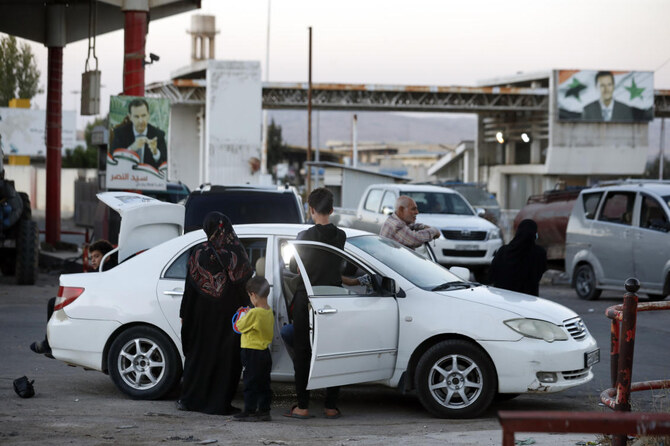
Lebanese fleeing the Israeli bombardment, arrive in a taxi at the Syrian-Lebanese border crossing in Jdaidet Yabous, Syria. (AP)
Updated 27 September 2024
Follow

Over 30,000 crossed into Syria from Lebanon in past days, says UN

  • About 80 percent of those crossings are Syrians and about 20 percent are Lebanese

BERLIN: Well over 30,000 people, mainly Syrians, have crossed into Syria from Lebanon in the past 72 hours, the UN refugee agency said on Friday, amid an escalating conflict between Israeli forces and Hezbollah that has killed hundreds of people in Lebanon.
About 80 percent of those crossings are Syrians and about 20 percent are Lebanese, said the UNHCR representative in Syria, Gonzalo Vargas Llosa, adding that about half are children and adolescents, and that men are making the crossing in smaller numbers than women.
“They are crossing from a country at war to one that has faced a crisis conflict for 13 years,” an extremely difficult choice, he told a news conference.
“We will have to see over the next few days how many more do so,” added the representative.


South Sudan says its troops are guarding strategic Heglig oil field in Sudan

Updated 4 sec ago
Follow

South Sudan says its troops are guarding strategic Heglig oil field in Sudan

NAIROBI: South Sudan has sent its troops to neighboring Sudan to guard the strategic Heglig oil field near the border, its military head said on Thursday, days after the paramilitary Rapid Support Forces (RSF) took control of it.
Heglig houses the main processing facility for South Sudanese oil, which makes up the bulk of South Sudan’s public revenues. Some oil has continued to flow through Heglig, though at much reduced volumes.
Sudanese government forces and workers at the Heglig oil field withdrew from the area on Sunday to avoid fighting that could have damaged facilities there, government sources told Reuters on Monday.
General Paul Nang, South Sudan chief of defense forces, said the troop deployment was agreed between South Sudan’s President Salva Kiir, Sudan Army Chief General Abdel Fattah Al-Burhan and RSF head Mohamed Hamdan Dagalo.
“The three agreed that the area of Heglig should be protected because (it) is a very important strategic area for the two countries,” Nang said in comments on state-owned South Sudan Broadcasting Radio.
“Now it is the forces of South Sudan that are in Heglig.”
Oil is transported through the Greater Nile pipeline system to Port Sudan on the Red Sea for export, making the Heglig site critical both for Sudan’s foreign exchange earnings and for South Sudan, which is landlocked and relies almost entirely on pipelines through Sudan.
Another pipeline, Petrodar, runs from South Sudan’s Upper Nile State to Port Sudan.
The war that started in April 2023 between the Sudanese army and the RSF has repeatedly disrupted South Sudan’s oil flows, which before the conflict averaged between 100,000 and 150,000 barrels per day for export via Sudan.