

Saudi Kafalah program exceeds $26.6bn in financing, supporting 23k SMEs, event told

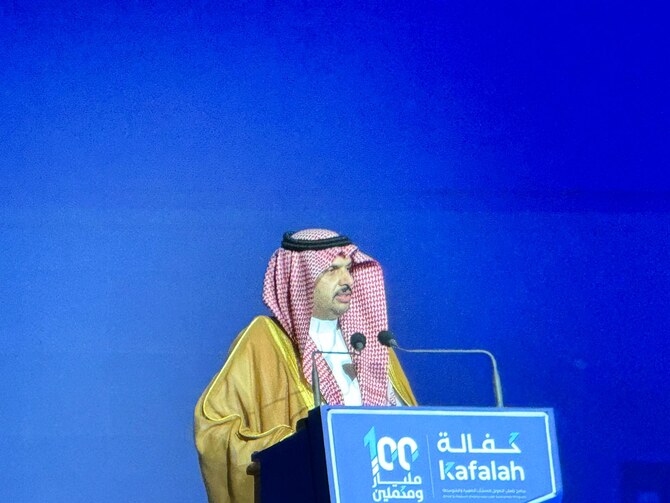
Abdul Rahman bin Mansour, chairman of Kafalah, speaking to the event in Riyadh. AN
Short Url
Updated 26 September 2024
Follow

Saudi Kafalah program exceeds $26.6bn in financing, supporting 23k SMEs, event told

RIYADH: Saudi Arabia’s Small and Medium Enterprises Loan Guarantee Program, Kafalah, has facilitated over SR100 billion ($26.6 billion) in financing guarantees, it was announced at an event in Riyadh.

Through working with a range of financial institutions including Saudi Central Bank, National Development Fund, and the General Authority for Small and Medium Enterprises, the initiative has helped create around 1 million jobs, supported more than 23,000 SMEs, and formed 100 partnerships with public and private entities since Kafalah was launched in 2006.

The figures were revealed at event, organized by the Kafalah program, that recognized the contributions of financial institutions in supporting SMEs, a crucial sector for economic development under Saudi Vision 2030. 

In an interview with Arab News, Humam Hashem, CEO of Kafalah, highlighted the program’s alignment with Vision 2030, focusing on sectors such as tourism, manufacturing, and entertainment.  

“Simultaneously, when we help them, we give them higher exposure. For example, the standard is that we take 80 percent of the risk. This is the ceiling for the regular Kafalah. However, if we are targeting specific sectors, we increase our exposure from 80 to 90 or 95 percent,” he said.  

Hashem added: “We also reduce our fees and help SMEs by giving them better ways to go for better business.” 

The CEO noted that the Kafalah program aims to provide SR22 billion in funding by the end of the year and is on track to meet this target. “Next year, we are aiming for at least a 20 percent increase from the current year to go to the market,” he said. 

Kafalah is also examining its environmental, social, and governance impact to support Saudi Arabia’s green initiatives.

“It’s one of our focal points. We are looking to improve our impacts and give the green Kafalah,” Hashem explained, adding that they are also examining the 17 pillars of ESG to determine which could align with the program. 

Additionally, Hashem noted that Kafalah is working to improve efficiency in the industrial and manufacturing sectors, with the goal of increasing their exposure in these areas. 

During his opening speech at the event, Abdul Rahman bin Mansour, chairman of the program, emphasized the importance of the Kafalah Award for Outstanding Performance in fostering collaboration with the SME sector.  

He stated that this initiative broadens financing access to underserved businesses, significantly contributing to the local economy’s growth and diversification. 

The event was presided over by Youssef Al-Benyan, minister of education and chairman of the SME Bank, who honored success partners from both public and private sectors. 

Recognized government entities included the Saudi Central Bank, National Development Fund, and the General Authority for Small and Medium Enterprises. 

Other recognized entities included the Tourism Development Fund, SME Bank, and Cultural Development Fund, as well as the General Authority for Entertainment, Awqaf, and the National Information Technology Program. 

Private sector awardees comprised Riyad Bank, Arab National Bank, National Commercial Bank, and Bank Albilad, along with companies such as Abdul Latif Jameel, Al-Amthal, and Al-Raeda Finance.  

To date, the Kafalah program has provided 64,494 guarantees totaling SR72.5 billion, with the remaining funds coming from partnering institutions. As a result, 27 medium-sized enterprises funded by the program transitioned to the parallel market. 

Additionally, 8 percent of micro-enterprises expanded into small and medium-sized businesses, while 4 percent of small businesses grew into medium-sized enterprises. 

From 2019 to 2023, Kafalah saw a 166 percent increase in guarantees issued, accompanied by a reduction in processing time from 48 working days to just 36 hours, thanks to artificial intelligence-driven systems. 

The program has also supported 18 initiatives linked to Saudi Vision 2030. A study with King Fahd University of Petroleum and Minerals found that companies supported by Kafalah created 17.3 percent more jobs compared to similar businesses receiving conventional financing.  

Furthermore, the program has contributed an estimated SR27 billion to Saudi Arabia’s gross domestic product over the past five years. 


Major airlines suspend, reroute flights amid US-Israel strikes on Iran

Updated 28 February 2026
Follow

Major airlines suspend, reroute flights amid US-Israel strikes on Iran

  • Saudia says decision taken in line with aviation safety and security standards
  • Emirates said it temporarily suspended it's operations out of Dubai

RIYADH: Major international airlines across the Middle East and South Asia have suspended, canceled or rerouted flights following ongoing US-Israel attacks on Iran and the resulting airspace closures, according to official statements issued via X.

Saudia said in an official statement that it had canceled a number of flights due to developments in the region and the closure of airspace.

The airline said the decision was taken in line with aviation safety and security standards, noting that its Emergency Coordination Center is closely monitoring developments with relevant authorities.

Saudia urged passengers to verify the status of their flights before heading to the airport and said guests would be notified of updates through the contact details associated with their bookings.

The carrier added that further information would be announced in a subsequent statement if available.

Air Arabia said its flights were experiencing cancellations, delays or rerouting as a result of the evolving situation and airspace closures.

The airline advised passengers to check the status of their flights before traveling to the airport by visiting its website or contacting its call center.

Customers booked on affected flights will be notified directly, the airline said, adding that further updates would be provided as the situation develops.

Air India announced a broader suspension, stating that “in view of the developing situation in parts of the Middle East, all Air India flights to all destinations in the Middle East have been suspended.”

The airline said it remains committed to maintaining the highest standards of safety for passengers and crew and will continue to assess the safety and security environment for flight operations, adjusting services proactively as required.

Air India said its teams would extend necessary support to passengers and advised customers to check flight status online or contact its 24/7 call center for assistance.  

All flight operations at Dubai International and Dubai World Central – Al Maktoum International are suspended until further notice, according to a post by Dubai Media Office on X.

Dubai-based Emirates reported that regional airspace closures had caused disruption to several of its flights and that the airline had temporarily suspended its operations from its hub Dubai.

The airline said it is actively monitoring the situation, engaging with relevant authorities and adjusting operations in line with the latest developments. 

The carrier apologized to affected customers and said it is assisting them with rebooking, refunds or alternative travel arrangements, reiterating that the safety and security of passengers and crew remain its highest priority.  

Qatar Airways confirmed a temporary suspension of flights to and from Doha due to the closure of Qatari airspace.

The airline said it is working closely with government stakeholders and relevant authorities to support impacted passengers and will resume operations once the airspace reopens.

It warned that delays are anticipated when usual operations resume and said additional ground staff have been deployed at Hamad International Airport and other key airports to assist passengers.  

Meanwhile, Al Jazeera reported that British Airways had canceled flights to Tel Aviv and Bahrain, adding to the list of carriers adjusting operations.

Across their statements, airlines consistently cited airspace closures and safety considerations as the primary reasons for suspensions and disruptions, while urging passengers to monitor official channels for updates as the situation continues to evolve.