

Houthis threaten to ‘cut off heads’ of Yemenis who celebrate Sept. 26 revolution

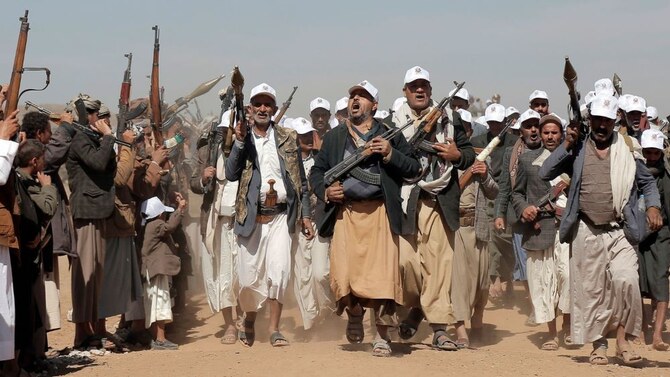
Houthi fighters march during a rally outside of Sanaa, Yemen, Jan. 22, 2024. (AP Photo)
Short Url
Updated 25 September 2024
Follow

Houthis threaten to ‘cut off heads’ of Yemenis who celebrate Sept. 26 revolution

  • Militant group deploys forces across northern Yemen to crack down on gatherings, and abducts more than 200 people over online anniversary celebrations
  • The 1962 revolution overthrew the Zaidi Imamate, which ruled northern Yemen for centuries and was ideologically similar to the Houthis

AL-MUKALLA: The Houthis vowed to violently suppress any public celebrations this week of the 62nd anniversary of the Sept. 26 revolution in Yemen.

The militant group has deployed armored vehicles and forces across northern Yemen to crack down on any gatherings that take place on Thursday, and abducted more than 200 people who celebrated it online.

The revolution, which began on Sept. 26, 1962, resulted in the overthrow of the Zaidi Imamate rulers who had controlled northern Yemen for centuries, paving the way for the establishment of the Yemen Arab Republic.

The Houthis share a similar ideology with the Zaidi Imamate, including a desire to limit rule over the country to Hashemites. The group fears people will be motivated by the anniversary to take to the streets in large numbers and demand an end to repressive Houthi rule.

Nasruddin Amer, a Houthi media official, threatened to “cut off the heads” of those who gather on Thursday to commemorate the 1962 revolution. He accused them of being “stooges for the Zionists” and seeking to undermine security and stability in areas under Houthi control. Houthi authorities will allow people to celebrate the anniversary under supervision, in designated locations, he added.

“We do not have mercy or pity for enemies … If anyone tries to twist our arm, we will remove his head,” Amer said. “This is our nature and methodology. We are unconcerned about the entire world or public opinion.”

Abdulkader Al-Murtada, the head of the Houthi prisoner-exchange committee, issues similar threats and accused people who would celebrate the revolution of “serving the US agenda” in an attempt to force the Houthis to halt their attacks on international shipping, which the group claims to be carrying out in support of the Palestinian people.

“We will deal with any anarchists or charlatans, as well as anyone who attempts to cause trouble, in the same way that we deal with the enemy, and everyone is aware of how we do so,” Al-Murtada said.

Local media and residents of Sanaa, Hodeidah and other Houthi-controlled areas confirmed on Wednesday that the group had deployed armed vehicles and military forces as part of an intensive crackdown on those who celebrate the revolution or incite others to do so online.

The Mayyun Organization for Human Rights and Development said that in the past few days the Houthis abducted 270 Yemenis, including teachers, activists, journalists and members of the former ruling party, the General People’s Congress, in Sanaa and other areas for posting online messages that praised the Sept. 26 revolution and urged the public to commemorate it.

“We denounce these intimidation campaigns against civilians, particularly women, which coincide with security crackdowns and public threats of arrest aimed at deterring people from participating in planned public celebrations and raising the national flag,” the organization said.

Activists reported that in the past 24 hours the Houthis abducted people in Sanaa and other areas for flying the Yemeni flag, as well as a person in Sanaa who appeared in a video dancing to nationalist songs commemorating the revolution.

The Yemeni Journalists Syndicate also demanded the immediate release of four Yemeni journalists abducted over the past six days as part of the Houthi crackdown on Sept. 26 anniversary celebrations.

“The syndicate reiterates its call to all organizations concerned with freedom of opinion and expression to show solidarity with the abducted journalists and press for their release,” it said.

Hundreds of people marched through the streets of the government-controlled southern city of Taiz on Tuesday night to commemorate the 1962 revolution, carrying the Yemeni flag and chanting nationalist slogans. Thousands of people in Marib and other cities were expected to hold similar rallies on Wednesday and Thursday.

Meanwhile, the US Central Command said on Wednesday that its forces destroyed a Houthi drone over the Red Sea before it reached a vessel it was targeting in a critical shipping lane.

It was the latest US military response against the Houthis intended to weaken them and pressure them into halting their attacks on ships in international waters off the coast of Yemen.


White House names some leaders with roles in next steps in Gaza, while Palestinian committee meets

Updated 14 sec ago
Follow

White House names some leaders with roles in next steps in Gaza, while Palestinian committee meets

  • Blair is a controversial choice in the Middle East because of his role in the 2003 invasion of Iraq, and Trump himself said last year that he wanted to make sure he was an “acceptable choice to everybody”
  • The plan’s second phase is now underway, though clouded by allegations of aid shortages and violence

CAIRO: The White House released the names of some of the leaders who will play a role in overseeing next steps in Gaza after the Palestinian committee set to govern the territory under US supervision met for the first time Friday in Cairo.
The committee’s leader, Ali Shaath, an engineer and former Palestinian Authority official from Gaza, pledged to get to work quickly to improve conditions. He expects reconstruction and recovery to take about three years and plans to focus first on immediate needs, including shelter.
“The Palestinian people were looking forward to this committee, its establishment and its work to rescue them,” Shaath said after the meeting, in a television interview with Egypt’s state-owned Al-Qahera News.
US President Donald Trump supports the group’s efforts to govern Gaza after the two-year war between Israel and Hamas. Israeli troops withdrew from parts of Gaza after the ceasefire took effect on Oct. 10, while thousands of displaced Palestinians have returned to what is left of their homes.
Now, there will be a number of huge challenges going forward, including the deployment of an international security force to supervise the ceasefire deal and the difficult process of disarming Hamas.
Under Trump’s plan, Shaath’s technocratic committee will run day-to-day affairs in Gaza under the oversight of a Trump-led “Board of Peace,” whose members have not yet been named.
White House names some officials to oversight boards
The White House said an executive board will work to carry out the vision of the Board of Peace.
The executive board’s members include US Secretary of State Marco Rubio, Trump envoy Steve Witkoff, Trump’s son-in-law Jared Kushner, former British Prime Minister Tony Blair, Apollo Global Management CEO Marc Rowan, World Bank President Ajay Banga, and Trump’s deputy national security adviser Robert Gabriel.
Nickolay Mladenov, a former Bulgarian politician and UN Mideast envoy, is to serve as the executive board’s representative overseeing day-to-day matters.
The White House also announced the members of another board, the “Gaza Executive Board,” which will work with Mladenov, the technocratic committee and the international stabilization force.
Witkoff, Kushner, Blair, Rowan and Mladenov will also sit on that board. Additional members include: Turkish Foreign Minister Hakan Fidan; Qatari diplomat Ali Al-Thawadi; Hassan Rashad, director of Egypt’s General Intelligence Agency; Emirati minister Reem Al-Hashimy; Israeli businessman Yakir Gabay; and Sigrid Kaag, the Netherlands’ former deputy prime minister and a Mideast expert.
Death of boy mourned in the West Bank
In the West Bank, friends and relatives gathered Friday to mourn the death of a 14-year-old Palestinian boy killed by Israeli forces.
The Palestinian Health Ministry, which confirmed his death, said Mohammad Na’san was the first child killed by the army in the occupied West Bank in 2026.
Residents said Israeli forces fired stun grenades and tear gas in an unprovoked attack. Israel’s military said in a statement that the incursion came after Palestinians had hurled rocks at Israelis and set tires aflame.
“There was gunfire directed at citizens and farmers, the most dangerous of which occurred during the storming of the village as people were leaving the mosques. The streets were crowded with the elderly, children, women, and elders, and they began firing relentlessly,” said Ameen Abu Aliya, head of the Al-Mughayyir village council.
The death was the latest episode of violence to hit Al-Mughayyir, a village east of Ramallah that has become a flashpoint in the West Bank. Much of the community’s agricultural land falls under Israeli military control.
Early this year, settlers and Israeli military bulldozers destroyed olive groves in the area, saying they were searching for Palestinian gunmen. A children’s park in Al-Mughayyir was also demolished.
In 2025, 240 Palestinians — including 55 children — were killed by Israeli forces or settlers in the West Bank, while Palestinians killed 17 Israelis — including one child — in the region, according to the United Nations.
Meanwhile, two children were killed Friday in Gaza, a 7-year-old girl and a 16-year-old boy. They were killed in Beith Lahiya, near the Yellow Line, and their bodies taken to Al-Shifa Hospital, the hospital said. No further details were immediately available.