

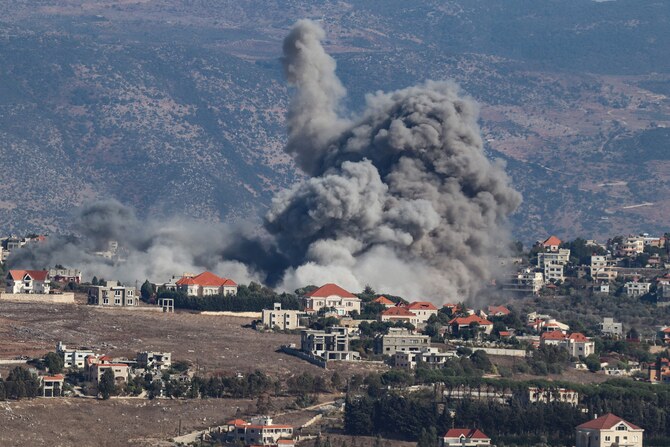


BEIRUT: The Israeli Air Force continued its airstrikes on dozens of towns in southern Lebanon and the Bekaa region on Wednesday, the third day of its war against Hezbollah.
For the first time, the strikes reached deep into Lebanese territory, targeting the predominantly Christian area of Keserwan and the Druze-majority region of Chouf.
The bloody attacks resulted in dozens of civilian casualties and further destruction.
Health Minister Firass Abiad said at least 51 people were killed and 223 wounded in the attacks.
The UN High Commissioner for Refugees said: “The devastating bombings in Lebanon are claiming the lives of innocents and forcing thousands to flee,” adding that “the losses inflicted on civilians are unacceptable.”
The attacks have been intense over the past 24 hours, with Israeli planes attacking first southern areas then the Bekaa region. Many towns were shelled for the first time.
On Wednesday morning, Hezbollah escalated its rocket attacks on Israeli targets, introducing a new phrase in its official statements, replacing “in support for the Gaza Strip” with “in defense of Lebanon and its people.”
Hezbollah targeted the vicinity of Tel Aviv with a short-range ballistic missile, an action previously unrecorded in conflicts between Israel and Lebanon.
It also targeted Israeli military bases and army headquarters, demonstrating the effectiveness of its offensive weapons.
On Tuesday, the Israeli army counted more than 400 rockets fired by Hezbollah toward the Israeli side. It said the assault was “the highest rate of shelling since the escalation began on Oct. 8, 2023.”
On Wednesday, the army reported “detecting the launch of 40 rockets from Lebanon toward the Upper Galilee, with some intercepted, while a house in Safed was hit, causing a fire but no injuries.”
Municipal officials in Safed urged residents to stay near shelters, while the Israeli Home Front advised the remaining residents of Kiryat Shmona in the Upper Galilee to do the same.
An Israeli army spokesman said that “some rockets from Lebanon fell in the Carmel area and Wadi Ara south of Haifa, with others hitting Zikhron Ya’akov and Bat Shlomo, also south of Haifa, for the first time.”
Israeli media reported that three people were injured in the settlement of Sa’ar, near Nahariya, one of whom was said to be in a critical condition.
In an official statement, Hezbollah said: “The ballistic missile ‘Qader 1’ was aimed at a Mossad headquarters in the suburbs of Tel Aviv, which is responsible for assassinating Hezbollah leaders and blowing up pagers and walkie-talkies.”
The missile traveled more than 100 km, but the Israeli army intercepted it using the David’s Sling air defense system.
Israeli Channel 13 reported that the surface-to-surface missile launched from Lebanon was directed toward the Glilot base near Herzliya.
The army spokesperson said “the Israeli Air Force detected the surface-to-surface missile launch toward the greater Tel Aviv area this morning and after locating its launch platform in the area of Naffakhiyah in Tyre, it shelled it.”
The Israeli Northern Medical Center said Hezbollah’s attacks resulted in “12 people being lightly injured.”
Hezbollah said it targeted the Hatsor settlement and Dado base “with dozens of rockets.”
Later, Israeli Army Radio reported that about 100 targets in Lebanon were attacked in response to the assault on Tel Aviv.
Israel said its raids targeted Hezbollah artillery sites, which it alleged were situated within residential buildings.
Israeli military resumed shelling villages that had previously been targeted, including ones recently added to the target list in areas north of the Litani line, including the Nabatieh region, Iqlim Al-Tuffah, Zahrani and western, central and northern Bekaa.
For the first time, an Israeli airstrike targeted the town of Al-Maaysra located in the Keserwan District of Mount Lebanon.
The Lebanese Civil Defense reported an initial death toll of three individuals, with nine others injured.
Israel claimed the strike was aimed at Sheikh Mohammed Amr, a Hezbollah official in Mount Lebanon and the north. However, it was later revealed that he was not in the targeted residence, which belonged to his nephew.
The Ministry of Health said that four people were killed and seven injured during an Israeli operation in the mixed-sect town of Joun, located in the Chouf District, predominantly inhabited by Druze.
The raid targeted a three-story residential structure that housed both Lebanese and Syrian residents.
Israeli airstrikes targeted Civil Defense personnel from the Muslim Scout Association in the town of Burj El-Shemali while they were helping residents whose homes had been struck in an earlier attack on the area.
An airstrike targeting the border town of Bint Jbeil resulted in the deaths of three people, while strikes in the Baalbek-Hermel region killed four and injured 38.
Hezbollah mourned the death of three of its members: Abbas Ibrahim Sharaf Al-Din, Hussein Ahmad Awali and Mohammed Hussein Al-Rabbah.
Kamel Karky, a media photographer for Al-Manar TV, affiliated with Hezbollah, was killed in an Israeli airstrike that targeted his home in Qantara.
The Lebanese Red Cross issued repeated calls for blood donations following the depletion of the stocks that had been collected in recent days.
An intense airstrike was carried out by the Israeli military late on Tuesday night against a facility in the coastal town of Jiyeh, 28 km south of Beirut. The repercussions were felt in Beirut, resulting in significant destruction and causing debris and rocks to obstruct the Beirut-South highway for some time.
The Israeli army also conducted an airstrike near the oil facilities in Zahrani, south of Sidon, for the first time.
The Lebanese Ministry of Health reported that an “airstrike on the border town of Tebnine resulted in the deaths of two and injuries to 27 others.”
The Israeli army reiterated in leaflets its request to the residents of the Lebanese border villages who evacuated their homes not to return to them “for your safety due to the presence of weapons or Hezbollah elements, so do not return to your homes until further notice.”
Public education institutions in Beirut and its surrounding areas were transformed into shelters for displaced people, with official agencies estimating their number at about 40,000 since Monday.
There were many complaints regarding a severe shortage of blankets, bedding and other essential supplies.
Maj. Gen. Mohammed Khair, chief of the Lebanese High Relief Commission, said: “Our efforts are focused on meeting essential needs with the resources at our disposal.”
He appealed to “Arab and foreign countries, international organizations and expatriate businessmen to assist the displaced and provide aid to Lebanon during these challenging circumstances.”


