

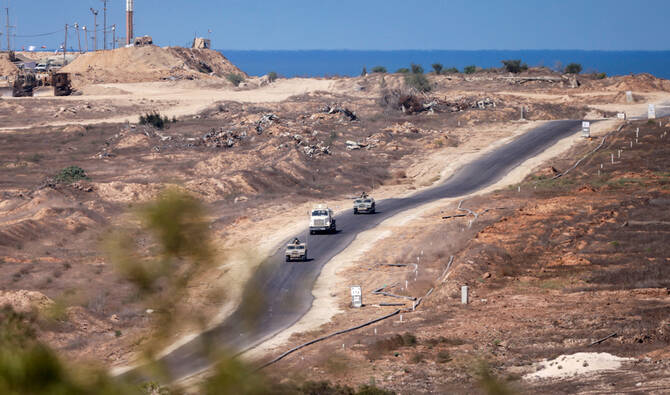

ISLAMABAD: Foreign office spokesperson Tahir Andrabi said on Thursday that Pakistan has identified its “red lines” on contributing to the International Stabilization Force (ISF) in Gaza, adding that Islamabad would be unable to take a decision on the matter without clarity about the force’s mandate.
Andrabi’s comments come as Prime Minister Shehbaz Sharif gears up to attend the inaugural Board of Peace meeting to be chaired by US President Donald Trump in Washington today, Thursday.
Trump’s 20-point peace plan for Gaza calls for a multi-nation force to oversee a transition period for reconstruction and economic recovery in the Palestinian territory. Pakistan has previously said it is willing to contribute troops for the peace force but would not be part of any move to disarm Hamas.
“On the international security assistance force, we understand that a decision is awaited on the contours of the mandate of the Board of Peace, on the mandate of the International Stabilization Force,” Andrabi said during a weekly briefing to reporters.
“And till such time, we would obviously not be in a position to take any decision on this matter. We have identified our red lines quite explicitly.”
Andrabi quoted a previous statement of Deputy Prime Minister Ishaq Dar by saying: “Pakistan can be part of the peacekeeping mandate, but we would obviously not be part of any disarming, de-militarization mandates.”
He said discussion on the international force might take place in Washington today.
The foreign office spokesperson said Pakistan has joined the Board of Peace with a particular focus of aiding in the reconstruction of Gaza and for the long-term settlement of issues faced by Palestinians.
Andrabi said Israel’s recent move to register lands in the West Bank will also come up in the Board of Peace meeting today.
“That is how Israel is violating international law, UN resolutions on wider occupied Palestinian territories, not just Gaza,” he said.
“So, I think the board of peace meeting affords an opportunity to discuss this important development.”
SAUDI MEDIATION FOR PAKISTANI DETAINEES
To a question about the release of three Pakistani detainees by Afghanistan this week on Saudi Arabia’s mediation, Andrabi welcomed the role played by the Kingdom and “other brotherly Muslim countries.”
Afghanistan government spokesperson Zabihullah Mujahid announced on Tuesday that it had released three Pakistani soldiers captured during border clashes between the two countries in October after mediation from Saudi Arabia. Mujahid said the detainees were handed over to a visiting Saudi delegation in Kabul.
“Pakistan values the positive role of our brotherly countries, our important OIC Islamic countries, in basically messaging Taliban leadership, reminding them of their obligations under international law, to ensure that their territory is not used for terrorism in Pakistan,” the spokesperson said.
“I think such an exchange also took place between Riyadh and Kabul.”
However, he said Saudi Arabia was not part of any “structured mediation talks” between Pakistan and Afghanistan.
“I am not aware of that role and I would strongly urge you not to speculate into it,” he said.
To a question about Pakistan’s response if India violates the Indus Waters Treaty, Andrabi said Islamabad will not compromise on its water rights.
“We will not let India weaponize water. We will not compromise on even a single drop of water that this treaty allows us to have a share of, and we will not compromise on the water rights of the people of Pakistan,” he added.


