BAGHDAD: Recent clashes between Syria’s military and Kurdish forces are a “setback” and a “plot” to derail the PKK peace process with Turkiye, a spokesman for the Kurdish militant group told AFP on Tuesday.
“The developments in Syria and the larger Middle East have a direct effect on the peace process in Turkiye,” said Zagros Hiwa, spokesman for the political wing of the Kurdistan Workers’ Party.
The attacks “against the Kurds are a plot and conspiracy against the peace process and they indicate a setback in the process,” he said.
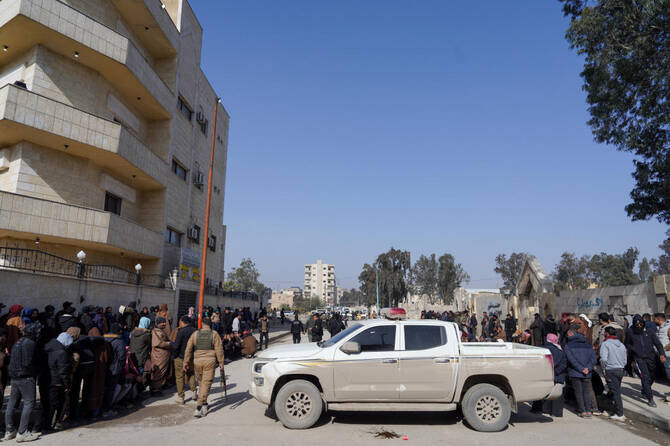
Syria’s government and Kurdish forces on Saturday extended a truce by 15 days after the Kurds lost large areas to government forces during weeks of clashes.
The Kurdish-led Syrian Democratic Forces (SDF) find themselves now restricted to Kurdish-majority areas in the country’s north.
Turkiye is a close ally of Syria’s new leadership that overthrew Bashar Assad in December 2024, and which is now seeking to extend state control across Syria.
Ankara is simultaneously leading a drive to reach a settlement with the PKK — listed as a terror group by Turkiye and its Western allies.
Last year, the PKK said it was ending its four-decade insurgency in favor of democratic means but the process has largely stalled amid the stand-off in Syria.
Turkiye accuses the Syrian Kurdish forces of being an offshoot of the PKK.
Hiwa said the PKK’s “commitment to the peace process is a strategic issue.”
But he added that “the new strategy does not exclude the urgency of self-defense against genocidal attacks.”

Syria army’s clashes with Kurds ‘setback’ to Turkiye peace process: PKK spokesman
https://arab.news/zp3va
Syria army’s clashes with Kurds ‘setback’ to Turkiye peace process: PKK spokesman
- “The developments in Syria and the larger Middle East have a direct effect on the peace process in Turkiye,” said Hiwa
- The attacks “against the Kurds are a plot and conspiracy against the peace process”
Fledgling radio station aims to be ‘voice of the people’ in Gaza
- The electricity crisis is one of the most serious and difficult problems in the Gaza Strip, says Shereen Khalifa Broadcaster
DEIR EL-BALAH: From a small studio in the central city of Deir El-Balah, Sylvia Hassan’s voice echoes across the Gaza Strip, broadcast on one of the Palestinian territory’s first radio stations to hit the airwaves after two years of war.
Hassan, a radio host on fledgling station “Here Gaza,” delivers her broadcast from a well-lit room, as members of the technical team check levels and mix backing tracks on a sound deck. “This radio station was a dream we worked to achieve for many long months and sometimes without sleep,” Hassan said.
“It was a challenge for us, and a story of resilience.”
Hassan said the station would focus on social issues and the humanitarian situation in Gaza, which remains grave in the territory despite a US-brokered ceasefire between Israel and Hamas since October.
“The radio station’s goal is to be the voice of the people in the Gaza Strip and to express their problems and suffering, especially after the war,” said Shereen Khalifa, part of the broadcasting team.
“There are many issues that people need to voice.” Most of Gaza’s population of more than 2 million people were displaced at least once during the gruelling war.
Many still live in tents with little or no sanitation.
The war also decimated Gaza’s telecommunications and electricity infrastructure, compounding the challenges in reviving the territory’s local media landscape. “The electricity problem is one of the most serious and difficult problems in the Gaza Strip,” said Khalifa.
“We have solar power, but sometimes it doesn’t work well, so we have to rely on an external generator,” she added.
The station’s launch is funded by the EU and overseen by Filastiniyat, an organization that supports Palestinian women journalists, and the media center at the An-Najah National University in Nablus, in the occupied West Bank.
The station plans to broadcast for two hours per day from Gaza and for longer from Nablus. It is available on FM and online.
Khalifa said that stable internet access had been one of the biggest obstacles in setting up the station, but that it was now broadcasting uninterrupted audio.
The Gaza Strip, a tiny territory surrounded by Israel, Egypt, and the Mediterranean Sea, has been under Israeli blockade even before the attack on Oct. 7, 2023, which sparked the war. Despite the ceasefire, Israel continues to strictly control the entry of all goods and people to the territory.
“Under the siege, it is natural that modern equipment necessary for radio broadcasting cannot enter, so we have made the most of what is available,” she said.


