

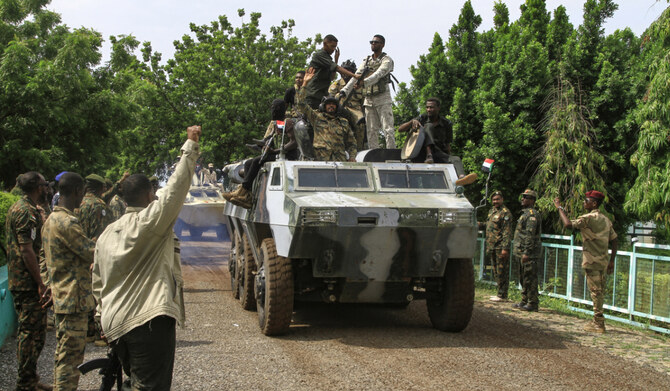

PORT SUDAN, Sudan: Civilians combed through the wreckage of their homes Sunday in the Sudanese city of El-Fasher, besieged for months by paramilitaries who have now launched a “full-scale assault,” according to the United Nations.
As the world body’s high-level General Assembly meeting prepares this week to spotlight Sudan’s 17-month war — which has claimed tens of thousands of lives and caused the world’s largest displacement crisis — global leaders have warned against cataclysmic violence in the city of two million.
US President Joe Biden has called on Sudan’s rival generals to “pull back their forces, facilitate unhindered humanitarian access, and re-engage in negotiations to end this war.”
But on the ground, shells have once again torn through civilian homes, in the latest flare-up of the war between the paramilitary Rapid Support Forces and the regular army which has raged since April 2023.
“Most of our homes in the city’s south have been completely destroyed,” local resident Al-Tijani Othman told AFP by phone from his bombed-out neighborhood.
“There’s barely anyone left here,” he said, after months of bombardment and starvation.
On Saturday alone, health authorities managed to confirm 14 civilian deaths and 40 injuries, a medical source told AFP.
“But that’s nowhere near the real number of victims,” the source warned, requesting anonymity for his protection.
“People often have to bury their loved ones right then and there rather than brave the fighting on the road to the hospital,” he continued.
UN chief Antonio Guterres’ spokesperson said Saturday the Secretary-General was “gravely alarmed by reports of a full-scale assault” by the RSF and called on its commander, Mohamed Hamdan Dagalo, “to act responsibly and immediately order a halt to the RSF attack.”
Since May, the RSF has laid siege to the North Darfur state capital of El-Fasher — the only major city in Sudan’s vast western region of Darfur not under their control.
Even before their long-threatened multi-directional attack on the city, the violence had killed hundreds, according to medical charity Doctors Without Borders.
It had also displaced hundreds of thousands and forced the nearby Zamzam displacement camp into all-out famine, the UN said.
El-Fasher has long been surrounded by multiple displacement camps — including Zamzam and Abu Shouk — which have swelled by hundreds of thousands since the war began.
The Yale School of Public Health’s Humanitarian Research Lab, which tracks the violence in Sudan using satellite imagery, reported on Friday civilians had been fleeing “en masse by foot on the road from El-Fasher to Zamzam,” where famine was declared last month.
On Sunday, those unwilling or unable to leave the city — such as resident Mohamed Safieldin — were compelled to take advantage of what they feared would be a brief respite in the fighting, venturing out to feed their families.
“But the food situation is difficult. We have to rely on community kitchens,” he told AFP while waiting for a meal from one of hundreds of volunteer initiatives that have popped up across Sudan — considered in places like El-Fasher the last defense against mass starvation.
The UN’s special adviser on the prevention of genocide, Alice Wairimu Nderitu, said the “RSF’s multi-pronged assault, launched from at least four directions,” had “unleashed a maelstrom of violence that threatens to consume everything in its path.”
Eyewitnesses have reported bombardment by both the RSF and the army, both of whom have consistently been accused of war crimes including targeting civilians and the indiscriminate bombing of residential areas.
The RSF has specifically been accused of crimes against humanity and ethnic cleansing. Their assault on the West Darfur town of El-Geneina last year left up to 15,000 dead, mostly from the non-Arab Massalit community, UN experts determined.
Darfur, a region the size of France home to around a quarter of Sudan’s population, is deeply scarred by years of ethnic violence committed by the Janjaweed — the militia from which the RSF emerged.
World leaders have repeatedly warned of a repeat of Darfur’s past.
“We will not bear witness to another genocide,” the European Union’s top diplomat Josep Borrell said Sunday, urging a return to negotiations — which experts warn have only ever been used by both sides to gain ground on the battlefield.
The World Health Organization said this month at least 20,000 people have been killed since the war began, but some estimates show up to 150,000 dead, according to US envoy to Sudan Tom Perriello.
The war has also displaced more than 10 million people — a fifth of Sudan’s population — both within the country and across borders.
In early September UN experts, after a fact-finding mission, called for deployment of an impartial force to protect Sudanese civilians — either a UN-mandated mission or an African Union-backed regional force.


