

Sudan army breaks RSF siege on southern city Dilling

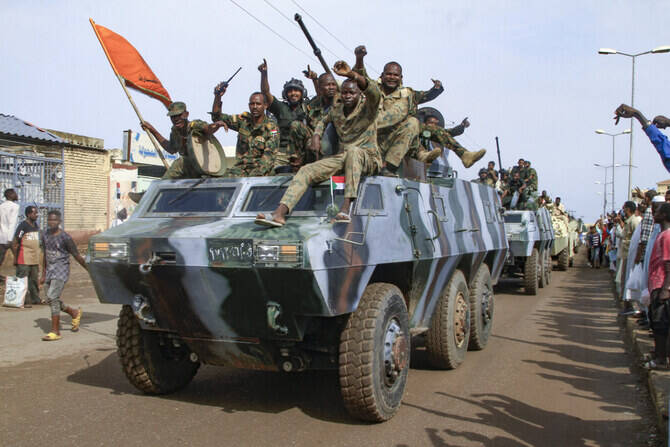
The Sudanese army is attempting to stem a sweeping advance by the paramilitary RSF across the wider Kordofan region. (AFP/File)
Short Url
Updated 26 January 2026
Follow

Sudan army breaks RSF siege on southern city Dilling

  • Army says its forces 'succeeded in opening the Dilling road after carrying out a successful military operation'
  • Victory comes as the military attempts to stem a sweeping paramilitary advance across the wider Kordofan region

KHARTOUM: The Sudanese army said on Monday it had broken a long-running siege of Dilling, a city in the country’s south, where paramilitary forces had choked off access for more than a year and a half.
Since April 2023, Sudan has been engulfed in a conflict between the army and the paramilitary Rapid Support Forces (RSF) that has killed tens of thousands of people.
The war has also left 11 million people displaced and triggered what the UN describes as the world’s largest displacement and hunger crises.
In its statement, the army said its forces “succeeded in opening the Dilling road after carrying out a successful military operation,” claiming they had inflicted “heavy losses” on the RSF.
If confirmed, the advance would secure the army’s hold over both the northern and southern approaches to Dilling, located in South Kordofan state.
The city lies halfway between Kadugli — the besieged state capital — and El-Obeid, the capital of neighboring North Kordofan, which the RSF has sought to encircle.
Videos shared on social media showed army forces, said to be in Dilling, celebrating atop pick-up trucks as people ululated and cheered alongside them.
AFP could not independently verify the army’s claim or the footage, and the RSF has not yet commented.

Sweeping offensive

The push around Dilling comes as the army attempts to stem a sweeping paramilitary advance across the wider Kordofan region.
Since seizing the army’s last stronghold in western Darfur last October, the RSF has shifted its focus eastward, aided by its local allies, namely the Sudan People’s Liberation Movement-North faction led by Abdelaziz Al-Hilu.
Since then, the paramilitary group has tightened its grip on West Kordofan, taken Heglig — home to Sudan’s largest oil field — and intensified its siege of Kadugli.
A UN-backed assessment last year already confirmed famine in Kadugli, which has been under RSF siege for more than a year and a half.
The assessment said conditions in Dilling were likely similar, but security issues and a lack of access have prevented a formal declaration.
The UN has repeatedly cautioned that atrocities similar to those reported during the RSF offensive in El-Fasher — including mass killings, sexual violence, abductions and widespread looting — could spread into Kordofan.
More than 65,000 people have fled the Kordofan region since October, according to the latest UN figures.
Those escaping, particularly from South Kordofan, face “long and uncertain journeys” lasting up to 30 days and sleep “wherever they can,” according to Mercy Corps, one of the few aid groups operating there.


Russian forces begin pulling out of bases in northeast Syria

Updated 4 sec ago
Follow

Russian forces begin pulling out of bases in northeast Syria

  • Despite having been on opposite sides of the battle lines during the civil war, the new rulers in Damascus have taken a pragmatic approach to relations with Moscow

QAMISHLI, Syria: Russian forces have begun pulling out of positions in northeast Syria in an area still controlled by the Kurdish-led Syrian Democratic Forces after the group lost most of its territory in an offensive by government forces.
Associated Press journalists visited one base next to the Qamishli airport Tuesday and found it guarded by SDF fighters who said the Russians had begun moving their equipment out in recent days.
Inside what had been living quarters for the soldiers was largely empty, with scattered items left behind, including workout equipment, protein powder and some clothing.
Ahmed Ali, an SDF fighter deployed at the facility, said the Russian forces began evacuating their positions around the airport five or six days ago, withdrawing their equipment via a cargo plane.
“We don’t know if its destination was Russia or the Hmeimim air base,” he said, referring to the main Russian base on Syria’s coast. “They still have a presence in Qamishli and have been evacuating bit by bit.”
A UN humanitarian convoy from Damascus reached Qamishli on Tuesday, UN spokesman Stéphane Dujarric said.
“It delivered food, warm clothes and blankets, among other supplies,” he told UN reporters. “More convoys are planned in the coming days.”
Dujarric said the UN is also continuing to distribute food, bread and cash elsewhere including displacement sites.
There has been no official statement from Russia about the withdrawal of its forces from Qamishli.
Russia has built relations with the new central Syrian government in Damascus since former President Bashar Assad was ousted in December 2024 in a rebel offensive led by now-interim President Ahmad Al-Sharaa — despite the fact that Moscow was a close ally of Assad.
Moscow’s scorched-earth intervention in support of Assad a decade ago turned the tide of Syria’s civil war at the time, keeping Assad in his seat. Russia didn’t try to counter the rebel offensive in late 2024 but gave asylum to Assad after he fled the country.
Despite having been on opposite sides of the battle lines during the civil war, the new rulers in Damascus have taken a pragmatic approach to relations with Moscow. Russia has retained a presence at its air and naval bases on the Syrian coast.
Al-Sharaa is expected to visit Moscow on Wednesday and meet with Putin.
Fighting broke out early this month between the SDF and government forces after negotiations over a deal to merge their forces together broke down. A ceasefire is now in place and has been largely holding.
After the expiration of a four-day truce Saturday, the two sides announced the ceasefire had been extended by another 15 days.
Syria’s defense ministry said in a statement that the extension was in support of an operation by US forces to transfer accused Daesh militants who had been held in prisons in northeastern Syria to detention centers in Iraq.