

ALPS group urges Sudan’s warring parties to open all famine-stricken areas to relief operations

1 / 2
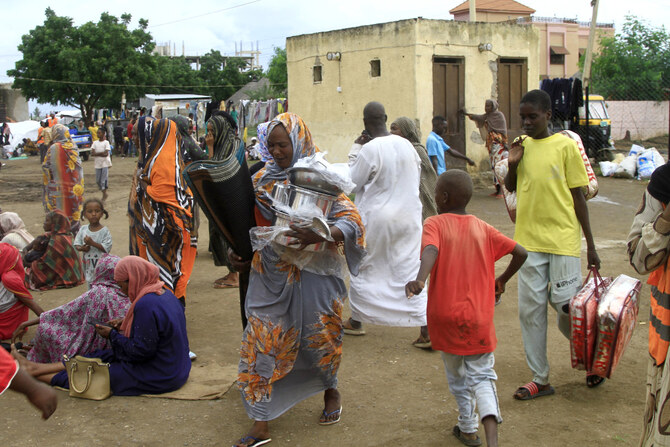
Sudanese, displaced from the town of Sinjah, receive humanitarian aid at their makeshift camp in the eastern city of Gedaref on August 22, 2024. (AFP)
2 / 2
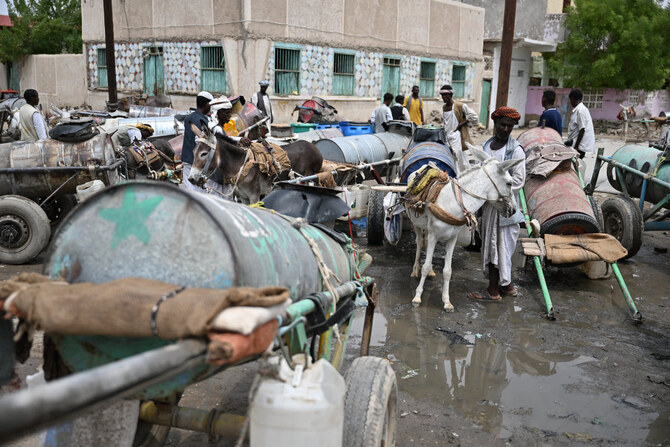
Sudanese queue to fill on water Port Sudan on August 26, 2024, after a dam collapsed as a result of heavy rain. (AFP)
Short Url
Updated 22 September 2024
Follow

ALPS group urges Sudan’s warring parties to open all famine-stricken areas to relief operations

  • Group calls on Sudan’s army and the RSF to allow relief efforts ‘to reach the heartland of the crisis and contain the famine’
  • RSF also urged ‘to refrain from any attacks targeting civilians’ and the Sudan Armed Forces to stop ‘widespread aerial bombardments’

RIYADH: A coalition of countries working for a resolution of the civil war in Sudan on Saturday urged the warring parties to expand access to famine-stricken areas by humanitarian relief efforts.

In a joint statement, the ALPS Group said that while humanitarian operations “are now moving across conflict lines from Port of Sudan through Shendi to Khartoum,” wider access must be ensured for relief efforts “to reach the heartland of the crisis and contain the famine.”

This “expansion of humanitarian access, while a positive sign, remains insufficient to meet both the needs of the people and to ensure the efficient delivery of the hundreds of thousands of tons of additional humanitarian assistance being mobilized for the people of Sudan,” the statement said.

The ALPS Group — which stands for Aligned for Advancing Lifesaving and Peace in Sudan — issued the statement after a virtual meeting on Sept. 19, during which it received “sobering updates” on the ground situation in the troubled North African country.

The group includes Saudi Arabia, the US, Switzerland, the UAE, Egypt, the African Union, and the UN. 
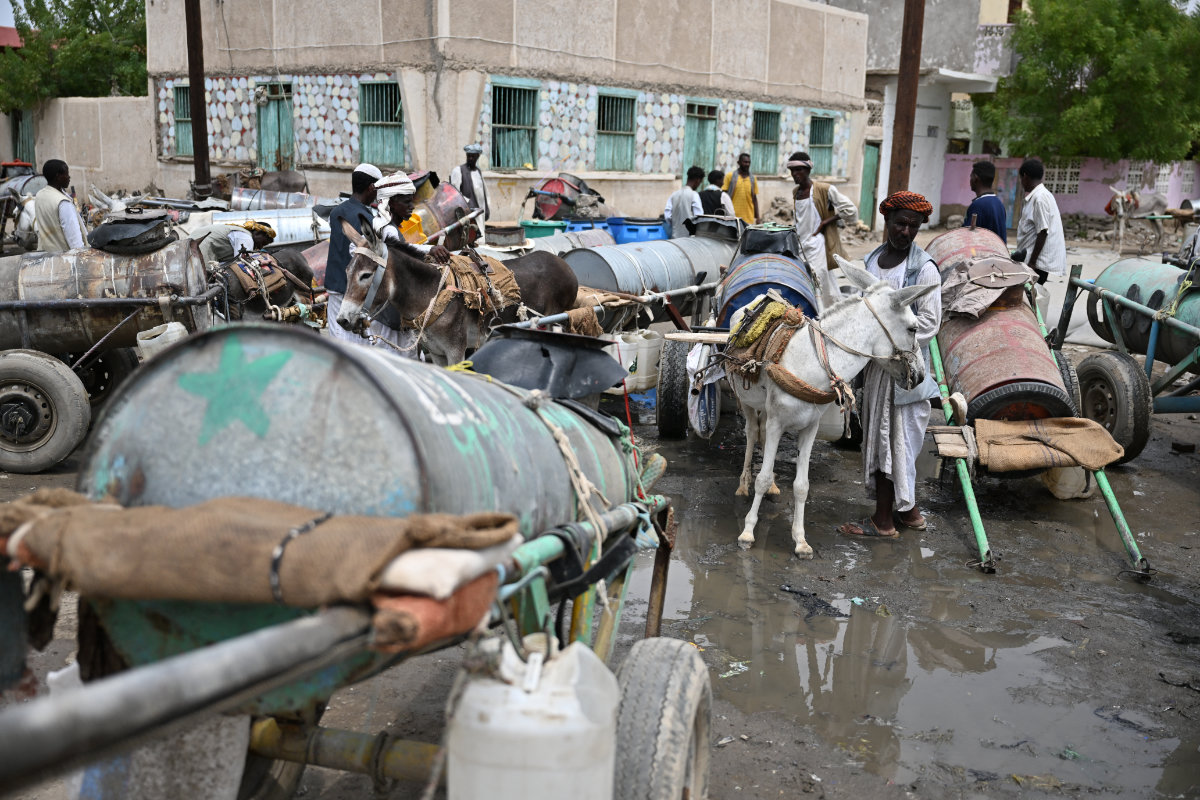


Sudanese queue to fill on water Port Sudan on August 26, 2024, after a dam collapsed as a result of heavy rain. (AFP)

During the virtual meeting, the group noted an instance of “catastrophic malnutrition” at the Zamzam camp near the town of El-Fasher in North Darfur state. 

Already the largest refugee camp in Sudan with half a million people, Zamzam has become more crowded after war broke out in April 2023 between Sudan’s army and the paramilitary Rapid Support Forces, according to relief agencies.

Recent reports reveal that the famine-stricken camp is now facing the risk of infectious diseases after it was hit by floods.

The humanitarian group Doctors Without Borders, warned last May of an “acute disaster on a catastrophic scale” happening in the camp as the number of evacuees continued to swell.
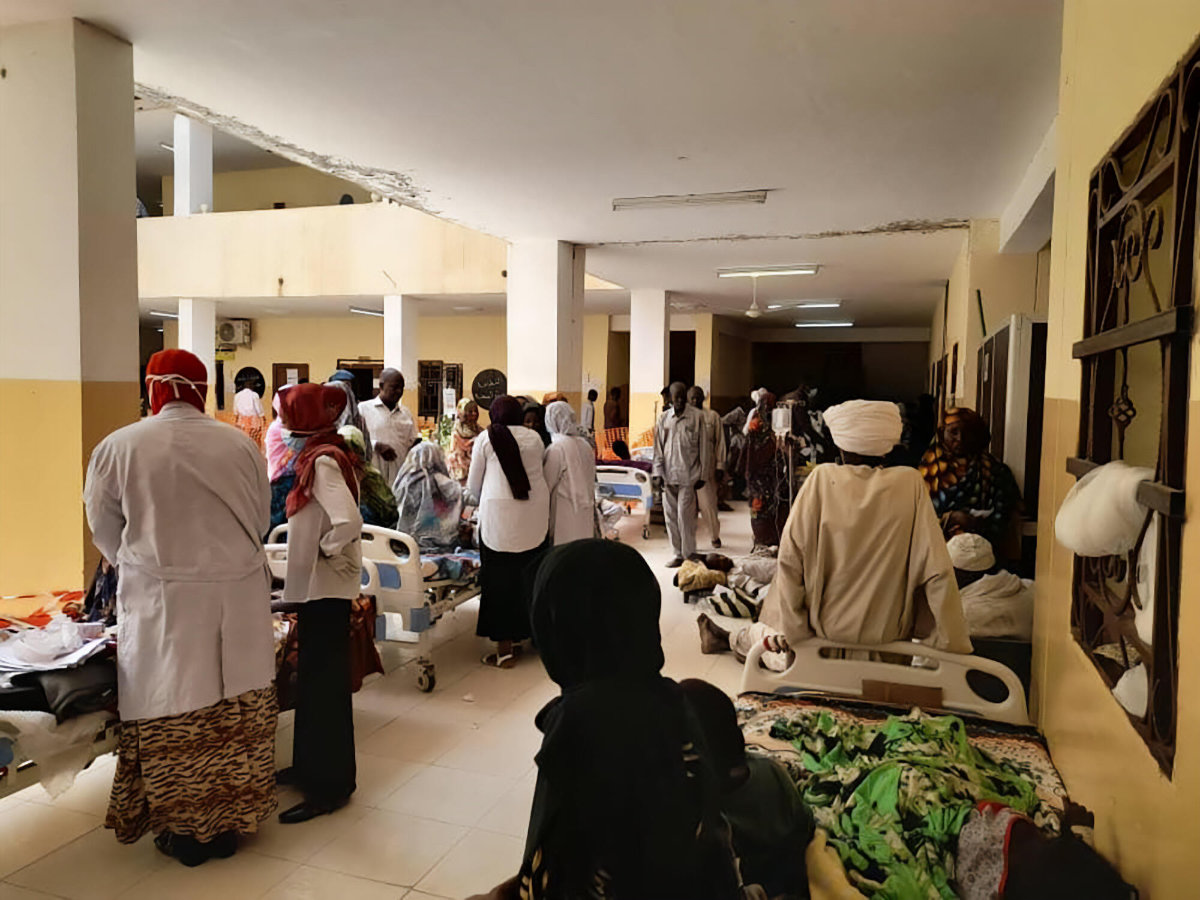


In this picture from the humanitarian aid group Medicins Sans Frontieres, people wait to receive treatment at El Fasher hospital in Sudan in May 2023. (MSF photo)

In its statement on Saturday, the ALPS Group welcomed the full opening by the government of Gen. Abdel Fattah Al-Burhan of the Kassala and Dongola airports for the UN World Food Program’s Humanitarian Air Service. 

However, it said, RSF and Sudan Armed Forces should also ensure “unhindered and safe access” for relief efforts along the Khartoum route and other routes, including from Khartoum to El Obeid and to Kosti, from Kassala to Wad Medani and beyond. 

The ALPS Group also urged the paramilitary RSF “to refrain from any attacks targeting civilians” and the Sudan Armed Forces “to stop its widespread aerial bombardments.” 

It also called on international partners to join efforts to reach immediate humanitarian pauses to the fighting to allow humanitarian access and corridors for civilians most in need. 


Syria Kurds chief says ‘all efforts’ being made to salvage deal with Damascus

Updated 25 December 2025
Follow

Syria Kurds chief says ‘all efforts’ being made to salvage deal with Damascus

  • Abdi said the Syrian Democratic Forces (SDF), the Kurds’ de facto army, remained committed to the deal
  • The two sides were working toward “mutual understanding” on military integration and counter-terrorism

DAMASCUS: Syrian Kurdish leader Mazloum Abdi said Thursday that “all efforts” were being made to prevent the collapse of talks on an agreement with Damascus to integrate his forces into the central government.
The remarks came days after Aleppo saw deadly clashes between the two sides before their respective leaders ordered a ceasefire.
In March, Abdi signed a deal with Syrian President Ahmed Al-Sharaa to merge the Kurds’ semi-autonomous administration into the government by year’s end, but differences have held up its implementation.
Abdi said the Syrian Democratic Forces (SDF), the Kurds’ de facto army, remained committed to the deal, adding in a statement that the two sides were working toward “mutual understanding” on military integration and counter-terrorism, and pledging further meetings with Damascus.
Downplaying the year-end deadline, he said the deal “did not specify a time limit for its ending or for the return to military solutions.”
He added that “all efforts are being made to prevent the collapse of this process” and that he considered failure unlikely.
Abdi also repeated the SDF’s demand for decentralization, which has been rejected by Syria’s Islamist authorities, who took power after ousting longtime ruler Bashar Assad last year.
Turkiye, an important ally of Syria’s new leaders, sees the presence of Kurdish forces on its border as a security threat.
In Damascus this week, Turkish Foreign Minister Hakan Fidan stressed the importance of the Kurds’ integration, having warned the week before that patience with the SDF “is running out.”
The SDF control large swathes of the country’s oil-rich north and northeast, and with the support of a US-led international coalition, were integral to the territorial defeat of the Daesh group in Syria in 2019.
Syria last month joined the anti-IS coalition and has announced operations against the jihadist group in recent days.