

US senator accuses Muslim advocate of supporting extremism in hearing on hate

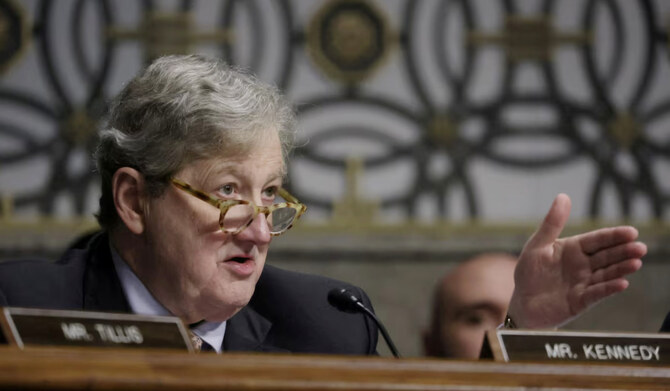
Republican US Senator John Kennedy. (REUTERS file photo)
Short Url
Updated 18 September 2024
Follow

US senator accuses Muslim advocate of supporting extremism in hearing on hate

  • “This harassment is alarming,” Muslim American advocacy group Engage Action said

WASHINGTON: Republican US Senator John Kennedy accused a leading Muslim civil rights advocate of supporting extremism during a Senate hearing on hate incidents in the US, drawing criticism from many rights groups.
“You support Hamas, do you not?” Kennedy told Arab American Institute Executive Director Maya Berry, who replied by saying: “You asking the executive director of the Arab American Institute that question very much puts the focus on the issue of hate in our country.”
In a follow-up question, the senator asked, “You support Hezbollah, too, don’t you?” He later told her, “You should hide your head in a bag.”
Berry repeatedly said in her responses that she did not support those groups, and added that she found the line of questioning “extraordinarily disappointing.”
Islamist militant groups Hamas, which carried out a deadly Oct. 7 attack on Israel, and Hezbollah are both designated as “foreign terrorist organizations” by the US government.
Multiple rights advocates denounced Senator Kennedy.
“It is absolutely reprehensible that a US senator would weaponize the racial identity of a witness and accuse her of supporting terrorism by using an anti-Arab and anti-Muslim trope in a hearing meant to tackle precisely that kind of bigotry,” Council on American Islamic Relations Government Affairs Director Robert McCaw told Reuters.
“This harassment is alarming,” Muslim American advocacy group Engage Action said.
The Democratic-led Senate Judiciary Committee, which organized Tuesday’s hearing, also condemned the senator and called Berry’s response to him “powerful.”
Rights advocates have warned about rising threats against American Muslims, Arabs and Jews since the eruption of Israel’s war in Gaza following Hamas’ Oct. 7 attack.
US incidents in recent months include the attempted drowning of a 3-year-old Muslim girl in Texas, the fatal stabbing of a 6-year-old Muslim boy in Illinois, the stabbing of a Muslim man in Texas, the beating of a Muslim man in New York, threats of violence against Jews at Cornell University that led to a conviction and sentencing, and an unsuccessful plot to attack a New York City Jewish center.



Bangladesh arrests journalist for ‘anti-state activities’

Updated 15 December 2025
Follow

Bangladesh arrests journalist for ‘anti-state activities’

DHAKA: Bangladesh police on Monday said they had arrested a veteran journalist for alleged “anti-state activities,” accused of promoting the banned party of ousted prime minister Sheikh Hasina.
The arrest, which comes ahead of key elections in February, the first vote since the student-led uprising last year that overthrew the autocratic government of Hasina and her Awami League, sparked concerns from a key rights group.
Anis Alamgir was arrested under the Anti-Terrorism Act along with three others, accused of spreading propaganda in talk shows and social media posts, and conspiring to rehabilitate the Awami League.
The interim government banned Hasina’s Awami League in May under amendments to the Anti-Terrorism Act — a move Human Rights Watch condemned as “draconian.”
“Anis Alamgir has been arrested on accusations of conspiring against the state,” said Kazi Mohammad Rafiq, officer-in-charge of Uttara West police station in the capital Dhaka.
Three others were named in police documents alongside Alamgir, including actress Meher Afroz Shaon.
Rights organization Ain o Salish Kendra condemned the arrest.
“Using a law, originally enacted to prevent terrorist activities, against freedom of expression and journalism is against the fundamental principles of a democratic state,” it said in a statement.
“It’s an attack on freedom of expression.”
Press freedom in Bangladesh has long been under threat, and Hasina’s tenure was marked as one of the worst periods for media freedom in the South Asian nation.
Bangladesh ranks 149 out of 180 countries for press freedom in 2025, according to Reporters Without Borders (RSF), up from 165 a year before.
But RSF also notes that over 130 journalists were subjected to “unfounded judicial proceedings” and five detained, in the “political purge that followed the fall of Sheikh Hasina.”
Those listed as detained pending trial are Ekattor TV’s Farzana Rupa, Shakil Ahmad and Mozammel Babu, as well as freelancer Shahriar Kabir and Shyamal Dutta, editor of Bhorer Kagoj newspaper.