Shy penguin wins New Zealand’s bird election after campaign filled with memes and tattoos

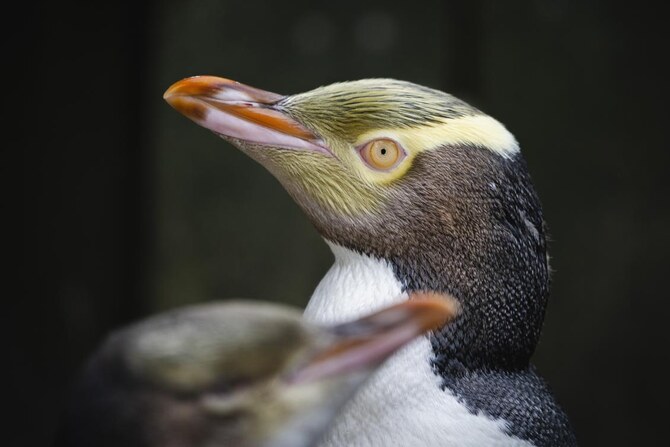
The hoiho — a noisy, smelly and shy bird believed to be the world’s rarest penguin — was propelled to its second victory by a star-studded campaign. (AP)
Short Url
Updated 16 September 2024
Follow

Shy penguin wins New Zealand’s bird election after campaign filled with memes and tattoos

  • The hoiho — a noisy, smelly and shy bird believed to be the world’s rarest penguin — was propelled to its second victory by a star-studded campaign

WELLINGTON: It’s noisy, smelly, shy — and New Zealand’s bird of the year.
The hoiho, or yellow-eyed penguin, won the country’s fiercely fought avian election on Monday, offering hope to supporters of the endangered bird that recognition from its victory might prompt a revival of the species.
It followed a campaign for the annual Bird of the Year vote that was absent the foreign interference scandals and cheating controversies of past polls. Instead, campaigners in the long-running contest sought votes in the usual ways — launching meme wars, seeking celebrity endorsements and even getting tattoos to prove their loyalty.
More than 50,000 people voted in the poll, 300,000 fewer than last year, when British late night host John Oliver drove a humorous campaign for the pūteketeke — a “deeply weird bird” which eats and vomits its own feathers – securing a landslide win.
This year, the number of votes cast represented 10 percent of the population of New Zealand — a country where nature is never far away and where a love of native birds is instilled in citizens from childhood.
“Birds are our heart and soul,” said Emma Rawson, who campaigned for the fourth-placed ruru, a small brown owl with a melancholic call. New Zealand’s only native mammals are bats and marine species, putting the spotlight on its birds, which are beloved — and often rare.
This year’s victor, the hoiho — its name means “noise shouter” in the Māori language — is a shy bird thought to be the world’s rarest penguin. Only found on New Zealand’s South and Chatham islands — and on subantarctic islands south of the country — numbers have dropped perilously by 78 percent in the past 15 years.
“This spotlight couldn’t have come at a better time. This iconic penguin is disappearing from mainland Aotearoa before our eyes,” Nicola Toki, chief executive of Forest & Bird — the organization that runs the poll — said in a press release, using the Māori name for New Zealand. Despite intensive conservation efforts on land, she said, the birds drown in nets and sea and can’t find enough food.
“The campaign has raised awareness, but what we really hope is that it brings tangible support,” said Charlie Buchan, campaign manager for the hoiho. But while the bird is struggling, it attracted a star billing in the poll: celebrity endorsements flew in from English zoologist Jane Goodall, host of the Amazing Race Phil Keoghan, and two former New Zealand prime ministers.
Aspiring bird campaign managers — this year ranging from power companies to high school students — submit applications to Forest & Bird for the posts. The hoiho bid was run by a collective of wildlife groups, a museum, a brewery and a rugby team in the city of Dunedin, where the bird is found on mainland New Zealand, making it the highest-powered campaign of the 2024 vote.
“I do feel like we were the scrappy underdog,” said Emily Bull, a spokesperson for the runner-up campaign, for the karure — a small, “goth” black robin only found on New Zealand’s Chatham Island.
The karure’s bid was directed by the students’ association at Victoria University of Wellington, prompting a fierce skirmish on the college campus when the student magazine staged an opposing campaign for the kororā, or little blue penguin.
The rivalry provoked a meme war and students in bird costumes. Several people got tattoos. When the magazine’s campaign secured endorsements of the city council and local zoo, Bull despaired for the black robin’s bid.
But the karure — which has performed a real-life comeback since the 1980s, with conservation efforts increasing the species from five birds to 250 — took second place overall.
This weekend as Rawson wrapped up her campaign for the ruru, she took her efforts directly to the people, courting votes at a local dog park. The veteran campaign manager who has directed the bids for other birds in past years was rewarded by the ruru placing fourth in the poll, her best ever result.
“I have not been in human political campaigning before,” said Rawson, who is drawn to the competition because of the funds and awareness it generates. The campaign struck a more sedate tone this year, she added.
“There’s been no international interference, even though that was actually a lot of fun,” she said, referring to Oliver’s high-profile campaign.
It was not the only controversy the election has seen. While anyone in the world can vote, Forest & Bird now requires electors to verify their ballots after foreign interference plagued the contest before. In 2018, Australian pranksters cast hundreds of fraudulent votes in favor of the shag.
The following year, Forest & Bird was forced to clarify that a flurry of votes from Russia appeared to be from legitimate bird-lovers.
While campaigns are fiercely competitive, managers described tactics more akin to pro wrestling — in which fights are scripted — than divisive political contests.
“Sometimes people want to make posts that are kind of like beefy with you and they’ll always message you and be like, hey, is it okay if I post this?” Bull said. “There is a really sweet community. It’s really wholesome.”


As an uncertain 2026 begins, virtual journeys back to 2016 become a trend

Updated 30 January 2026
Follow

As an uncertain 2026 begins, virtual journeys back to 2016 become a trend

  • Over the past few weeks, millions have been sharing throwback photos to that time on social media, kicking off one of the first viral trends of the year

LONDON: The year is 2016. Somehow it feels carefree, driven by Internet culture. Everyone is wearing over-the-top makeup.
At least, that’s how Maren Nævdal, 27, remembers it — and has seen it on her social feeds in recent days.
For Njeri Allen, also 27, the year was defined by the artists topping the charts that year, from Beyonce to Drake to Rihanna’s last music releases. She also remembers the Snapchat stories and an unforgettable summer with her loved ones. “Everything felt new, different, interesting and fun,” Allen says.
Many people, particularly those in their 20s and 30s, are thinking about 2016 these days. Over the past few weeks, millions have been sharing throwback photos to that time on social media, kicking off one of the first viral trends of the year — the year 2026, that is.
With it have come the memes about how various factors — the sepia hues over Instagram photos, the dog filters on Snapchat and the music — made even 2016’s worst day feel like the best of times.
Part of the look-back trend’s popularity has come from the realization that 2016 was already a decade ago – a time when Nævdal says she felt like people were doing “fun, unserious things” before having to grow up.
But experts point to 2016 as a year when the world was on the edge of the social, political and technological developments that make up our lives today. Those same advances — such as developments under US President Donald Trump and the rise of AI — have increased a yearning for even the recent past, and made it easier to get there.
2016 marked a year of transition
Nostalgia is often driven by a generation coming of age — and its members realizing they miss what childhood and adolescence felt like. That’s certainly true here. But some of those indulging in the online journeys through time say something more is at play as well.
It has to do with the state of the world — then and now.
By the end of 2016, people would be looking ahead to moments like Trump’s first presidential term and repercussions of the United Kingdom leaving the EU after the Brexit referendum. A few years after that, the COVID-19 pandemic would send most of the world into lockdown and upend life for nearly two years.
Janelle Wilson, a professor of sociology at the University of Minnesota-Duluth, says the world was “on the cusp of things, but not fully thrown into the dark days that were to come.”
“The nostalgia being expressed now, for 2016, is due in large part to what has transpired since then,” she says, also referencing the rise of populism and increased polarization. “For there to be nostalgia for 2016 in the present,” she added, “I still think those kinds of transitions are significant.”
For Nævdal, 2016 “was before a lot of the things we’re dealing with now.” She loved seeing “how embarrassing everyone was, not just me,” in the photos people have shared.
“It felt more authentic in some ways,” she says. Today, Nævdal says, “the world is going downhill.”
Nina van Volkinburg, a professor of strategic fashion marketing at University of the Arts, London, says 2016 marked the beginning of “a new world order” and of “fractured trust in institutions and the establishment.” She says it also represented a time of possibility — and, on social media, “the maximalism of it all.”
This was represented in the bohemian fashion popularized in Coachella that year, the “cut crease” makeup Nævdal loved and the dance music Allen remembers.
“People were new to platforms and online trends, so were having fun with their identity,” van Volkinburg says. “There was authenticity around that.”
And 2016 was also the year of the “boss babe” and the popularity of millennial pink, van Volkinburg says, indications of young people coming into adulthood in a year that felt hopeful.
Allen remembers that as the summer she and her friends came of age as high school graduates. She says they all knew then that they would remember 2016 forever.
Ten years on, having moved again to Taiwan, she said “unprecedented things are happening” in the world. “Both of my homes are not safe,” she said of the US and Taiwan, “it’s easier to go back to a time that’s more comfortable and that you felt safe in.”
Feelings of nostalgia are speeding up
In the last few days, Nævdal decided to hide the social media apps on her phone. AI was a big part of that decision. “It freaks me out that you can’t tell what’s real anymore,” she said.
“When I’ve come off of social media, I feel that at least now I know the things I’m seeing are real,” she added, “which is quite terrifying.”
The revival of vinyl record collections, letter writing and a fresh focus on the aesthetics of yesterday point to nostalgia continuing to dominate trends and culture. Wilson says the feeling has increased as technology makes nostalgia more accessible.
“We can so readily access the past or, at least, versions of it,” she said. “We’re to the point where we can say, ‘Remember last week when we were doing XYZ? That was such a good time!’”
Both Nævdal and Allen described themselves as nostalgic people. Nævdal said she enjoys looking back to old photos – especially when they show up as “On This Day” updates on her phone, She sends them to friends and family when their photos come up.
Allen wished that she documented more of her 2016 and younger years overall, to reflect on how much she has evolved and experienced since.
“I didn’t know what life could be,” she said of that time. “I would love to be able to capture my thought process and my feelings, just to know how much I have grown.”