

Pakistan ruling coalition set to pass constitutional amendments to consolidate power in judicial appointments

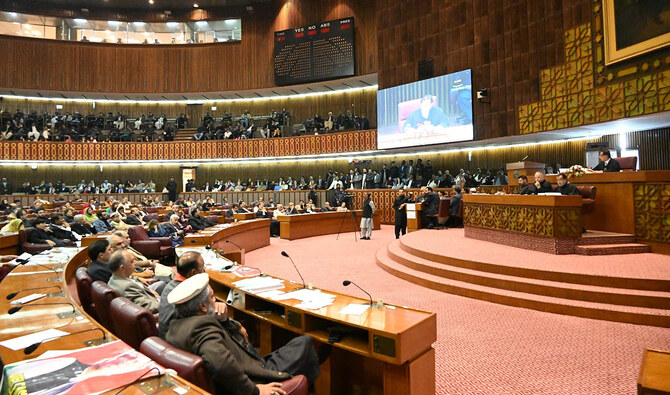
In this handout photo, taken and released by the Government of Pakistan, members of Pakistan’s lower house of parliament attend the National Assembly meeting in Islamabad on March 1, 2024. (Photo courtesy: X/@NAofPakistan/File)
Short Url
Updated 15 September 2024
Follow

Pakistan ruling coalition set to pass constitutional amendments to consolidate power in judicial appointments

  • Constitutional amendment package will set tenure of Supreme Court Chief Justice to three years, change process of CJ’s appointment
  • Opposition PTI party has called judicial reforms package an ‘attack’ on judiciary, threatened nationwide protests if amendments passed

ISLAMABAD: Both the upper and lower houses of parliament are scheduled to convene today, unusual for a Sunday, as the government plans to table a history-making ‘constitutional amendment package’ that will increase the retirement age of superior judges by three years and change the process by which the Supreme Court chief justice is appointed.
The package of reforms, widely believed to include as many as 22 amendments to the constitution, has raised widespread concerns among opposition parties and independent experts who say the moves are aimed at increasing the government’s power in making key judicial appointments and dealing with the defection of lawmakers during house votes. The reforms also include changes to Article 63-A of the Constitution, which relates to the disqualification of legislators who cross party lines in voting for a constitutional amendment.
Ahead of the parliamentary session, Defense Minister Khawaja Asif, a senior member of the ruling Pakistan Muslim League-Nawaz (PMLN) party, told reporters the government had the 224 votes, two-thirds majority, needed to pass the amendment. He also refuted reports that the amendment was being introduced to grant an extension to Supreme Court Chief Justice Qazi Faez Isa, widely believed to be aligned with the ruling coalition led by Prime Minister Shehbaz Sharif and in opposition to its chief rival, the Pakistan Tehreek-e-Insaf (PTI) party of jailed former PM Imran Khan, who has threatened nationwide protests against the reforms.
“It’s not going to be a person-specific or individual-specific legislation,” Information Minister Ataullah Tarar told reporters on Sunday. “Whatever is going to happen will be in the greater good of the people. It would be to benefit the people, the nation.”
PM Sharif’s office quoted him as saying at a dinner for legislators on Saturday night that the legislation would be passed “in the national and public’s interest” and to “ensure the sanctity of parliament.”
As of 8pm on Sunday night, separate consultations continued among the coalition partners and opposition parties on the amendments, according to the information minister.
“Consultations are ongoing among the government parties, while Maulana Fazlur Rehman is taking the opposition on board on the amendments,” Tarar told reporters. “Efforts are being made to reach a consensus.”
AMENDMENTS
The coalition government is proposing that the retirement age of superior judges be increased by three years. Currently, Article 179 of the Constitution envisages that a judge of the Supreme Court shall hold office until he attains the age of retirement of 65 years, whereas Article 195 of the Constitution says that a judge of a high court shall hold office until he attains the age of 62 years. The current CJ retires on Oct. 25.
The government is also mulling revising the seniority principle in the appointment of the top judge, the coalition government’s spokesperson on legal affairs Aqeel Malik told media this week.
At present, according to Article 175A of the Constitution, the senior most judge of the Supreme Court is appointed as the chief justice on the basis of the principle of seniority, but there are widespread reports that the constitutional amendment envisions the top judge chosen from a panel of five senior-most judges by a judicial commission and a parliamentary committee together.
The reform package also includes a proposal to allow the transfers of judges from one high court to another.
“If passed, the reforms could mark a seismic shift in the country’s judiciary, shaking up long-established procedures and leaving a lasting impact on how the judicial and executive branches interact,” Pakistan’s Express Tribune newspaper said in a news analysis.
In an interaction with reporters, PTI Chairman Gohar Khan said the constitutional package was an “attack” on the judiciary and its freedom.

“We believe the government is adopting an unconstitutional process,” he said. “Primarily, every aspect of the state needs to be independent, especially the judiciary, it cannot be compromised, … If there is any attempt to do this to the judiciary, we will strongly condemn it.”
RESERVED SEATS
The amendments have been proposed after a string of Supreme Court judgments that have ostensibly challenged Sharif’s coalition government, mostly notably a July 12 verdict by a 13-member bench of the Supreme Court that declared the PTI eligible for reserved parliamentary seats.
The verdict dealt a major blow to Sharif’s weak ruling coalition, which may lose its two-thirds majority in Pakistan’s parliament if the verdict is implemented. Sharif’s PML-N party has filed a review petition in the Supreme Court against the verdict.
PTI candidates contested the Feb. 8 general elections as independents after the party was barred from polls on the technical grounds that it did not hold genuine intra-party polls, which is a legal requirement.
Subsequently, the PTI-backed candidates won the most seats in the election, but the Election Commission of Pakistan (ECP) ruled independents were ineligible for their share of 70 reserved seats — 60 for women, 10 for non-Muslims. The reserved seats were then distributed among other parties, mostly those in the ruling coalition, a decision Khan allies contested in the court.
Reserved parliamentary seats for women and minorities are allocated in Pakistan in proportion to the number of seats a political party wins in general elections. This completes the National Assembly’s total 336 seats.
A simple majority in Pakistan’s parliament is 169 seats.


Pakistani politicians urge dialogue with Imran Khan’s party as PM offers talks

Updated 54 min 16 sec ago
Follow

Pakistani politicians urge dialogue with Imran Khan’s party as PM offers talks

  • National Dialogue Committee group organizes summit attended by prominent lawyers, politicians and journalists in Islamabad
  • Participants urge government to lift alleged ban on political activities and media restrictions, form committee for negotiations 

ISLAMABAD: Participants of a meeting featuring prominent politicians, lawyers and civil society members on Wednesday urged the government to initiate talks with former prime minister Imran Khan’s Pakistan Tehreek-e-Insaf (PTI) party, lift alleged bans on political activities after Prime Minister Shehbaz Sharif recently invited the PTI for talks. 

The summit was organized by the National Dialogue Committee (NDC), a political group formed last month by former PTI members Chaudhry Fawad Husain, ex-Sindh governor Imran Ismail and Mehmood Moulvi. The NDC has called for efforts to ease political tensions in the country and facilitate dialogue between the government and Khan’s party. 

The development takes place amid rising tensions between the PTI and Pakistan’s military and government. Khan, who remains in jail on a slew of charges he says are politically motivated, blames the military and the government for colluding to keep him away from power by rigging the 2024 general election and implicating him in false cases. Both deny his allegations. 

Since Khan was ousted in a parliamentary vote in April 2022, the PTI has complained of a widespread state crackdown, while Khan and his senior party colleagues have been embroiled in dozens of legal cases. Prime Minister Shehbaz Sharif last month invited the PTI for talks during a meeting of the federal cabinet, saying harmony among political forces was essential for the country’s progress.

“The prime objective of the dialogue is that we want to bring the political temperatures down,” Ismail told Arab News after the conference concluded. 

“At the moment, the heat is so much that people— especially in politics— they do not want to sit across the table and discuss the pertaining issues of Pakistan which is blocking the way for investment.”

Former prime minister Shahid Khaqan Abbasi, who heads the Awaam Pakistan political party, attended the summit along with Jamaat-e-Islami senior leader Liaquat Baloch, Muttahida Quami Movement-Pakistan’s Waseem Akhtar and Haroon Ur Rashid, president of the Supreme Court Bar Association. Journalists Asma Shirazi and Fahd Husain also attended the meeting. 

Members of the Pakistan Peoples Party, the ruling Pakistan Muslim League-Nawaz (PML-N) and the PTI did not attend the gathering. 

The NDC urged Prime Minister Shehbaz Sharif, President Asif Ali Zardari and PML-N chief Nawaz Sharif to initiate talks with the opposition. It said after the government forms its team, the NDC will announce the names of the opposition negotiating team after holding consultations with its jailed members. 

“Let us create some environment. Let us bring some temperatures down and then we will do it,” Ismail said regarding a potential meeting with the jailed Khan. 

Muhammad Ali Saif, a former adviser to the Khyber Pakhtunkhwa chief minister, told participants of the meeting that Pakistan was currently in a “dysfunctional state” due to extreme political polarization.

“The tension between the PTI and the institutions, particularly the army, at the moment is the most fundamental, the most prominent and the most crucial issue,” Saif noted. 

‘CHANGED FACES’

The summit proposed six specific confidence-building measures. These included lifting an alleged ban on political activities and the appointment of the leaders of opposition in Pakistan’s Senate and National Assembly. 

The joint communique called for the immediate release of women political prisoners, such as Khan’s wife Bushra Bibi and PTI leader Yasmin Rashid, and the withdrawal of cases against supporters of political parties.

The communiqué also called for an end to media censorship and proposed that the government and opposition should “neither use the Pakistan Armed Forces for their politics nor engage in negative propaganda against them.”

Amir Khan, an overseas Pakistani businessperson, complained that frequent political changes in the country had undermined investors’ confidence.

“I came here with investment ideas, I came to know that faces have changed after a year,” Amir Khan said, referring to the frequent change in government personnel. 

Khan’s party, on the other hand, has been calling for a “meaningful” political dialogue with the government. 

However, it has accused the government of denying PTI members meetings with Khan in the Rawalpindi prison where he remains incarcerated. 

“For dialogue to be meaningful, it is essential that these authorized representatives are allowed regular and unhindered access to Imran Khan so that any engagement accurately reflects his views and PTI’s collective position,” PTI leader Azhar Leghari told Arab News last week.