

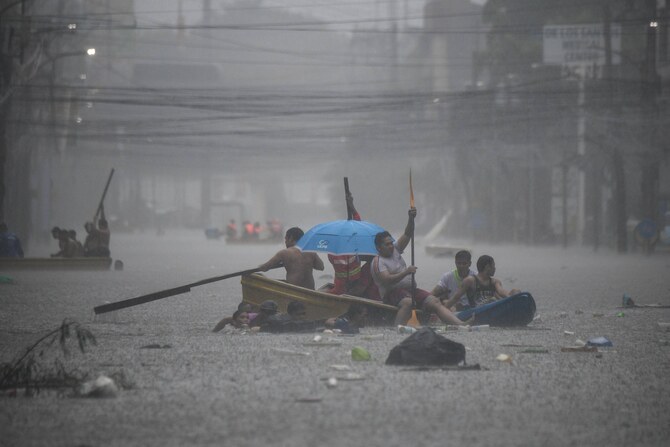

MANILA: The Philippines is the country most at risk from natural disasters, the 2024 World Risk Report shows, with environmentalists highlighting sluggish climate action amid worsening and extreme weather conditions.
The archipelago nation of nearly 120 million people is no stranger to natural disasters, with millions of people often displaced during annual storms and typhoons, which have been made more unpredictable and extreme by the changing climate.
For the third year in a row, the Philippines tops the report’s World Risk Index, which breaks down the disaster risk of 193 countries.
Published by Germany-based research institute IFHV and the alliance of development organizations Bundnis Entwicklung Hilft, this year’s top five most at-risk countries include Indonesia, India, Colombia and Mexico.
“It is definitely a worsening and concerning trend. There are noticeable extreme weather conditions, heat during the summers have been record-breaking, seasons have been unpredictable, there have been high intensity and (high) frequency typhoons,” Ann Dumaliang, a Filipino conservationist and managing trustee of Masungi Georeserve, told Arab News.
“In the Philippines, it is no longer vulnerable communities that are affected. It’s now felt widely across the nation — schools need to be canceled, heatstroke patients overwhelm emergency rooms, in addition to devastating floods.”
This month, more than a dozen people were killed when Typhoon Yagi, known locally as Enteng, passed central and northern Philippines, before it wreaked havoc in southern China and parts of Vietnam and Thailand.
For Filipinos, it is the fifth tropical storm to hit their country since May.
It is more accurate to describe natural disasters as geographical realities, Dumailang said, which for the Philippines are multifold due to its archipelagic nature and location in the “Ring of Fire,” the arc of volcanoes and fault lines in the Pacific Basin.
Those aspects intersect with “man-made causes that lead to continuous environment degradation and poor infrastructure,” and are further “exacerbated by lack of political willpower to make the necessary interventions at the right time,” she added.
John Leo Algo, national coordinator of Aksiyon Klima Pilipinas, a leading civil society network for climate action, said the country’s vulnerability to natural disasters has got worse over time.
“The Philippines’ vulnerability to the climate crisis is worsening because of a combination of more extreme impacts and the lack of capacity to address them. There really is no such thing as a ‘natural disaster’; disasters, by definition, occur when stakeholders do not properly prepare against an impending hazard,” Algo said.
The country’s vulnerability can be traced to insufficient local understanding of the climate crisis and its effects, delays and incoherence in climate policy development, as well as issues with funding and support to implement climate solutions, he added.
Resolving the issue would require “every sector, every stakeholder, and every community” to be prepared to address the effects of the climate crisis.
For now, the Philippines’ National Adaptation Plan and Nationally Determined Contribution Implementation Plan, new mechanisms adopted in an effort to address climate change, “are crucial to reduce the country’s risk to the climate crisis,” Algo said.
“But a lot of work still has to be done, especially in improving its inclusion of communities and civil society groups in both the decision-making and implementation process.”


