

Sudan’s Al-Fasher city hit by heavy fighting

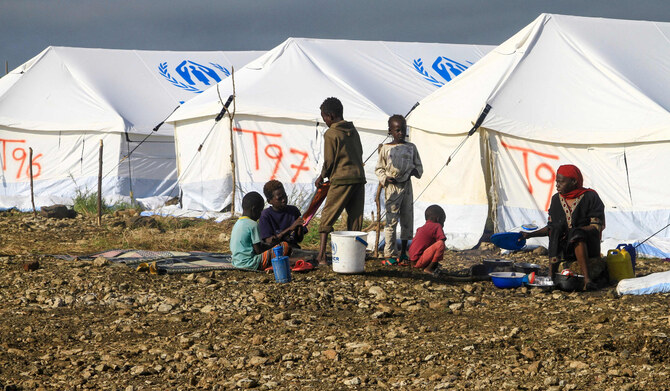
Displaced Sudanese who have returned from Ethiopia gather in a camp run by the United Nations Refugee Agency (UNHCR) in Sudan's border town of Gallabat in the eastern state of Gadaref on September 11, 2024. (AFP)
Short Url
Updated 14 September 2024
Follow

Sudan’s Al-Fasher city hit by heavy fighting

  • Darfur has seen some of the war’s worst atrocities, and the RSF has besieged Al-Fasher since May

KHARTOUM: Heavy fighting on Saturday shook a Sudanese city besieged by Rapid Support Forces, witnesses said, as US researchers reported unprecedented and escalating combat in the North Darfur state capital.
Al-Fasher is one of five state capitals in Sudan’s western Darfur region and the only one not in the hands of the Rapid Support Forces, who have been battling the regular army since April 2023.
The UN says the war across much of Sudan has created the world’s largest displacement crisis, with millions uprooted, and has led to famine at a displacement camp near Al-Fasher.
Darfur has seen some of the war’s worst atrocities, and the RSF has besieged Al-Fasher since May.
“Neighborhoods are completely deserted, and all you can hear are explosions and missiles,” said Ibrahim Ishaq, 52.
“The central market area has become unliveable because of the intensity of the explosions,” said Ishaq, who fled westward from the city on Friday.
Witnesses reported army bombardment south and east of the city on Saturday and said they heard air-defense batteries firing.
The Yale School of Public Health’s Humanitarian Research Lab said in a report on Friday that its analysis confirmed “unprecedented large-scale combat operations” in El-Fasher within the previous 10 days, “with significant escalation in the past 36 hours” involving both the army and the paramilitary forces.
It cited reports that describe “a major multidirectional RSF attack from the northern, eastern, and southern directions” on Thursday.
Darfur Gov. Mini Minawi said on Thursday on social media platform X that the army had repelled “a large attack” by the RSF.
The paramilitaries, however, said they seized military sites in Al-Fasher.
Using satellite imagery and other data, the Yale researchers said they found munition impacts “likely related to high-tempo aerial bombardment” from the regular army but said other structural damage resulted from “RSF bombardment” and combat activity by both sides.
Whatever the battle’s outcome, current fighting levels “are likely to reduce what is left of El-Fasher to rubble effectively,” the Yale study said.
The US special envoy for Sudan, Tom Perriello said on X: “We are extremely concerned about the RSF’s renewed attacks.”
He urged the RSF “to stop its assault.”
It was not immediately possible to determine the number of victims.
Sudan’s war has already killed tens of thousands of people, with some estimates as high as 150,000, according to Perriello.
In Khartoum on Saturday, around 800 km from Al-Fasher, witnesses reported heavy explosions and strikes to the city’s south.
Independent UN experts earlier this month appealed for the urgent deployment of an “impartial force” in Sudan for civilian protection.
Sudan’s foreign ministry, loyal to the army, rejected the idea.


Lebanese finance minister denies any plans for a Kushner-run economic zone in the south

Updated 22 January 2026
Follow

Lebanese finance minister denies any plans for a Kushner-run economic zone in the south

  • Proposal was made by US Envoy Morgan Ortagus but was ‘killed on the spot’
  • Priority is to regain control of state in all aspects, Yassine Jaber tells Arab News

DAVOS: Lebanon’s finance minister dismissed any plans of turning Lebanon’s battered southern region into an economic zone, telling Arab News on the sidelines of the World Economic Forum’s meeting in Davos that the proposal had died “on the spot.”

Yassine Jaber explained that US Envoy to Lebanon Morgan Ortagus had proposed the idea last december for the region, which has faced daily airstrikes by Israel, and it was immediately dismissed.

Jaber’s comments, made to Arab News on the sidelines of the World Economic Forum in Davos, were in response to reports which appeared in Lebanese media in December which suggested that parts of southern Lebanon would be turned into an economic zone, managed by a plan proposed by Jared Kushner, US President Donald Trump’s son in law.

Meanwhile, Jaber also dismissed information which had surfaced in Davos over the past two days of a bilateral meeting between Lebanese ministers, US Middle East Envoy Steve Witkoff and Kushner.

Jaber said that the meeting on Tuesday was a gathering of “all Arab ministers of finance and foreign affairs, where they (Witkoff and Kushner) came in for a small while, and explained to the audience the idea about deciding the board of peace for Gaza.”

He stressed that it did not develop beyond that.

When asked about attracting investment and boosting the economy, Jaber said: “The reality now is that we need to reach the situation where there is stability that will allow the Lebanese army, so the (Israeli) aggression has to stop.”

Over the past few years, Lebanon has witnessed one catastrophe after another: one of the world’s worst economic meltdowns, the largest non-nuclear explosion in its capital’s port, a paralyzed parliament and a war with Israel.

A formal mechanism was put in place between Lebanon and Israel to maintain a ceasefire and the plan to disarm Hezbollah in areas below the Litani river.

But, the minister said, Israel’s next step is not always so predictable.

“They’re actually putting pressure on the whole region. So, a lot of effort is being put on that issue,” he added.

“There are still attacks in the south of the country also, so stability is a top necessity that will really succeed in pushing the economy forward and making the reforms beneficial,” he said.

Lawmakers had also enacted reforms to overhaul the banking sector, curb the cash economy and abolish bank secrecy, alongside a bank resolution framework.

Jaber also stressed that the government had recently passed a “gap law” intended to help depositors recover funds and restore the banking system’s functionality.

“One of the priorities we have is really to deal with all the losses of the war, basically reconstruction … and we have started to get loans for reconstructing the destroyed infrastructure in the attacked areas.”

As Hezbollah was battered during the war, Lebanon had a political breakthrough as the army’s general, Joseph Aoun, was inaugurated as president. His chosen prime minister was the former president of the International Court of Justice, Nawaf Salam.

This year marks the first time a solid delegation from the country makes its way to Davos, with Salam being joined by Jaber, Economy and Trade Minister Amr Bisat, and Telecoms Minister Charles Al-Hage.

“Our priority is to really regain the role of the state in all aspects, and specifically in rebuilding the institutions,” Jaber said.