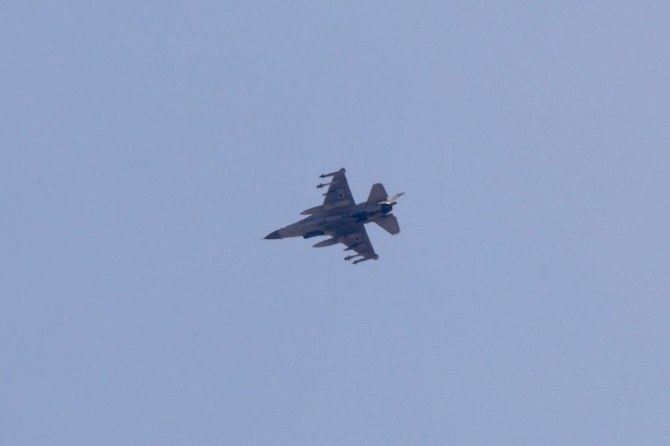
BEIRUT: Israeli warplanes targeted the Qasr-Hermel area in the far northeast of Lebanon on Saturday evening for the first time in weeks. No deaths were reported.
The warplanes hit the surroundings of the town of Hawsh Al-Sayyid Ali in Hermel, a border area between Lebanon and Syria. They also targeted the Sarein Plain in the Bekaa Valley, 21 km from the city of Baalbek.
Loud explosions were heard in most parts of Baalbek and central Bekaa, causing panic among residents.
Hostilities between Israel and Hezbollah have escalated, with Israeli Prime Minister Benjamin Netanyahu announcing that he “decided to expand the military operation against Hezbollah … on the border with Lebanon.”
Israel’s Channel 13 quoted him as saying: “We are in the process of a broad and powerful operation on the northern front, and the Israeli army is seeking a gradual escalation on the northern front with Lebanon.”
Hostilities have reached new areas over the past 24 hours on both sides of the border. In the evening, Israel targeted the Sarafand area north of the Litani Line, while Hezbollah targeted settlements in the Safed, Kiryat Shmona and Margaliot areas in northern Israel.
The Israeli military announced in the evening that “two drones launched by Hezbollah from Lebanon towards the Kiryat Shmona and Margaliot settlements exploded, and they fell north of Kiryat Shmona.”


Israel strikes northern Lebanon in sudden escalation
https://arab.news/bbr5x
Israel strikes northern Lebanon in sudden escalation

- Hostilities have reached new areas over the past 24 hours on both sides of the border


Anti-Daesh coalitions issues joint statement after Riyadh meeting
RIYADH: Saudi Arabia hosted a meeting of senior diplomatic and defense officials from the Small Group of the Global Coalition to Defeat Daesh in Riyadh on Monday.
Saudi Vice Foreign Minister Waleed Elkhereiji opened the meeting, which was co-chaired by US Special Envoy for Syria Ambassador Tom Barrack.
Participants expressed their appreciation to the Kingdom for hosting the meeting and for its continued role in supporting regional and international efforts to counter terrorism and promote stability.
Participants welcomed the comprehensive agreement between the Government of Syria and the Syrian Democratic Forces, including the permanent ceasefire and arrangements for the civil and military integration of northeast Syria.
They noted the Government of Syria’s stated intention to assume national leadership of counter-Daesh efforts and expressed appreciation for the sacrifices made by the Syrian Democratic Forces in the fight against Daesh.
Participants also thanked the Government of Iraq for its continued leadership in the Defeat Daesh campaign.
The participants reaffirmed their priorities, including the swift transfer and safeguarding of Daesh detainees, third-country repatriation, the dignified reintegration of families from Al-Hol and Roj camps to their communities of origin, and continued coordination with Damascus and Baghdad on the future of the Defeat Daesh campaign in Syria and Iraq.
Participants welcomed the Syrian government as the 90th member of the D-Daesh Coalition. Coalition members underscored their readiness to work closely with the Syrian government and encouraged members to provide direct support to Syrian and Iraqi efforts.
Coalition defense officials highlighted the close coordination between diplomatic and military lines of effort.
Participants received briefings on the current Defeat Daesh campaign, including ongoing detainee transfer operations.
Officials commended Iraq’s efforts to securely detain Daesh fighters and welcomed Syria’s assumption of responsibility for detention facilities and displacement camps housing Daesh fighters and their family members.
Participants reiterated the need for countries to take responsibility for and repatriate their nationals from Iraq and Syria.
Coalition members thanked Iraq for its leadership and recognized that the transfer of detainees into Iraqi custody is essential to regional security.
They reaffirmed their shared commitment to defeating Daesh in Iraq and Syria and pledged continued support to both governments in securing Daesh-affiliated detainees.