

‘An eye for an eye’: Hezbollah targets two Israeli military bases in Safed

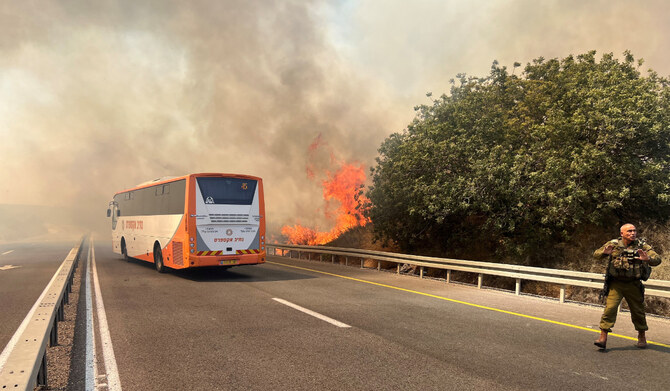
Smoke rises near the Israel-Lebanon border, after Hezbollah fired projectiles towards Israel from Lebanon, amid cross-border hostilities between Hezbollah and Israeli forces, in northern Israel, September 12, 2024. 9REUTERS)
Short Url
Updated 13 September 2024
Follow

‘An eye for an eye’: Hezbollah targets two Israeli military bases in Safed

  • Lebanon Humanitarian Fund allocates $10 million to aid displaced people in southern Lebanon

BEIRUT: Hezbollah launched a swarm of assault drones on Filon Base — the headquarters of Israel’s 210th Division — and its warehouses in the southeast of Safed on Friday, the second attack on Safed in less than 12 hours.

Hezbollah said it had “targeted the positions and locations of the base’s soldiers and officers, striking them directly.”

Israeli media outlets confirmed the attack, stating that “20 rockets were launched from Lebanon toward Safad.”

FASTFACT

UN Humanitarian Coordinator for Lebanon Imran Riza announced the allocation of $24 million as an aid package from the Lebanon Humanitarian Fund ‘to support the country’s most vulnerable groups.’

This came hours after Israeli raids on Friday morning that targeted several houses in Bint Jbeil, the largest city in the area of the Israel-Lebanon border. The impact of the explosions destroyed some residential buildings and caused damage to other structures.

The Israeli army also raided the outskirts of Yaroun and Aita Al-Shaab, with heavy artillery targeting the forests of Alma Al-Shaab and the outskirts of Kfarshouba.

Israeli forces also targeted two motorcycles in Nabatieh on Thursday night, killing three people, including a four-year-old child identified as Mehdi Mubarak, along with his father, Sadeq Mubarak from Markaba, and Sajed Mustafa, Hezbollah announced.

Hezbollah immediately responded by targeting a major air-defense base in Safad with dozens of Katyusha missiles, setting parts of it ablaze and leading to a complete power outage in Safad and nearby areas. Around 50,000 settlers fled to shelters after hearing the sound of sirens, according to Israeli media outlets.

European and US calls to prevent the expansion of war in Lebanon have yet to have any effect.

In his Friday sermon, the head of Hezbollah’s Shariah Council, Sheikh Mohammed Yazbek, said “An eye for an eye, a tooth for a tooth, and the initiator is the aggressor.”

He added: “Hezbollah stands up to the Israeli enemy’s attacks, the monstrous and destructive bombing of houses, and killing of civilians, by launching rocket and drone operations against more settlements.”

Yazbek highlighted “the Israeli escalation,” and said that Hezbollah “is fully prepared to teach the enemy a lesson it hasn’t dreamed of, and won’t stop before the attack against Gaza stops.”

Israeli media outlets reported on Thursday night that the US presidential envoy to Lebanon and Israel, Amos Hochstein, will head to Israel with a message calling for it to avoid “carrying out an expanded military operation in Lebanon.”

The Lebanese authorities have yet to receive confirmation of whether Hochstein intends to visit Beirut.

According to Information International, the death toll from confrontations on the southern front between Oct. 8, 2023, and the morning of Sept. 13, 2024, was 626. Among them are 431 Hezbollah members and 97 civilians. A total of 2,050 homes have been completely destroyed, 1,800 homes have been partially destroyed, and around 8,000 homes have suffered minor damage, while more than 110,000 people have been displaced, with many losing their livelihoods.

Meanwhile, UN Humanitarian Coordinator for Lebanon Imran Riza issued a statement announcing the allocation of $24 million as an aid package from the Lebanon Humanitarian Fund “to support the country’s most vulnerable groups, and address the needs of those affected by the escalating hostilities in southern Lebanon.”

Riza said: “As the escalation of hostilities in south Lebanon drags on longer than we had hoped, it has led to further displacement and deepened the already critical needs. The long-term consequences on vulnerable groups are particularly worrying — schools are closing, healthcare services are under strain, and basic services are being stretched thin.”

He continued: “We are allocating these funds from the LHF at a time of unprecedented challenges. Lebanon is grappling with multiple crises, which have overwhelmed the country’s capacity to cope. Despite our best efforts, only 25 percent of our annual appeal has been met. We urgently call on the international community for more support.

“The LHF has allowed us to support over 200,000 people, but this is still far from enough. Without sufficient funding, we are not only limited in addressing those immediate needs but also risk weakening our preparedness efforts and our capacity to address the other urgent crises Lebanon is currently facing.”

The LHF clarified that the new funding will “provide urgent support to those in need, including food, shelter, healthcare, WaSH and protection. Specifically, $10 million from the LHF will be directed toward emergency relief for those affected by the hostilities in south Lebanon. “Additionally, $13 million will be allocated to support vulnerable communities across Lebanon, and the remaining $1 million will be dedicated to empowering local NGOs, enhancing their ability to respond effectively to the multifaceted crisis.”

In November 2023, in response to the escalation of hostilities on Lebanon’s southern border, the LHF allocated $4.1 million to support advanced preparedness and immediate response efforts for those displaced and in need. This response was further bolstered in February, when the UN’s Central Emergency Response Fund allocated an additional $9 million to address the urgent needs of vulnerable populations, particularly in southern Lebanon.



Kuwait airport targeted as Iran presses on with attacks on Gulf states

Updated 14 min 31 sec ago
Follow

Kuwait airport targeted as Iran presses on with attacks on Gulf states

KUWAIT CITY/DUBAI: Gulf nations on Sunday reported new missile and drone attacks, while Iran vowed to press on with strikes against neighboring countries as the war entered its second week.

Kuwait’s defense forces were “responding to a wave of hostile drones” that penetrated the country’s airspace, accoring to the Defense Ministry.

“The fuel tanks of Kuwait International Airport were attacked by drones in a direct targeting of vital infrastructure,” the Kuwaiti News Agency (KUNA) reported, quoting a statement by the Public Authority for Civil Aviation.

Saudi Arabia's Ministry of Defense was also reporting a wave of drone attacks, saying 21 unmanned aerial vehicles were intercepted and destroyed in the last four hours.

Major General Turki Al-Maliki, spokesman for the Defense Ministry, said in separate posts on X that 13 drones were intercepted and destroyed east of the national capital, Riyadh city, while eight drones were shot down just after entering Saudi air space.

Qatar’s defense ministry said on Sunday that the country was targeted a day earlier by 10 ballistic missiles and two cruise missiles fired from Iran, but most of them were intercepted and caused no casualties.

Before midnight on Saturday, loud explosions were heard in Dubai, the Qatari capital Doha and Bahrain’s Manama, with attacks reported in the UAE, Saudi Arabia, Qatar and Kuwait, where the national oil company announced a “precautionary” cut to production.

The attacks came despite Iran’s president earlier apologizing to Gulf countries for earlier strikes. He had said they would no longer be targeted unless strikes were launched from their territory first.
Hours later, Iran said it would continue conducting strikes on sites in Gulf countries which were “at the disposal of the enemy.”
UAE President Mohammed bin Zayed Al Nahyan said in a rare televised address that the Emirates were in “a period of war” and “will emerge stronger” from it.
Dubai authorities said Saturday evening one person had been killed by debris from an “aerial interception,” adding they were a Pakistani national.

Dubai airport closed, reopens 

Earlier in the day, Dubai closed its main airport — the world’s busiest for international traffic — after authorities said an unidentified object was intercepted nearby.
The government said there had been “a minor incident resulting from the fall of debris after an interception,” without directly mentioning the airport. It said there were no injuries.
The Flightradar24 tracking website earlier showed planes circling above the airport in an apparent holding pattern.
In a statement since deleted from X, Emirates, the largest airline in the Middle East, had announced it was suspending all flights to and from Dubai until further notice, but later said it had resumed operations.
The UAE, a US ally and home to American military installations, has been the most heavily targeted nation in the Gulf during the war.
Earlier in the day, the Ministry of Defense said that of the 16 ballistic missiles fired at the country on Saturday, all but one had been intercepted, with that missile falling into the sea.
Of the 121 drones detected, 119 were brought down, while two fell within Emirati territory.
The barrage brings the number of ballistic missiles detected by the UAE since the start of the war last Saturday to 221, the defense ministry said, with the number of drones surpassing 1,300.
Flights from Dubai’s main airport had partially resumed on Monday despite daily drone attacks targeting sites in the UAE.
Last Saturday, four employees were injured and an airport terminal damaged as the war broke out following US-Israeli strikes on Iran.
Iranian attacks have also hit Abu Dhabi airport, the upmarket Palm Jumeirah development and the Burj Al Arab luxury hotel over the past week, while drone debris caused a fire at the US consulate in Dubai on Tuesday.

Relentless air threats

Elsewhere in the Gulf on Saturday, Qatar’s defense ministry said its military had intercepted two missile attacks targeting the country.

Kuwait said Saturday night it had intercepted seven drones since dawn, with the attacks resulting “only in material damage from falling debris.”
And Bahrain said it has intercepted and 92 missiles and 151 drones since the start of the “brutal Iranian aggression.”
AFP journalists heard an explosion Saturday night in Manama, Bahrain’s capital, as authorities said one person was injured after rocket shrapnel fell in a public street.
In Saudi Arabia, the defense ministry said it had destroyed three ballistic missiles heading toward Prince Sultan Air Base, which hosts American troops, as well as 17 drones over the Shaybah oil field in the southeast.
Kuwait also reported intercepting a drone, while the country’s national oil company announced a “precautionary” cut to its production of crude due to Iranian attacks and threats to the Strait of Hormuz, a key transit point for Gulf hydrocarbons.
Further north, Jordan accused Iran of directly targeting sites in the kingdom, saying Tehran had fired 119 missiles and drones in the past week.
“These missiles and drones were targeting vital installations inside Jordan and were not passing through our territories,” said military spokesman Brig. Gen. Mustafa Hayari.

(With AFP)