KARACHI: As the southern Pakistani city of Karachi evolves into a sprawling metropolis, one constant has stood the test of time: the rhythmic chime of its historic clock towers — relics of the British colonial era that serve not only as timekeepers but as enduring symbols of the rich history of the seaside metropolis.
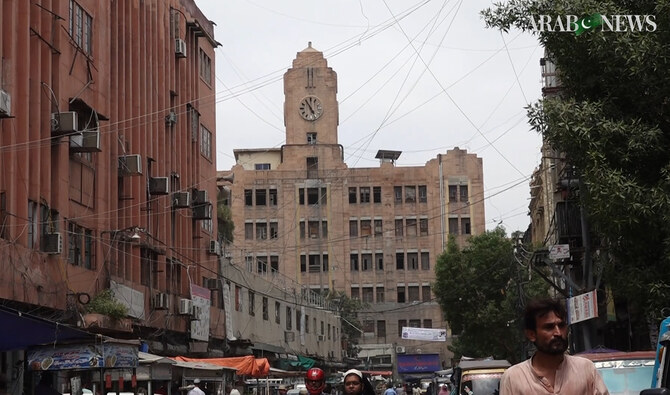
With over a dozen of these monuments scattered across the city, the clock towers remind residents of an era when punctuality and precision were highly valued. At the heart of this legacy lies the iconic clock tower atop the Karachi Municipal Corporation (KMC) building. Built in 1935 to commemorate King George V’s Silver Jubilee, the historic timekeeper remains the only one still functioning on its original mechanics.
Each day, technician Saleem Ahmed Khan Zubairi climbs the five-story structure of the KMC building to maintain the clock’s intricate machinery. With a simple turn of a key, he sets the mechanism in motion and the clock’s chimes ring out through the bustling streets below.
“It’s been operating for nearly 90 years and is still in almost in perfect original condition,” 55-year-old Zubairi, who has been working at the clock tower for the last 15 years, told Arab News.
Most of the other 13 clocktowers documented by Arab News in Karachi have ceased functioning, now only serving as visual reminders of a bygone era.
“Only two [of Karachi’s clock towers] are in working condition. One of them, as you can see at the KMC Head Office, it is in 100 percent genuine condition,” Zubairi said. “The others, like Merewether Tower, are no longer genuine because electronic machines have been installed in it.”
The clock towers were more than just functional structures but also were symbolic of the value placed on time during the British colonial era, according to Shaheen Nauman, a researcher specializing in Karachi’s heritage buildings.
“These clock towers were built to instill a sense of time and its value in the local population,” Nauman explained, standing outside the Edulji Dinshaw Charitable Dispensary, the oldest clock tower in Karachi, built in 1882. “They [the British] not only valued it, but they also tried to inculcate this value in the natives of Karachi.”
Clock towers were first introduced in the Indian Subcontinent during an exhibition by Bennett and Co. in Agra in 1867, according to Nauman, referring to a company owned by Sir John Bennett (1814-1897), a clock and watch maker. Over the decades, they continued to help residents tell time before wristwatches and household clocks became commonplace.
“The first person who purchased the clock was Lala Sohan Lal and he gave it to his municipality in Mirzapur,” she said, referring to the famous Punjabi historiographer who died in 1852.
“FALL INTO DESPAIR”
The clock towers of Karachi, like much of the city’s colonial architecture, are diverse in their design. Many were constructed with Gizri stone but the KMC clock tower is unique, built using red sandstone imported from Jodhpur.
The towers were strategically placed in busy marketplaces or public spaces, ensuring that the sound of their chimes would reach far and wide. Some of them include Merewether Tower (1884), Trinity Church Cathedral (1885), Denso Hall & Library (1886), Empress Market (1889), Poonabai Mamaiya (1889), Jaffer Fuddoo Dispensary (1904), Sydenham Passenger Pavilion at Keamari (1913), Lakshmi Building (1924), and Lea Market (1927).
“They were built in a crowded area, especially the market area, like the Empress Market or the KMC building, so that people could not only hear it, they can, because it was an hour bell and a quarter bell, quarter-hour bell, the time can visually be seen.,” Nauman said.
Yasmeen Lari, a pioneering Pakistani architect and historian, writes in her book, “The Dual City: Karachi During the Raj,” that the native agrarian society had continued to subsist in the pre-industrialized, colonized Subcontinent, unaware of the greater importance attached to time by industrialized Britain.
“The fascination [of the British] with clocks was reflected by their placement on prominent buildings such as the Edulji Dinshaw charitable dispensary and Empress Market in Karachi,” she wrote.
Today, while the clock towers may no longer serve as vital timekeepers in Karachi, they still stand as “silent witnesses to the passage of time” and as symbols of a “city that has not forgotten its heritage,” Zubairi, at the KMC Clock Tower, said.
A proposal was once floated to automate the tower’s winding process through electric motors, but it was abandoned to preserve the originality of the clock, Zubairi said.
The mayor’s office has recently developed a plan to restore the dysfunctional timekeepers, starting with one at Empress Market.
“We will soon bring it back to working condition,” Zubairi said, as the KMC clock tower struck four in the evening behind him.


![]()

Karachi’s iconic clock towers keep time and heritage alive for over a century
Short Url
https://arab.news/6efdf
Karachi’s iconic clock towers keep time and heritage alive for over a century
- Clocktowers were first introduced in the Indian Subcontinent during an exhibition by Bennett and Co. in Agra in 1867, researcher says
- Most of the over a dozen clock towers scattered across Karachi have ceased functioning but serve as visual reminders of British colonial era
Latest updates


© 2026 SAUDI RESEARCH & PUBLISHING COMPANY, All Rights Reserved And subject to Terms of Use Agreement.