Why the Trump-Harris debate is not likely to sway undecided Arab American voters

Short Url
Updated 15 October 2024
Follow

Why the Trump-Harris debate is not likely to sway undecided Arab American voters

  • Experts say neither candidate succeeded in convincing the non-monolithic community to lend them their support in November
  • Commentators feel both the Republican and Democrat relied on fear-mongering rather than in-depth policy discussions

CHICAGO: While the US presidential debate between Kamala Harris and Donald Trump on Tuesday night demonstrated sharp contrasts on major issues, experts suggest it may have done little to sway undecided voters, including those in the Arab American community.

“I don’t think this debate is going to tell us a lot about the results of the election,” Amal Mudallali, the former Lebanese ambassador to the UN, told “The Ray Hanania Show” on Wednesday.

“Neither side succeeded in bringing Arab Americans in or convincing them that he’s the one or she’s the one that will be better for them as president and will take their interests into account.”

Also speaking on Wednesday’s show, Joseph Haboush, Washington correspondent at Al Arabiya English, even called the debate “a bit bland overall.”

He said: “I’m not sure that there are any undecided voters that would change their minds based on last night’s performance.”

The debate, which was held less than two months before election day on Nov. 5, marked the first direct confrontation between the Democratic vice president and the former Republican president.

For Harris, the debate represented an opportunity to solidify her leadership after replacing President Joe Biden on the Democratic ticket after his poor debate performance in June forced him to step aside.
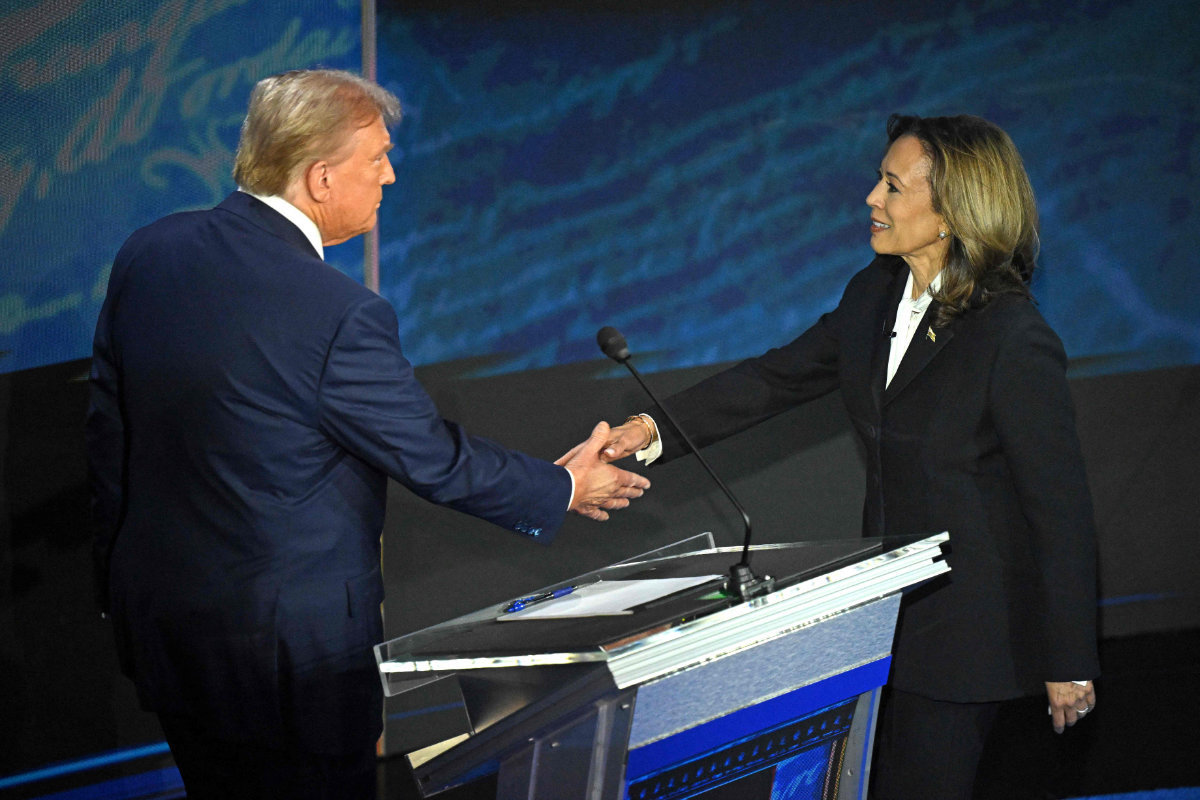


Democratic presidential candidate Kamala Harris (R) shakes hands with her Republican rival Donald Trump during the presidential debate at the National Constitution Center in Philadelphia, Pennsylvania, on Sept. 10, 2024. (AFP)

Trump, on the other hand, saw the debate as an opportunity to link Harris to the perceived failures of the Biden administration, particularly around democracy, immigration, and the economy.

“I was a bit surprised that they didn’t delve into more policy-related issues in more detail, on what either side would want to do,” said Haboush.

“It was more, I would say, fear-mongering; both sides accusing the other of trying to portray the other as a threat to any future of the US, be it democracy or on other issues that they were both accusing one another of.

“There wasn’t much more that was said or given to the audience that they didn’t already know.”

However, foreign policy issues, such as Ukraine, Gaza, China, and Afghanistan, were mentioned in the debate.


Pro-Palestinian demonstrators block roads as they rally in front of Philadelphia City Hall in Pennsylvania on Sept. 10, 2024, ahead of the Harris-Trump debate. (AFP)

On Ukraine, Trump criticized Biden’s handling of the war and promised to end the conflict, claiming that it would not have occurred had he been president.

Pledging to “settle” the conflict even before taking office, Trump said: “What I’ll do is I’ll speak to one and I’ll speak to the other. I’ll get them together.”

He added: “I know (Ukrainian President Volodymyr) Zelensky very well, and I know (Russian President Vladimir) Putin very well. They respect me. They don’t respect Biden.”

Harris attacked Trump’s perceived coziness with Putin, stating that the Russian leader would “eat you for lunch,” and accused him of undermining American support for Ukraine — a key concern given Trump’s ambiguous stance on the conflict.


Kamala Harris slams Donald Trump for being in league with the world's dictators. (AFP)

She defended the Biden administration’s support for Kyiv, highlighting US military aid as essential to Ukraine’s continued independence.

“Because of our support, because of the air defense, the ammunition, the artillery, the Javelins, the Abrams tanks that we have provided, Ukraine stands as an independent and free country,” she said.

However, Harris did not propose new strategies for future US involvement.

Trump hit back, accusing Harris of being weak on foreign policy and of hating Israel and Arabs. He offered no specific solutions for the Israel-Hamas conflict, however, instead claiming the war in Gaza would not have happened under his leadership.


Donald Trump said the Russian invasion of Ukraine and the war in Gaza would not have happened if he were the president. (AFP)

He said: “She hates Israel. She wouldn’t even meet with (Israeli Prime Minister Benjamin) Netanyahu when he went to Congress to make a very important speech.” While Harris did skip the speech, she did meet Netanyahu the following day.

“If she’s president, I believe that Israel would not exist within two years from now,” Trump added, going on to say Harris also hates Arabs, claiming that “the whole place (the Middle East) is going to get blown up.”

He added: “Look at what’s happening with the Houthis and Yemen. Look at what’s happening in the Middle East. This would have never happened. I will get that settled, and fast, and I will get the war with Ukraine and Russia ended.

“If I’m president-elect, I’ll get it done before even becoming president.”


People gather outside of the Berkeley Art Museum and Pacific Film Archive in Berkeley, California, to watch the Harris-Trump debate. (San Francisco Chronicle via AP)

Harris, meanwhile, affirmed her support for Israel’s right to defend itself against Iran and its proxies, while acknowledging the heavy civilian toll on Palestinians in Gaza, where 11 months of fighting have left some 42,000 people dead, according to Gaza’s Health Ministry.

“Far too many innocent Palestinians have been killed,” she said.

She reiterated her support for the two-state solution and emphasized the importance of both Israeli security and Palestinian self-determination. Gaza, however, may not be a deciding issue in the election, even among Arab Americans.


Hours after the Harris-Trump debate in which the Gaza war was discussed, an Israeli air strike hit a school in Nuseirat, Central Gaza, ckilling at least 34 people. (AFP)

“I don’t think Arab American voters are a monolith. It’s not all of them voting on one single issue,” Joyce Karam, a senior news editor at Al-Monitor, told Wednesday’s program.

“I have Arab American friends who have prioritized the war in Gaza and some of them are going for a third party candidate.”

She added: “I think it would not be fair to the community to just say this is a ‘one vote’ or ‘one priority’ kind of drive.”
In relation to China, the candidates sparred over tariffs and trade. Trump promised sweeping tariff increases on Chinese goods, while Harris criticized these measures, citing concerns over inflation and economic instability.

Afghanistan also featured briefly in the debate, with Harris standing by Biden’s decision to withdraw US troops in August 2021, while Trump criticized the manner in which the withdrawal was executed.

Both candidates blamed each other for the chaotic aftermath and the Taliban’s return to power.


Kamala Harris’ calm demeanor was in stark contrast to Trump’s frequent interruptions and emotional outbursts. (AP)

One of the standout features of the debate was the contrast in the candidates’ delivery. Harris’ calm demeanor was in stark contrast to Trump’s frequent interruptions and emotional outbursts, which included raising his voice and launching personal attacks.

Harris’ ability to maintain her composure in the face of Trump’s barrage of insults seemed to play well with viewers. A CNN snap poll conducted after the debate found that 63 percent of respondents believed Harris had won, compared to 37 percent who favored Trump.

Online prediction market PredictIt’s 2024 presidential general election market showed Trump’s likelihood of victory declining during the debate, while Harris’ odds rose to 55 percent from 53 percent.

The debate may prove to be a pivotal moment for both campaigns. In the immediate aftermath, Harris’ campaign capitalized on her performance by calling for a second debate, challenging Trump to meet her again in October.


Donald Trump speaks to reporters in the spin room after the debate. (AP)

Trump, however, appeared reluctant to commit, claiming he had already won the debate and dismissing the idea of a rematch. But his appearance in the debate “spin room” afterwards suggested that even he recognized it had not gone as planned.

Perhaps the most poignant takeaway from the debate was the reminder that, as important as US foreign policy decisions are for the rest of the world, it is domestic issues that swing elections.

“We really don’t know what could happen. There could be many surprises to come,” said Karam. “It’s also very important to remind our audience in the Middle East that while the Gaza war is important, it’s not going to be the deciding factor for many voters.”

“This debate was not a debate that focused on the substance of the issues, it was much more stylistic and about who came off as presidential,” Senior Fellow at the Middle East Institute Firas Maksad told Arab News.

Summing up, Firas Maksad, senior fellow at the Washington-based Middle East Institute, told Arab News: “This debate was not a debate that focused on the substance of the issues. It was much more stylistic and about who came off as presidential.”


Left to right, Arab media practitioners Amal Mudallali, Joseph Haboush and Joyce Karam.


With Iran war exit elusive, Trump aides vie to affect outcome

Updated 13 March 2026
Follow

With Iran war exit elusive, Trump aides vie to affect outcome

  • Aides debate when and how to declare victory even as the conflict spreads across the Middle East
  • In taking America to war, US President Donald Trump offered little explanation

WASHINGTON: A complex tug-of-war inside the White House is driving US President Donald Trump’s shifting public statements on the course of the Iran war, as aides debate when and how to declare victory even as the conflict spreads across the Middle East.

Some officials and advisers are warning Trump that surging gasoline prices could exact a political cost from the US-Israeli attacks on Iran, while some hawks are pressing the president to maintain the offensive against the Islamic Republic, according to interviews with a Trump adviser and others close to the deliberations.

Their observations to Reuters offer a previously unreported glimpse inside White House decision-making as it adjusts its approach to the biggest US military operation since the 2003 Iraq war.

Shifting messages, various internal viewpoints

The behind-the-scenes maneuvering underscores the high stakes Trump, who returned to office last year promising to avoid “stupid” military interventions, faces nearly two weeks after plunging the nation into a war that has rattled global financial markets and disrupted the international oil trade.

The jockeying for Trump’s ear is a feature of his presidency, but this time the consequences are a matter of war and peace in one of the world’s most volatile and economically critical regions.

Shifting from the sweeping goals he framed in launching the war on February 28, Trump in recent days has emphasized that he views the conflict as a limited campaign whose objectives have mostly been met.

But the message remains unclear to many, including the energy markets, which have lurched in both directions in response to Trump’s statements.

He told a campaign-style rally in Kentucky on Wednesday that “we won” the war, then abruptly pivoted: “We don’t want to leave early, do we? We’ve got to finish the job.”

Economic advisers and officials, including from the Treasury Department and the National Economic Council, have warned Trump that an oil shock and rising gasoline prices could quickly erode domestic support for the war, said the adviser and two others close to the deliberations, speaking on the condition of anonymity to disclose internal discussions.

Political advisers, including Chief of Staff Susie Wiles and deputy chief James Blair, are making similar arguments, focusing on the political fallout from higher gas prices and urging Trump to define victory narrowly and signal the operation is limited and nearly finished, the sources said.

Pushing in the other direction are hawkish voices urging Trump to sustain military pressure on Iran, including Republican lawmakers such as US Senators Lindsey Graham and Tom Cotton, and media commentators such as Mark Levin, according to people familiar with the matter.

They argue the US must prevent Iran from obtaining a nuclear weapon and respond forcefully to attacks on American troops and shipping.

A third force comes from Trump’s populist base and figures such as strategist Steve Bannon and right-wing television personality Tucker Carlson, who have been pressing him and his top aides to avoid getting dragged into another prolonged Middle East conflict.

“He is allowing the hawks to believe the campaign continues, wants markets to believe the war might end soon and his base to believe escalation will be limited,” the Trump adviser said.

Asked for comment, White House press secretary Karoline Leavitt said in a statement: “This story is based on gossip and speculation from anonymous sources who aren’t even in the room for any discussions with President Trump.

“The President is known for being a good listener and seeking the opinions of many people, but ultimately everyone knows he’s the final decision maker and his own best messenger,” she said. “The President’s entire team is focused on ensuring the objectives of Operation Epic Fury are fully achieved.”

Other people named for their roles in the deliberations did not immediately respond to Reuters’ questions.

Looking for an exit

In taking America to war, Trump offered little explanation, and the administration’s stated war aims have ranged from thwarting an imminent attack by Iran to crippling its nuclear program to replacing its government.

As he seeks an exit from an unpopular conflict, Trump is trying to juggle competing narratives that some critics say have complicated an already difficult situation, with Iran defiant despite the devastating US-Israeli air assault.

Top political aides and economic advisers, whose warnings before the war of the potential economic shock were largely ignored, appear to have played a major role in pushing Trump’s efforts this week to reassure skittish markets and contain rising oil and gas prices.

His public shift to downplaying the war’s impact, describing it as a “short-term excursion,” and his insistence that gas price hikes would be short-lived appeared aimed at calming fears of an open-ended conflict.

Some top aides have advised him to work toward a conclusion to the conflict that he can call a triumph, at least militarily, the sources said, even if much of the Iranian leadership survives, along with remnants of a nuclear program that the campaign was meant to target.

Wave after wave of US and Israeli air strikes have killed a number of top Iranian leaders among some 2,000 people overall – some as far away as Lebanon – devastated its ballistic missile arsenal, sunk much of its navy and degraded its ability to support armed proxies around the Middle East.

But the military achievements have been seriously undercut by Iran’s stepped-up attacks on oil tankers and transport facilities in the Gulf, driving up oil prices.

Trump has said he will decide when to end the campaign. He and his aides say they are far ahead of the four- to six-week timeframe Trump initially announced.

The shifting reasons for launching the conflict, which has spilled over into more than half a dozen other countries, have only made it more difficult to predict what comes next.

For their part, Iran’s rulers will claim victory, analysts say, for simply surviving the US-Israeli onslaught, especially after demonstrating their ability to fight back and inflict damage on Israel, the US and its allies.

Venezuela miscalculation

Critical to the war’s final trajectory will be the Strait of Hormuz. A fifth of the world’s oil shipments, which normally traverses the narrow waterway, has come to a near-standstill. Iran in recent days has struck tankers in Iraqi waters and other ships near the strait, and the new Supreme Leader Mojtaba Khamenei has vowed to keep it shut.

If Iran’s stranglehold on the waterway pushes US gas prices high enough, that could increase political pressure on Trump to end the military campaign to help his Republican Party, which is defending narrow majorities in Congress in November’s midterm elections.

Trump has recently refrained from pushing the idea that the war seeks to topple the government in Tehran. US intelligence indicates that Iran’s leadership is not at risk of collapse anytime soon, Reuters reported on Wednesday.

At least some of the confusion over the war’s trajectory appears rooted in the quick US military success in Venezuela.

Since the start of the war, some aides have struggled to convince Trump that the Iran campaign was unlikely to unfold in the same way as the January 3 Venezuela raid that captured President Nicolas Maduro, according to another source familiar with the administration’s thinking.

That operation opened the way for Trump to coerce former Maduro loyalists into giving him considerable sway over the country’s vast oil reserves – without requiring extended US military action.

Iran, by contrast, has proved a much tougher, better-armed foe with an entrenched clerical and security establishment.

Experts have rejected claims by Trump aides that Iran had been within weeks of being able to produce a nuclear weapon, despite the president’s insistence in June that US-Israeli bombing had “obliterated” its nuclear program.

Most of Iran’s stockpile of highly enriched uranium is believed to have been buried by the June strikes, meaning the material potentially could be retrieved and purified to bomb grade. Iran has always denied seeking nuclear weapons.

If the war drags on, American casualties mount and the economic costs multiply, some analysts say it could erode backing from Trump’s political base. But despite criticism from some supporters opposed to military interventions, members of his “Make America Great Again” movement have so far largely stayed with him on Iran.

“The MAGA base is going to give the president wiggle room,” said Republican strategist Ford O’Connell.