



PHILADELPHIA: Democrat Kamala Harris and Republican Donald Trump met on Tuesday for their first and perhaps only debate, a square-off that could have a significant impact on the Nov. 5 election as polls show a tight race.
Here are takeaways from the debate:
RILING HER RIVAL
Harris made a point to get under Trump’s skin, as her campaign had forecast.
She urged viewers to attend a Trump rally, where she said Trump would say bizarre things such as windmills cause cancer (something he has, in fact, said) and where, she taunted, attendees would leave out of exhaustion and boredom.
Trump, who prides himself on the crowds he draws, was clearly riled.
“My rallies, we have the biggest rallies, the most incredible rallies in the history of politics,” he said. He accused Harris of busing in attendees to her rallies.
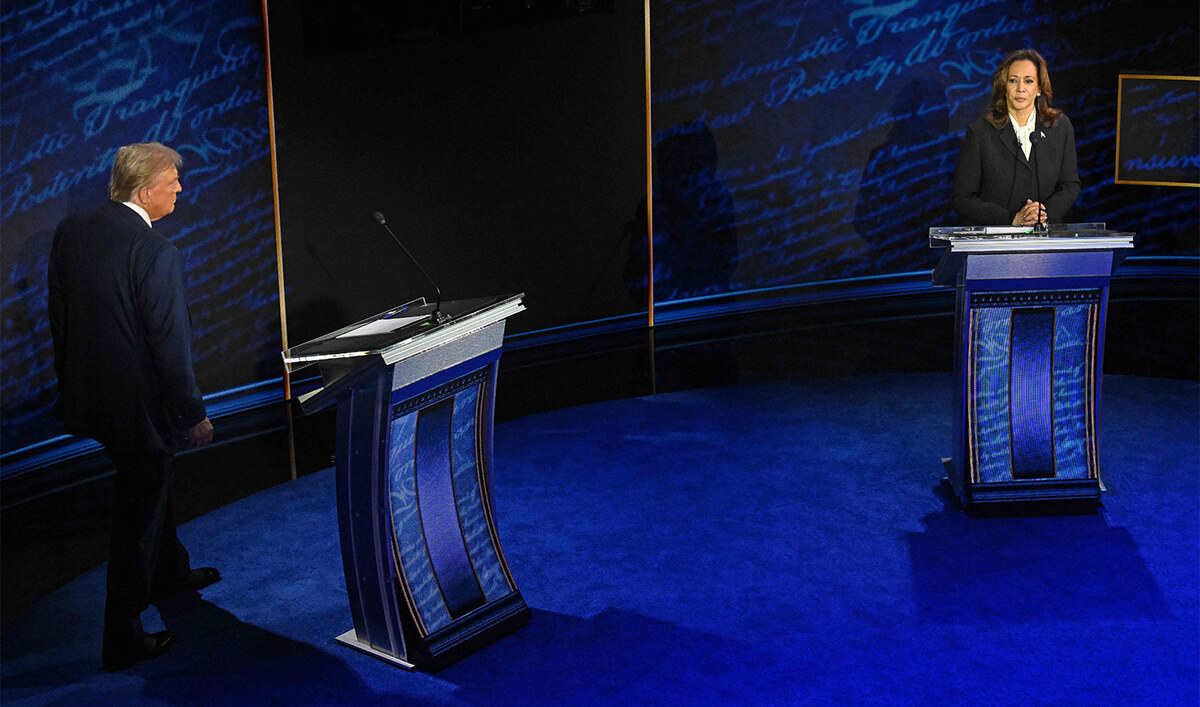
Former US President and Republican presidential candidate Donald Trump returns from a commercial breaks during a presidential debate with US Vice President and Democratic presidential candidate Kamala Harris at the National Constitution Center in Philadelphia, Pennsylvania, on September 10, 2024. (AFP)
Trump then falsely claimed that immigrants in the country illegally were killing and eating people’s pets in the city of Springfield, Ohio, an unsubstantiated claim that has circulated on social media and been amplified by Trump’s vice presidential running mate JD Vance.
“In Springfield, they’re eating the dogs! The people that came in, they’re eating the cats!” Trump said. “They’re eating the pets of the people that live there.”
City officials in Springfield have said those reports are untrue, which the ABC moderators pointed out after Trump’s comments.
“Talk about extreme,” Harris responded, laughing.
PLAYING DEFENSE
Another of Harris’ goals, as a former California prosecutor, was to call Trump out for his past actions, particularly his efforts to overturn the 2020 election.
An hour into the debate, her strategy appeared to be paying off. Trump was continually on the defensive.
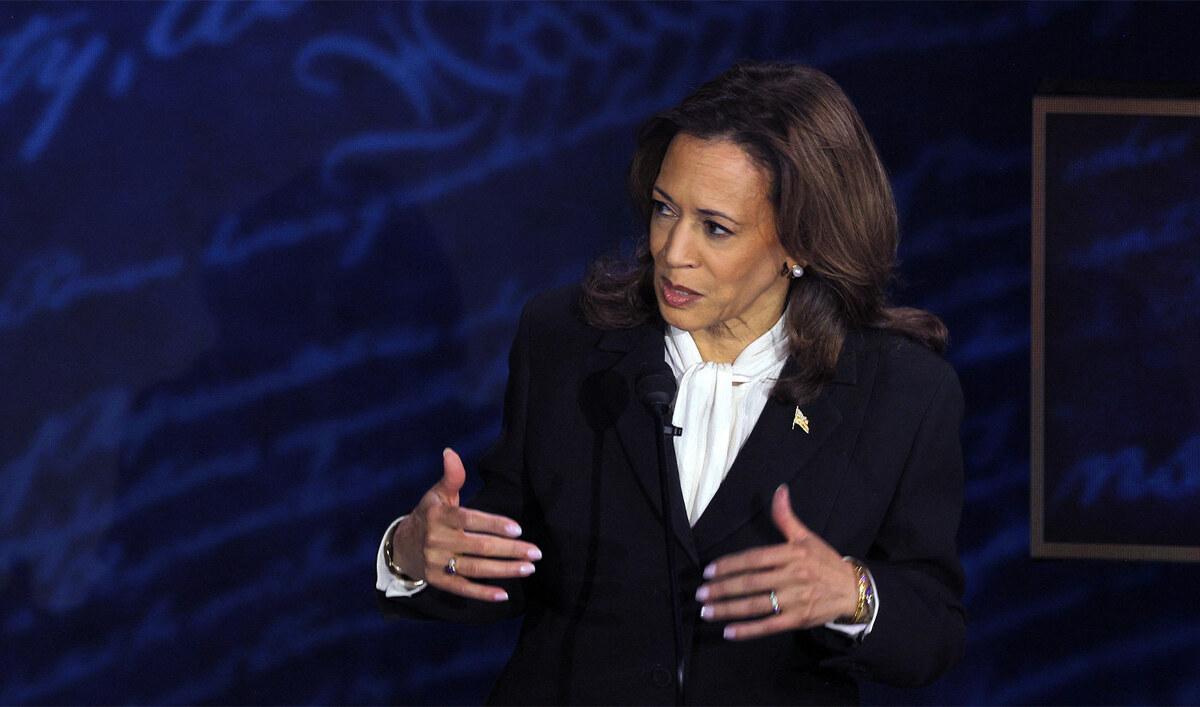
Democratic presidential nominee, U.S. Vice President Kamala Harris gestures as she speaks during a presidential debate with Republican presidential nominee, former U.S. President Donald Trump, hosted by ABC in Philadelphia, Pennsylvania, U.S., on September 10, 2024. (REUTERS)
Asked about the Jan. 6, 2021, siege of the US Capitol, he insisted he “had nothing to do with that, other than they asked me to make a speech.” He also maintained, falsely, that he had won the 2020 election.
Harris used Trump’s actions as an argument for the country to turn the page.
“Donald Trump was fired by 81 million people, so let’s be clear about that, and clearly he is having a very difficult time processing that, but we cannot afford to have a president of the United States who attempts as he did in the past to upend the will of the voters in a free and fair election,” Harris said.
The vice president dug at Trump a little more, saying world leaders were “laughing” at him and calling him a disgrace – language that Trump has employed himself at rallies in reference to how he says other countries view President Joe Biden.
A few minutes later, Trump erupted, claiming Harris had received “no votes” in claiming the Democratic nomination and suggesting she replaced Biden as part of some sort of coup.
“He hates her,” Trump said of Biden. “He can’t stand her.”
The exchanges may have aided Harris’ argument that Trump, as she put it, lacks the “temperament” to be president.
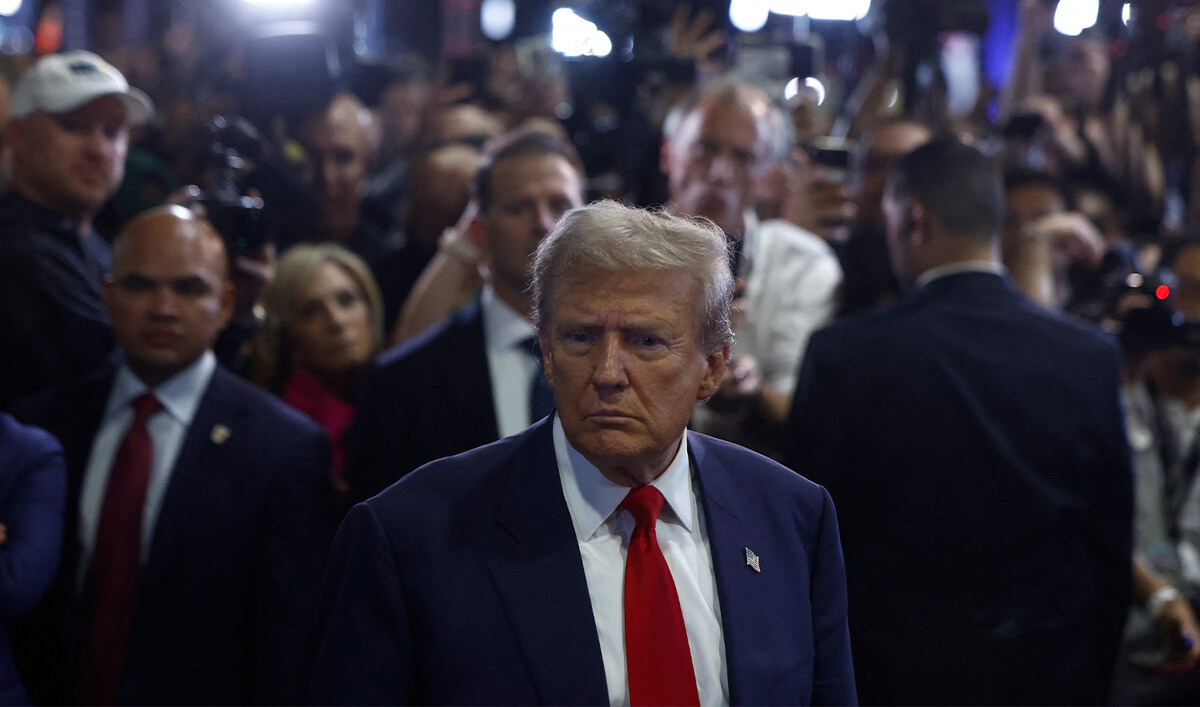
Republican presidential nominee and former U.S. President Donald Trump reacts in the spin room on the day of his debate with Democratic presidential nominee and U.S. Vice President Kamala Harris, in Philadelphia, Pennsylvania, U.S., on September 10, 2024. (REUTERS)
RACIAL DIVIDE
Deep into the debate, the long-simmering topic of race came up. Trump was asked why he had publicly questioned Harris’ dual heritage as a Black and South Asian woman.
“I don’t care what she is,” he responded. “I read that she was Black. Then I read that she was not Black.”
Asked to respond, Harris accused Trump of using race to divide Americans throughout his career. She cited how he and his father turned away Black renters in the 1970s and how Trump led the public outcry against five young Black and Latino men who were wrongly convicted of assaulting a jogger in New York City’s Central Park in 1989.
More recently, he openly questioned whether President Barack Obama was a US citizen, Harris noted.
“I think it’s a tragedy that we have someone who wants to be president who has, consistently, over the course of his career, attempted to use race to divide the American people,” she said.
“I think the American people want better than that,” Harris added. “We don’t want a leader who is constantly trying to have Americans point their fingers at each other.”
Instead of trying to defend his record, Trump pivoted back to the economy and tried to pin Biden’s economic policies on Harris. “She’s trying to get away from Biden,” he said.
Harris used the attack to pitch herself again as a change agent.
“Clearly, I am not Joe Biden, and certainly not Donald Trump,” Harris said, “and what I do offer is a new generation of leadership for our country.”
HANDSHAKE
Heading into the debate, there was a question as to how Harris and Trump, who have never met, would greet each other.
Harris settled the issue, definitively. She walked over to Trump at his podium, extended her hand and introduced herself as “Kamala Harris.”
It was a disarming way for Harris to approach a man who has spent weeks insulting her race and gender.
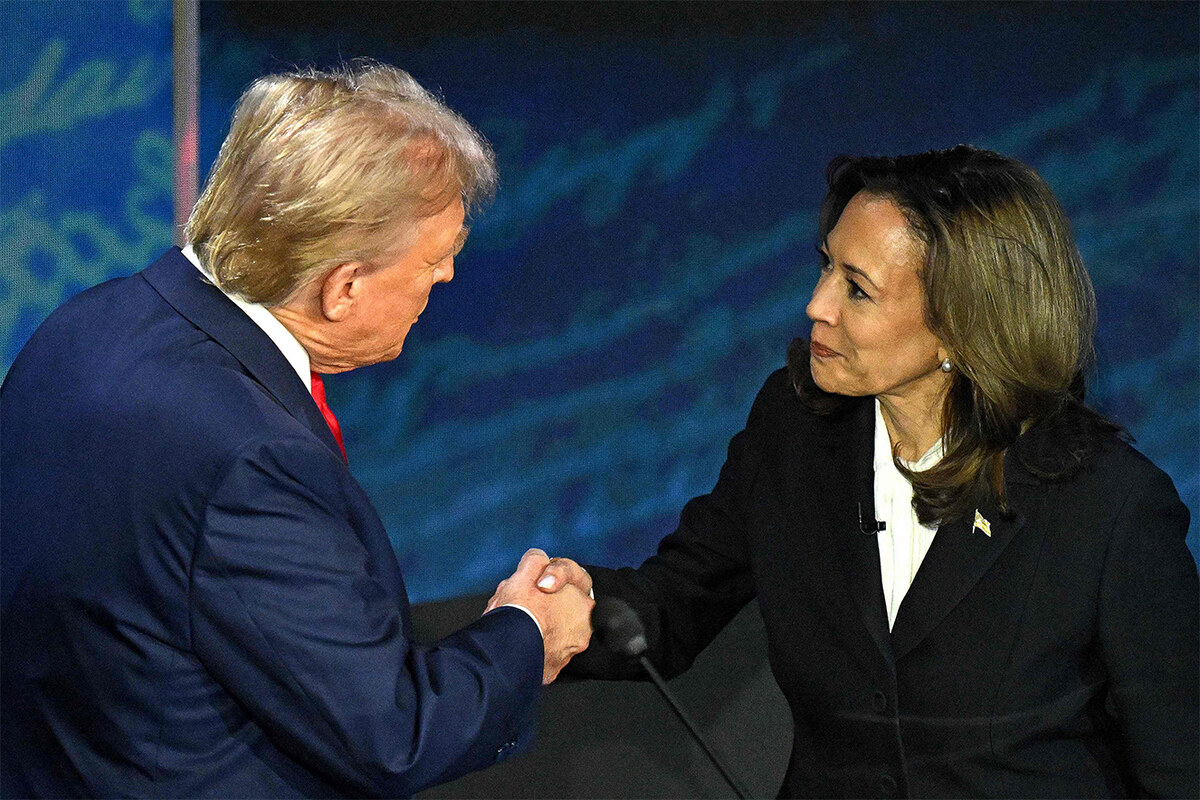
US Vice President and Democratic presidential candidate Kamala Harris (R) shakes hands with former US President and Republican presidential candidate Donald Trump during a presidential debate at the National Constitution Center in Philadelphia, Pennsylvania, on September 10, 2024. (AFP)
SPARRING ON THE ECONOMY
In the debate’s opening minutes, Trump and Harris went to battle on one of the issues that is top of mind for voters: the economy.
Harris detailed the economic policies she has rolled out in recent weeks, which include a substantial tax credit for small start-ups. Trump focused his comments on tariffs, saying he would protect the American economy from unfair foreign competition.
While both sides got their jabs in, Harris got to speak first on a topic where she trails Trump in terms of voter trust. She appeared to force the former president onto his back foot, and Trump essentially played defense on one of his strongest issues.
“She doesn’t have a plan” Trump said, after Harris’ opening comments. “It’s like Run, Spot, Run.”
A SCHISM ON ABORTION
The two candidates also engaged in a fractious debate about abortion, an issue where polls show Harris has the upper hand.
Trump defended the US Supreme Court’s 2022 ruling that ended constitutional protection for abortion and sent the issue back to individual states, arguing, incorrectly, that it was an outcome desired by both Republicans and Democrats. Democrats have long supported a constitutional right to abortion.
“I did a great service in doing it. It took courage to do it,” Trump said.
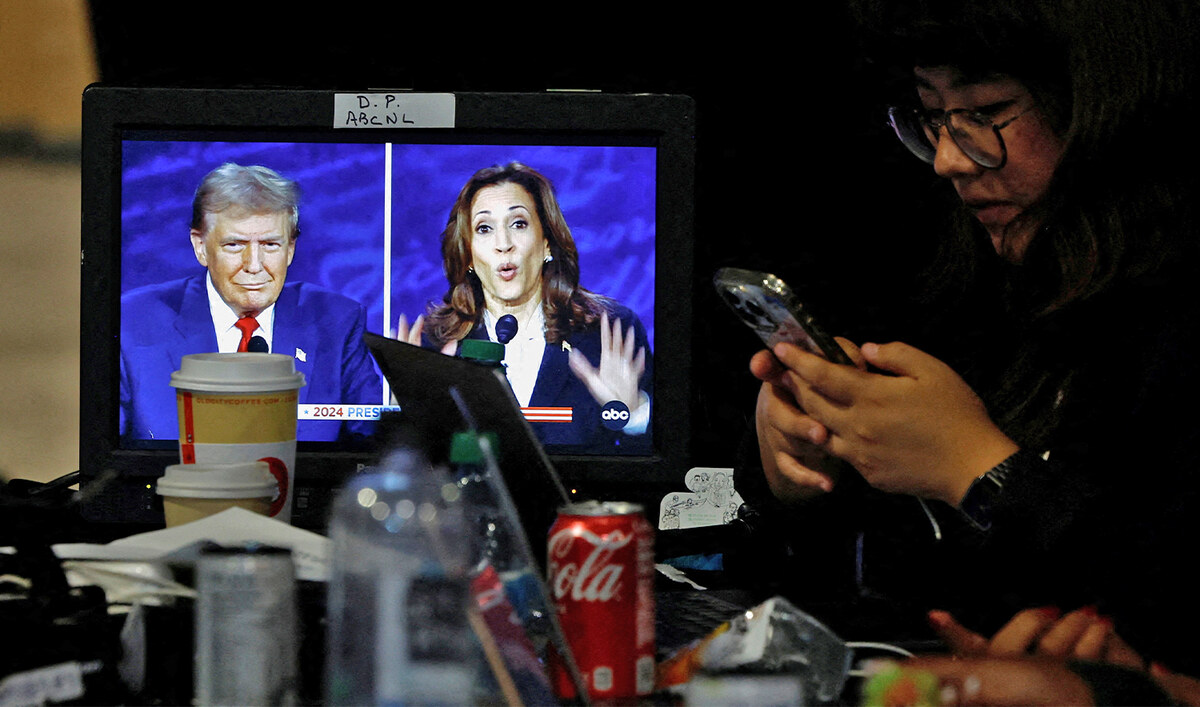
A member of the media uses phone as a screen displays the presidential debate, as Republican presidential nominee, former U.S. President Donald Trump and Democratic presidential nominee, U.S. Vice President Kamala Harris attend a presidential debate hosted by ABC in Philadelphia, Pennsylvania, U.S., on September 10, 2024. (REUTERS)
Trump contended that some states allow babies to be aborted after birth, a point corrected by ABC News moderator, Linsey Davis.
Harris flashed some outrage at Trump’s assertion that abortion becoming a states-rights issue was a popular result, referring to states that have passed restrictive bans.
“This is what people wanted?” Harris asked. “People being denied care in an emergency room because health care providers are being afraid of being hauled off to jail?“
Trump was asked whether he would veto a federal abortion ban if one were passed by Congress. He insisted it would never happen, but refused to answer the question definitively.
WORLDS APART
One of the most heated policy discussions came when Trump and Harris clashed over how they would handle Russia’s ongoing invasion of Ukraine.
The candidates’ responses revealed the degree to which their views on America’s role in the world fundamentally differ.
Trump refused to say he wanted Ukraine to win the war, even as ABC moderator David Muir pushed him on the point, saying only that he wanted to wrap up the conflict as soon as possible.
Harris shot back, arguing that what Trump really wanted was Ukraine’s quick and unconditional capitulation.
“If Donald Trump were president, (Russian President Vladimir) Putin would be sitting in Kyiv right now,” Harris said.
'WEAPONIZED’ JUSTICE
In one heated exchange, Trump and Harris accused each other of conspiring to “weaponize” the Justice Department in a bid to go after their enemies.
Trump said the indictments he faces for conspiring to overturn his 2020 election loss and for his mishandling of classified documents — as well as his conviction for forging documents related to hush money payments to a porn star — are all the result of a conspiracy cooked up by Harris and Biden. There is no evidence for that assertion.
Harris shot back by pointing out that Trump has promised to prosecute his enemies if he wins a second term.
“Understand this is someone who has openly said he would terminate, I’m quoting, terminate the Constitution,” Harris said.
The exchange underlined how Harris and Trump see the stakes of this election as existential. Both see their opponent as a threat to democracy itself.


