

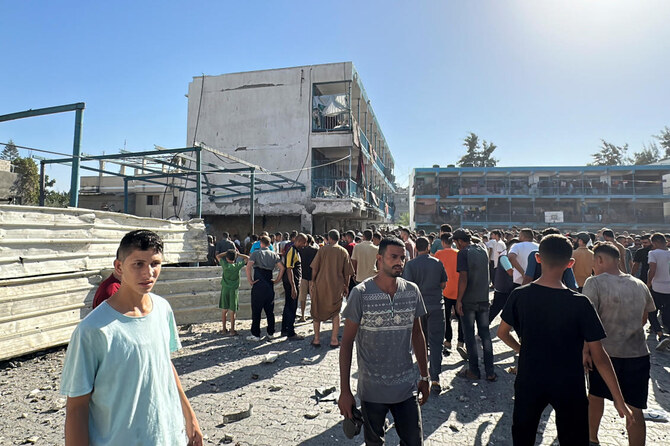
Israeli airstrikes hit UN school and homes in Gaza, killing at least 34 people, hospitals say

Palestinians inspect a school sheltering displaced people, after it was hit by an Israeli strike, in Nuseirat in the central Gaza Strip, on Sept. 11, 2024. (Reuters)
Short Url
Updated 12 September 2024
Follow

Israeli airstrikes hit UN school and homes in Gaza, killing at least 34 people, hospitals say

  • Strike targeted the UN’s Al-Jawni Preparatory Boys School in central Gaza’s Nuseirat refugee camp
  • The Israeli military said it was targeting Hamas militants planning attacks from inside the school

DEIR AL-BALAH, Gaza Strip: Israeli airstrikes across Gaza overnight and Wednesday hit a UN school sheltering displaced Palestinian families as well as two homes, killing at least 34 people, including 19 women and children, hospital officials said.
The deadliest strike came Wednesday afternoon, targeting the UN’s Al-Jawni Preparatory Boys School in central Gaza’s Nuseirat refugee camp. The Israeli military said it was targeting Hamas militants planning attacks from inside the school. The claim could not be independently confirmed.
At least 14 dead from the strike, including two children and a woman, were brought to Awda and Al-Aqsa Martyrs hospitals nearby, officials from the facilities said. At least 18 people were wounded in the strike, they said.
One of the children killed was the daughter of Momin Selmi, a member of Gaza’s civil defense agency, which works rescuing wounded and bodies after strikes, the agency said in a statement. Selmi hadn’t seen his daughter for 10 months, since he remained in north Gaza to keep working while his family fled south, the agency said.

Tens of thousands of Palestinians driven from their homes by Israeli offensives and evacuation orders are living in Gaza’s schools. The Al-Jawni school, one of many in Gaza run by the UN agency for Palestinians UNWRA, has been hit by multiple strikes over the course of the war.
Israel frequently bombs schools, saying they are being used by Hamas militants. It blames Hamas for civilian casualties from its strikes, saying its fighters base themselves and operate within dense residential neighborhoods.
More than 90 percent of Gaza’s school buildings have been severely or partially damaged in strikes, and more than half the schools housing displaced people have been hit, according to a survey in July by the Education Cluster, a collection of aid groups led by UNICEF and Save the Children.
Israel’s 11-month-old campaign in Gaza has killed at least 41,084 Palestinians and wounded another 95,029, the territory’s Health Ministry said Wednesday. Israel launched its campaign vowing to destroy Hamas after the Oct. 7 attack on southern Israel, in which militants killed some 1,200 people and abducted 250 others.
Earlier Wednesday, a strike hit a home near the southern Gaza city of Khan Younis, killing 11 people, including six brothers and sisters from the same family ranging in age from 21 months to 21 years old, according to the European Hospital, which received the casualties.
A strike late Tuesday on a home in the urban Jabaliya refugee camp in northern Gaza killed nine people, including six women and children, according to the Gaza Health Ministry and the civil defense. The civil defense said the home belonged to Akram Al-Najjar, a professor at the Al-Quds Open University, who survived the strike.


Thousands of Gaza children suffer from famine conditions

Updated 09 December 2025
Follow

Thousands of Gaza children suffer from famine conditions

  • “The number of children admitted is five times higher than in February, so we need to see the numbers come down further”

GENEVA: Thousands of children have been admitted for treatment for acute malnutrition in Gaza since an October ceasefire that was supposed to enable a major increase in humanitarian aid, the UN children’s agency said on Tuesday.
UNICEF, the biggest provider of malnutrition treatment in Gaza, said that 9,300 children were treated for severe acute malnutrition in October, when the first phase of an agreement to end the two-year Israel-Hamas war came into effect.

FASTFACTS

• UNICEF, the biggest provider of malnutrition treatment in Gaza, said that 9,300 children were treated for severe acute malnutrition in October. • While this is down from a peak of over 14,000 in August, the number is still significantly higher than during a brief February-March ceasefire.

While this is down from a peak of over 14,000 in August, the number is still significantly higher than during a brief February-March ceasefire and indicates that aid flows remain insufficient, UNICEF spokesperson Tess Ingram told a Geneva press briefing by video link from Gaza.
“It’s still a shockingly high number,” she said.
“The number of children admitted is five times higher than in February, so we need to see the numbers come down further.” Ingram described meeting underweight babies weighing less than 1 kilogram born in hospitals “their tiny chests heaving with the effort of staying alive.”
UNICEF is able to import considerably more aid into the enclave than it was before the October 10 agreement but obstacles remain, she said, citing delays and denials of cargoes at crossings, route closures and ongoing security challenges.
“We have seen some improvement, but we continue to call for all of the available crossings into the Gaza Strip to be open,” she added. There are not enough commercial supplies entering Gaza, she added, saying that meat was still prohibitively expensive at around $20 a kilogram.
“Most families can’t access this, and that’s why we’re still seeing high rates of malnutrition,” she said.
In August, a UN-backed hunger monitor determined that famine conditions were affecting about half a million people — or a quarter of Gaza’s population.
Children were severly affected by hunger as the war progressed, with experts warning that the effects could cause lasting damage.