

UN investigator accuses Israel of a ‘starvation campaign’ in Gaza that Netanyahu denies

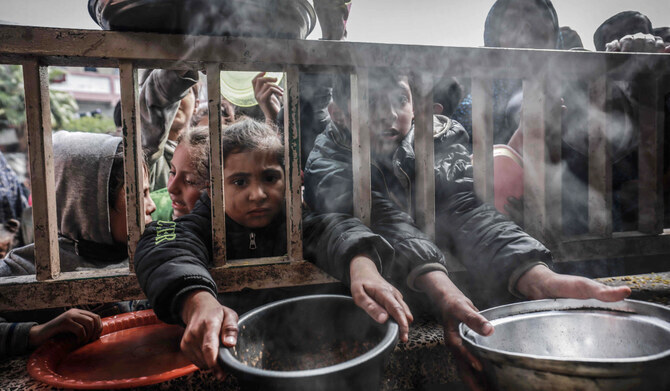
Displaced Palestinian children gather to receive food at a government school in Rafah in the southern Gaza Strip on February 19, 2024, amid the ongoing battles between Israel and Hamas. (AFP/File)
Short Url
Updated 07 September 2024
Follow

UN investigator accuses Israel of a ‘starvation campaign’ in Gaza that Netanyahu denies

  • ‘Never in post-war history population been made to go hungry so quickly as 2.3 million Palestinians living in Gaza,’ UN investigator says
  • Israeli Prime Minister Benjamin Netanyahu says accusations of Israel limiting humanitarian aid for people in Gaza ‘outrageously false’

UNITED NATIONS: The UN independent investigator on the right to food accused Israel of carrying out a “starvation campaign” against Palestinians during the war in Gaza, an allegation that Israel vehemently denies.
In a report this week, investigator Michael Fakhri claimed it began two days after Hamas’ surprise attack in southern Israel that killed some 1,200 people, when Israel’s military offensive in response blocked all food, water, fuel and other supplies into Gaza.
Israeli Prime Minister Benjamin Netanyahu said accusations of Israel limiting humanitarian aid were “outrageously false.”
“A deliberate starvation policy? You can say anything — it doesn’t make it true,” he said in a press conference Wednesday.


Palestinians are storming trucks loaded with humanitarian aid brought in through a new U.S.-built pier, in the central Gaza Strip, May 18, 2024. (AP)

Following intense international pressure — especially from close ally the United States — Netanyahu’s government gradually has opened several border crossings for tightly controlled deliveries. Fakhri said limited aid initially went mostly to southern and central Gaza, not to the north where Israel had ordered Palestinians to go.
A professor at the University of Oregon School of Law, Fakhri was appointed by the Geneva-based UN Human Rights Council as the investigator, or special rapporteur, on the right to food and assumed the role in 2020.
“By December, Palestinians in Gaza made up 80 percent of the people in the world experiencing famine or catastrophic hunger,” Fakhri said. “Never in post-war history had a population been made to go hungry so quickly and so completely as was the case for the 2.3 million Palestinians living in Gaza.”
Fakhri, who teaches law courses on human rights, food law and development, made the allegations in a report to the UN General Assembly circulated Thursday.


This image grab from an AFPTV video shows Palestinians running toward parachutes attached to food parcels, air-dropped from US aircrafts on a beach in the Gaza Strip on March 2, 2024. (AFP)

He claims it goes back 76 years to Israeli’s independence and its continuous dislocation of Palestinians. Since then, he accused Israel of deploying “the full range of techniques of hunger and starvation against the Palestinians, perfecting the degree of control, suffering and death that it can cause through food systems.”
Since the war in Gaza began, Fakhri said he has received direct reports of the destruction of the territory’s food system, including farmland and fishing, which also has been documented and recognized by the UN Food and Agriculture Organization and others.
“Israel then used humanitarian aid as a political and military weapon to harm and kill the Palestinian people in Gaza,” he claimed.
Israel insists it no longer places restrictions on the number of aid trucks entering Gaza, including food.
At Wednesday’s press conference, Netanyahu cited figures from COGAT, Israel’s military body overseeing aid entry into Gaza, that 700,000 tons of food items had been allowed into Gaza since the war began 11 months ago.
Nearly half of that food aid in recent months has been brought in by the private sector for sale in Gaza’s markets, according to COGAT figures. However, many Palestinians in Gaza say they struggle to afford enough food for their families.
Israel allows trucks of aid through two small crossings in the north and one main crossing in the south, Kerem Shalom. However, since Israel’s invasion of the southern city of Rafah in May, the UN and other aid agencies say they struggle to reach the Gaza side of Kerem Shalom to retrieve the aid for free distribution because Israel’s military operations make it too dangerous.
UN spokesman Stephane Dujarric called the humanitarian situation in Gaza “beyond catastrophic,” with more than 1 million Palestinians not receiving any food rations in August and a 35 percent drop in people getting daily cooked meals.
The UN humanitarian office attributed the sharp reduction in cooked meals partly to multiple evacuation orders from Israeli security forces that forced at least 70 of 130 kitchens to either suspend or relocate their operations, he said Thursday. The UN’s humanitarian partners also lacked sufficient food supplies to meet requirements for the second straight month in central and southern Gaza, Dujarric added.
He said critical shortages of supplies in Gaza are stem from hostilities, insecurity, damaged roads, and Israeli obstacles and access limitations.


Saad Hariri pledges to contest May election

Updated 14 February 2026
Follow

Saad Hariri pledges to contest May election

  • Beirut rally draws large crowds on anniversary of his father’s assassination

BEIRUT: Lebanon’s former Prime Minister Saad Hariri announced on Saturday that his movement, which represents the majority of Lebanon’s Sunni community, would take part in upcoming parliamentary elections scheduled for May.

The Future Movement had suspended its political activities in 2022.

Hariri was addressing a large gathering of Future Movement supporters as Lebanon marked the 21st anniversary of the assassination of his father and former Prime Minister Rafik Hariri, at Martyrs’ Square in front of his tomb.

He said his movement remained committed to the approach of “moderation.”

A minute’s silence was observed by the crowd in Martyrs’ Square at the exact time when, in 2005, a suicide truck carrying about 1,000 kg of explosives detonated along Beirut’s seaside road as Rafik Hariri’s motorcade passed, killing him along with 21 others, including members of his security guards and civilians, and injuring 200 people.

Four members of Hezbollah were accused of carrying out the assassination and were tried in absentia by the Special Tribunal for Lebanon.

The crowd waved Lebanese flags and banners of the Future Movement as they awaited Saad Hariri, who had returned to Beirut from the UAE, where he resides, specifically to commemorate the anniversary, as has been an annual tradition.

Hariri said that “after 21 years, the supporters of Hariri’s approach are still many,” denouncing the “rumors and intimidation” directed at him.

He added: “Moderation is not hesitation … and patience is not weakness. Rafik Hariri’s project is not a dream that will fade. He was the model of a statesman who believed, until martyrdom, that ‘no one is greater than their country.’ The proof is his enduring place in the minds, hearts and consciences of the Lebanese people.”

Hariri said he chose to withdraw from political life after “it became required that we cover up failure and compromise the state, so we said no and chose to step aside — because politics at the expense of the country’s dignity and the project of the state has no meaning.”

He said: “The Lebanese are weary, and after years of wars, divisions, alignments and armed bastions, they deserve a normal country with one constitution, one army, and one legitimate authority over weapons — because Lebanon is one and will remain one. Notions of division have collapsed in the face of reality, history and geography, and the illusions of annexation and hegemony have fallen with those who pursued them, who ultimately fled.”

Hariri said the Future Movement’s project is “One Lebanon, Lebanon first — a Lebanon that will neither slide back into sectarian strife or internal fighting, nor be allowed to do so.”

He added that the Taif Agreement is “the solution and must be implemented in full,” arguing that “political factions have treated it selectively by demanding only what suits them — leaving the agreement unfulfilled and the country’s crises unresolved.”

He said: “When we call for the full implementation of the Taif Agreement, we mean: weapons exclusively in the hands of the state, administrative decentralization, the abolition of political sectarianism, the establishment of a senate and full implementation of the truce agreement. All of this must be implemented — fully and immediately — so we can overcome our chronic problems and crises together.

“Harirism will continue to support any Arab rapprochement, and reject any Arab discord. Those who seek to sow discord between the Gulf and Arab countries will harm only themselves and their reputation.

“We want to maintain the best possible relations with all Arab countries, starting with our closest neighbor, Syria — the new Syria, the free Syria that has rid itself of the criminal and tyrannical regime that devastated it and Lebanon, and spread its poison in the Arab world.”

Hariri said he saluted “the efforts of unification, stabilization and reconstruction led by Syrian President Ahmad Al-Sharaa.”

When asked about the Future Movement’s participation in parliamentary elections following his withdrawal from politics, he said: “Tell me when parliamentary elections will be held, and I will tell you what the Future Movement will do. I promise you that, when the elections take place, they will hear our voices, and they will count our votes.”

The US Embassy in Lebanon shared a post announcing that Ambassador Michel Issa laid a wreath at the grave of Rafik Hariri.

Hariri’s legacy “to forge peace and prosperity continues to resonate years later with renewed significance,” the embassy said.