KYIV, Ukraine: The head of the United Nations’ nuclear watchdog on Tuesday described the situation at Europe’s largest nuclear power plant as “very fragile” following fresh attacks near the site in central Ukraine, and vowed to expand the agency’s inspections to include critical electricity supplies.
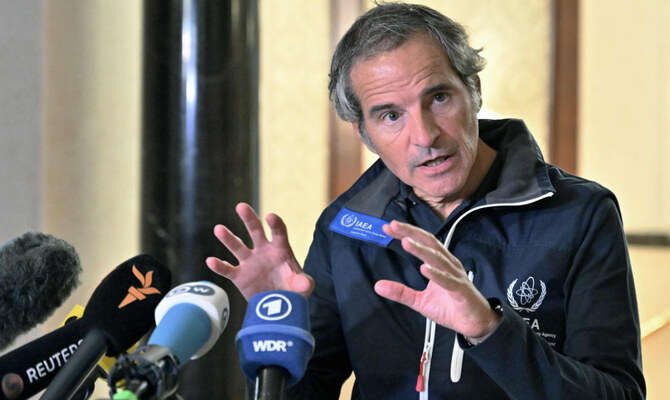
Rafael Mariano Grossi, the director-general of the International Atomic Energy Agency, was making his 10th visit to Ukraine since the Russia-Ukraine war began in February 2022.
He was headed to the Zaporizhzhia Nuclear Power Plant after talks in Kyiv with Ukrainian President Volodymyr Zelensky and top energy officials.
“I think the situation – I have very often characterized it – as very fragile,” Grossi told reporters in the Ukrainian capital. “The station is again on the verge of being on a blackout. We’ve had eight of those in the past. A blackout (means) no power: no power, no cooling. No cooling, then maybe you have a disaster.”
Earlier, Grossi posted on X that he was on his way to Zaporizhzhia to “help prevent a nuclear accident.”
The Zaporizhzhia plant, which came under Russian control in the wake of its full-scale invasion, saw artillery shelling in the area on Monday that damaged the facility’s power access, according to its operator Energoatom, which blamed Russia for the attacks.
“Russian shelling damaged one of the two external overhead lines through which … the Zaporizhzhya NPP receives power from the Ukrainian power system,” the operator said in a post on Telegram. “In the event of damage to the second line, an emergency situation will arise,” the Ukrainian agency said, adding that technicians couldn’t access the site of the damage because of the “real threat of repeated shelling.”
Analysts say an explosion at the Zaporizhzhia plant would produce radiation and likely trigger panic, but the radiation risk beyond the immediate blast area would be relatively low and nothing like the scale of the 1986 Chernobyl disaster. Also, if the wind is in an easterly direction, radiation could be pushed toward Russia.
The Zaporizhzhia region is one of four — along with Donetsk, Kherson and Luhansk — in southern and eastern Ukraine that Russia partly, and illegally, annexed in September 2022, seven months after it invaded its neighbor.
The Vienna-based IAEA says ongoing attacks in the Zaporizhzhia area, as well as damage to Ukraine’s grid, pose threats to the power supply that’s vital to the country’s nuclear power stations. The watchdog said its staff at Zaporizhzhia recently had to shelter indoors because of reported drone threats in the area.
Other than Zaporizhzhia, Ukraine has three active nuclear plants.
Grossi, who is traveling with a team of IAEA experts and officials, began a round of meetings in Kyiv with a stop at the Ministry of Energy and talks with the minister, Herman Halushchenko. Grossi said he had accepted a Ukrainian request to expand inspections to include electricity substations providing power to Ukraine’s nuclear power plants. He did not give further details but told reporters: “This is a new dimension, an important dimension I hope, of our support here, which we discussed and agreed with President Zelensky just now.” ___ Illia Novikov in Kyiv, Ukraine, contributed.

UN nuclear watchdog warns conditions ‘very fragile’ at Ukraine’s Zaporizhzhia power plant
https://arab.news/cbtwp
UN nuclear watchdog warns conditions ‘very fragile’ at Ukraine’s Zaporizhzhia power plant
- Analysts say an explosion at the Zaporizhzhia plant would produce radiation and likely trigger panic, but the radiation risk beyond the immediate blast area would be relatively low
US, Ukraine officials say they’ll meet for 3rd day after progress on creating a security framework
- Witkoff and Kushner’s talks in Florida with Umerov, Ukraine’s lead negotiator, and Hnatov follow discussions between President Vladimir Putin and the US envoys at the Kremlin on Tuesday
WASHINGTON: President Donald Trump’s advisers and Ukrainian officials say they’ll meet for a third day of talks on Saturday after making progress on finding agreement on a security framework for postwar Ukraine.
The two sides also offered the sober assessment that any “real progress toward any agreement” ultimately will depend “on Russia’s readiness to show serious commitment to long-term peace.”
The statement from US special envoy Steve Witkoff, Trump’s son-in-law Jared Kushner as well as Ukrainian negotiators Rustem Umerov and Andriy Hnatov came after they met for a second day in Florida on Friday. They offered only broad brushstrokes about the progress they say has been made as Trump pushes Kyiv and Moscow to agree to a US-mediated proposal to end nearly four years of war.
“Both parties agreed that real progress toward any agreement depends on Russia’s readiness to show serious commitment to long-term peace, including steps toward de-escalation and cessation of killings,” the statement said. “Parties also separately reviewed the future prosperity agenda which aims to support Ukraine’s post-war reconstruction, joint US–Ukraine economic initiatives, and long-term recovery projects.”
The US and Ukrainian officials also discussed “deterrence capabilities” that Ukraine will need “to sustain a lasting peace.”
Witkoff and Kushner’s talks in Florida with Umerov, Ukraine’s lead negotiator, and Hnatov follow discussions between President Vladimir Putin and the US envoys at the Kremlin on Tuesday.
Friday’s session took place at the the Shell Bay Club in Hallandale Beach, a high-end private golf and lifestyle destination owned by Witkoff’s real estate development company.
Previous diplomatic attempts to break the deadlock have come to nothing and the war has continued unabated. Officials largely have kept a lid on how the latest talks are going, though Trump’s initial 28-point plan was leaked.
Ukrainian President Volodymyr Zelensky said his country’s delegation in Florida wanted to hear from the US side about the talks at the Kremlin.
Zelensky, as well as European leaders backing him, have repeatedly accused Putin of stalling in peace talks while the Russian army tries to press forward with its invasion. Zelensky said in a video address late Thursday that officials wanted to know “what other pretexts Putin has come up with to drag out the war and to pressure Ukraine.”
Speaking to Russian journalist Pavel Zarubin on Friday, Kremlin foreign affairs adviser Yuri Ushakov praised Kushner as potentially playing an important role in ending Russia’s invasion of Ukraine. Ushakov also took part in Tuesday’s talks at the Kremlin.
“If any plan leading to a settlement is put on paper, it will be the pen of Mr. Kushner that will lead the way,” Ushakov said.
The flattering comments about Kushner by the senior Russian official come as Putin has sought to sow division between Trump and Ukraine and Europe at a moment when Trump’s impatience with the conflict is mounting. Putin said his five-hour talks this week with Witkoff and Kushner were “necessary” and “useful,” but some proposals were unacceptable.
Kushner, who is married to Trump’s daughter Ivanka, was a senior adviser to Trump during his first term and was the president’s point person on developing the Abraham Accords, which formalized commercial and diplomatic ties between Israel and a trio of Arab nations.
Kushner has played a more informal role in Trump’s second go-around, but he helped Witkoff close out ceasefire and hostage negotiations between Israel and Hamas this fall. Trump tapped Kushner again to pair up with Witkoff to try to find an endgame to Russia’s invasion of Ukraine.
The European take on the peace talks
Ushakov, who accompanied Putin on a visit to India on Friday, repeated the Russian president’s recent criticism of Europe’s stance on the peace talks. Kyiv’s European allies are concerned about possible Russian aggression beyond Ukraine and want a prospective peace deal to include strong security guarantees.
Kyiv’s allies in Europe are “constantly putting forward demands that are unacceptable to Moscow,” Ushakov told Russia’s state-owned Zvezda TV. “Putting it mildly, the Europeans don’t help Washington and Moscow reach a settlement on the Ukrainian issues.”
French President Emmanuel Macron said Friday that he made progress during a visit to Beijing on getting Chinese leader Xi Jinping’s support for peace efforts.
“We exchanged deeply and truthfully on all points, and I saw a willingness from the (Chinese) president to contribute to stability and peace,” Macron said.
The French president said he stressed that Ukraine needs guarantees that Russia won’t attack it again if a settlement is reached and that Europe must have a voice in negotiations.
“The unity between Americans and Europeans on the Ukrainian issue is essential. And I say it, repeat it, emphasize it. We need to work together,” Macron said.
The latest drone attacks
Russian drones struck a house in central Ukraine, killing a 12-year-old boy, officials said, while long-range Ukrainian strikes reportedly targeted a Russian port and an oil refinery.
The Russian attack on Thursday night in Ukraine’s central Dnipropetrovsk region destroyed the house where the boy was killed and also two women were injured, according to the head of the regional military administration, Vladyslav Haivanenko.
The Ukrainian air force said Russia fired 137 drones of various types during the night.
Ukrainian drones attacked a port and an oil refinery inside Russia overnight as part of Kyiv’s campaign to disrupt Russian logistics, Ukraine’s general staff said.
The drones struck Temriuk sea port in Russia’s Krasnodar region and the Syzran oil refinery in the Samara region, starting blazes, a statement said. Syzran is about 800 kilometers (500 miles) east of the border with Ukraine.
The Russian Defense Ministry said only that its air defenses intercepted 85 Ukrainian drones over Russian regions and Crimea, which Russia illegally annexed in 2014.


