


KYIV: Kyiv launched one of the biggest drone attacks on Russia since the full-scale war began, targeting power plants and an oil refinery overnight, while Moscow’s forces made further advances toward a key town in eastern Ukraine, officials said on Sunday.
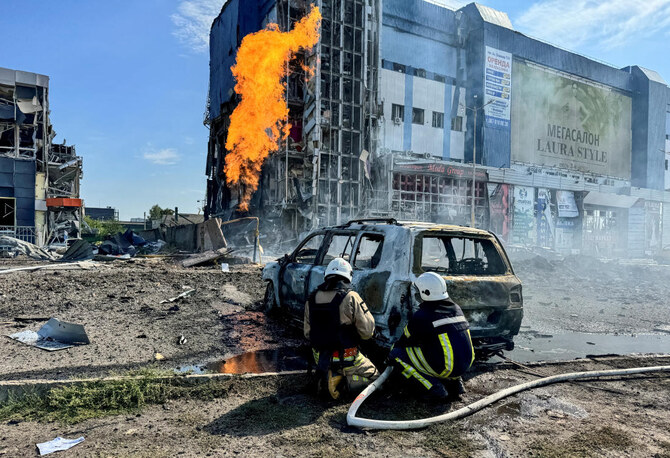
Russian missile strikes on Kharkiv injured more than 40 people, including five children, prompting Ukrainian President Volodymyr Zelensky to renew calls on allies to allow Kyiv to fire Western-supplied missiles deeper into enemy territory and reduce the threat of attack.
The fighting comes at a critical juncture in the two-and-a-half year conflict, with Russia pressing an offensive in eastern Ukraine while trying to expel Ukrainian forces that broke through its western border in a surprise incursion on Aug. 6.
Russia last week pounded Ukraine with its heaviest air strikes of the war, hitting energy facilities, part of a campaign of drone and missile barrages that have killed thousands of civilians and troops since the conflict began in February 2022.
Ukraine, with a rapidly expanding domestic drone industry, has stepped up its own attacks on Russian energy, military and transport infrastructure.
It is also pressing the United States and other allies for permission to use more powerful Western-supplied weapons to inflict greater damage inside Russia and impair Moscow’s abilities to attack Ukraine.
“All necessary forces for the rescue operation have been brought in,” Zelensky said on his Telegram channel, in response to the Kharkiv attack that officials said involved at least 10 missiles and struck locations including a shopping mall.
“And all the necessary forces of the world must be brought in to stop this terror. This does not require extraordinary forces, but enough courage on the part of the leaders — courage to give Ukraine what it needs to defend itself.”
In Kharkiv, rescue workers and volunteers carried injured civilians to ambulances after missiles struck the mall and an events hall. Shattered glass and debris were strewn across the ground and people fled to a metro station for safety.
Earlier, Russian officials said air defense units had destroyed 158 drones launched by Ukraine overnight, and that debris caused fires at the Moscow Oil Refinery and at the Konakovo Power Station in the neighboring Tver region.
Reuters could not independently verify the reports of drone attacks against Russia or from the battlefield in Ukraine, and Kyiv has yet to comment. Russia rarely discloses the full extent of damage inflicted by Ukraine’s air attacks.
Russia’s nuclear doctrine
Zelensky said that last week alone Russia had used 160 missiles, 780 guided aerial bombs and 400 attack drones against cities and troops across Ukraine.
He called on Telegram for “a decision on long-range strikes on missile launch sites from Russia, destruction of Russian military logistics, joint shooting down of missiles and drones.”
Kyiv’s allies are wary of how Russian President Vladimir Putin would respond should their weapons be used against targets far inside Russian territory.
Russia’s TASS state news cited Deputy Foreign Minister Sergei Ryabkov as saying that Moscow would change its nuclear doctrine in response to the West’s actions over the conflict in Ukraine. He did not specify what the changes would entail.
Russia’s existing nuclear doctrine, set out in a decree by Putin in 2020, says it may use nuclear weapons in the event of a nuclear attack by an enemy or a conventional attack that threatens the existence of the state.
Russia, which accuses the West of using Ukraine as a proxy to wage war against it, has said before that it is considering changes.
“The work is at an advanced stage, and there is a clear intent to make corrections,” TASS cited Ryabkov as saying.
Some hawks among Russia’s military analysts have urged Putin to lower the threshold for nuclear use in order to “sober up” Russia’s enemies in the West.
In eastern Ukraine, where the heaviest fighting of the war is concentrated, Russian forces continued to advance toward Pokrovsk, which is a vital military hub and transport link to towns and cities further north.
Ukraine had hoped that its surprise incursion into Russia’s Kursk region launched last month would force Russia to re-deploy troops and take the pressure off besieged forces in the east, but so far it does not appear to have had the desired effect.
Russia’s defense ministry said on Sunday its forces had captured two more settlements in Donetsk region and were “continuing to advance deep into the enemy defenses.” One of them, Ptyche, is just 21 km (13 miles) southeast of Pokrovsk.
At least three people were killed and nine wounded in Russian shelling of Kurakhove, a town around 35 km south of Pokrovsk, Ukrainian officials said.
Ukraine’s top commander Oleksandr Syrskyi said the situation was “difficult” around Russia’s main line of attack in eastern Ukraine.


