

Pakistan says serious about reform as top economist resigns from austerity committee

In this file photo, taken on June 26, 2024, people stand outside the Parliament house during a budget session in Islamabad. (AFP/File)
Short Url
Updated 02 September 2024
Follow

Pakistan says serious about reform as top economist resigns from austerity committee

  • Austerity committee was formed in Feb. this year to reduce expenditures and implement institutional rightsizing reforms 
  • Dr. Kaiser Bengali resigned from committee on Aug. 29 saying government “lacks the commitment to reducing expenditures”

ISLAMABAD: Pakistan is rightsizing all government positions from basic pay scale 1 to 22 in a bid to reduce official expenditures, the finance ministry said on Sunday, days after a prominent economist resigned from the government’s austerity committee saying it “lacks commitment” to measures aimed at reviving the economy.
Since avoiding a default last year, Pakistan, faced with low forex reserves, currency devaluation and high inflation, has been making desperate attempts to boost trade and investment to revive its $350 economy, and reached a staff-level agreement with the International Monetary Fund (IMF) in July for a new $7 billion loan to keep the dwindling economy afloat.
The South Asian country formed an austerity committee in Feb. this year to reduce expenditures and implement institutional rightsizing reforms and included Dr. Kaiser Bengali, who has a master’s degree in economics from Boston University, the United States, and a PhD degree in economics from the University of Karachi, in the panel in March.
Dr. Bengali resigned from the committee on Aug. 29 and said in his resignation letter, seen by Arab News, to the Institutional Reform Cell (IRC) secretary that the government “lacks the commitment to reducing expenditures,” but the Pakistani finance ministry said on Sunday that Dr. Bengali’s observations on the recently approved recommendations of the committee reflected a “lack of communication.”
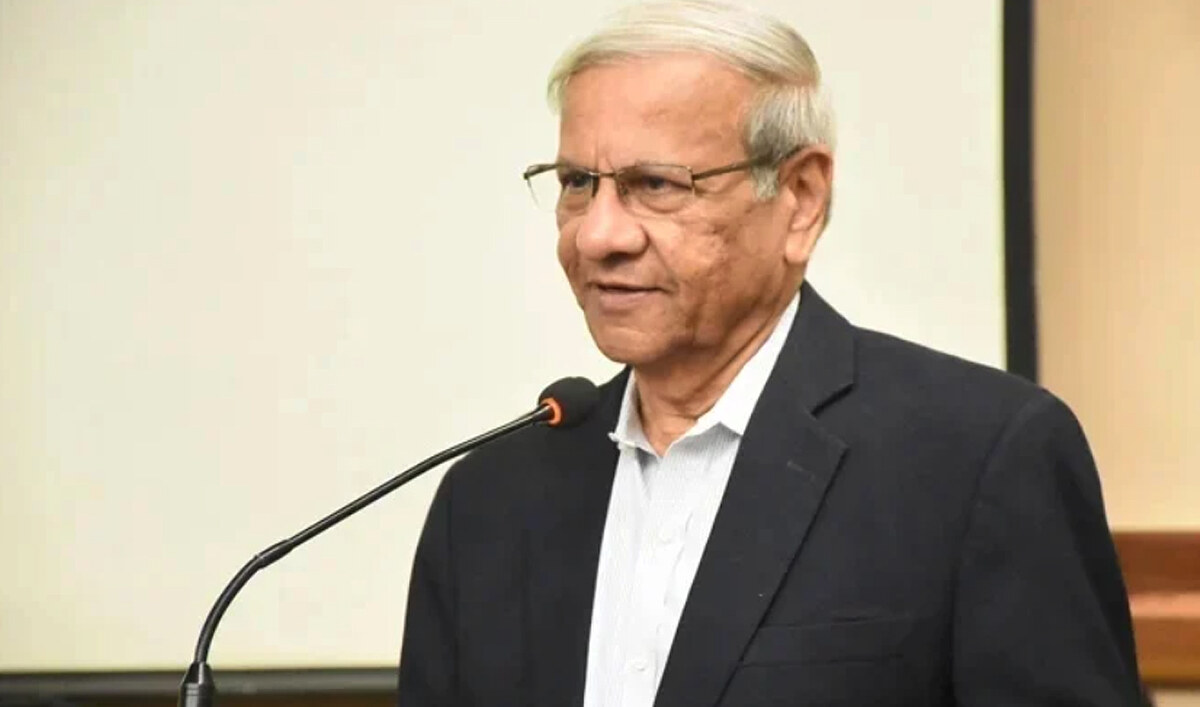


In this file photo, taken on February 20, 2024, Pakistan’s leading economist Dr. Kaiser Bengali speaks at an international conference on the transformation of ideas in Pakistan’s political culture in Karachi. (Photo courtesy: Facebook/Karachi University)

“All government positions in BS-1 to BS-22 are being rightsized, not just positions in BS-1 to 16,” the ministry said, adding that the committee had reviewed six ministries and their entities in the first phase of the rightsizing exercise.
“The estimated 60,000 positions that may be rendered surplus as a result of the exercise also include positions in BS-17 to BS-22.”
The development came a day after Dr. Bengali issued a statement in which he said the government committee had recommended abolishing 150,000 BPS1-16, putting the entire burden of rightsizing on the lower income strata of society, while there was no mention of any of the highly paid positions.
The economist also expressed disappointment that the government committee had only managed to recommend the closure of a “single non-commercial entity” and privatize 17 others out of 70 organizations reviewed in hours-long deliberations.
“The Rightsizing Committee has so far examined six Ministries in the first phase,” the finance ministry said. “One of these Ministries has been approved to be abolished, while two others are being merged, which means that at least two BS-22 and several positions in BS-17 to 21 will be abolished, rendering surplus an equivalent number of officers in same grades.”
It said the government was also working on an “obligatory severance package” in conjunction with requisite amendments in the Civil Servants Act, 1973 to make the package applicable to officials without any favor or preference.
“The rightsizing committee is reviewing ministries, attached departments, autonomous bodies, and state-owned enterprises against the clear criteria assigned to it, objectively and across the board,” the finance ministry added.


Pakistan forces retake Balochistan town using drones, helicopters as violence toll rises

Updated 6 sec ago
Follow

Pakistan forces retake Balochistan town using drones, helicopters as violence toll rises

  • Security forces say 197 BLA militants killed after coordinated attacks across the province
  • Police say additional troops were sent to the remote town of Nushki amid rising violence

QUETTA: Pakistan’s security forces used drones and helicopters to wrest control of a southwestern town from separatist insurgents after a three-day ​battle, police said on Wednesday, as the death toll in the weekend’s violence rose to 58.

Saturday’s wave of coordinated attacks by the separatist Baloch Liberation Army brought Pakistan’s largest province to a near standstill as security forces exchanged fire with insurgents in more than a dozen places, killing 197 militants.

“I thought the roof and walls of my house were going to blow up,” said Robina Ali, a housewife living near the main administrative building in the fortified provincial capital of Quetta, where a powerful morning blast rocked the area.

Fighters of the BLA, the region’s strongest insurgent group, stormed schools, banks, markets and ‌security installations across Balochistan ‌in one of their largest operations ever, killing more than 22 ‌security ⁠officials ​and 36 ‌civilians.

Police officials gave details of the situation on condition of anonymity as they were not authorized to speak to the media.

In the desert town of Nushki, home to about 50,000, the insurgents seized control of the police station and other security installations, triggering a three-day standoff.

Police said seven officers were killed in the fighting before they regained control of the town late on Monday, while operations against the BLA continue elsewhere in the province.

“More troops were sent to Nushki,” said one security official. “Helicopters and drones were used against the militants.”

Pakistan’s ⁠interior ministry did not immediately respond to a Reuters request for comment.

LATE NIGHT ATTACKS

Pakistan’s largest and poorest province, mineral-rich Balochistan borders Iran and ‌Afghanistan and is home to Beijing’s investment in the Gwadar deep-water ‍port and other projects.

It has grappled with a ‍decades-long insurgency led by ethnic Baloch separatists seeking greater autonomy and a larger share of its natural ‍resources.

The BLA, which has urged people of the province to support the movement, said on Tuesday it had killed 280 soldiers during its Operation “Herof,” Black Storm, but gave no evidence.

Security officials said the weekend attacks began at 4 a.m. on Saturday with suicide blasts in Nushki and the fishing port of Pasni and gun and grenade ​attacks in 11 more places, including Quetta.

The insurgents seized at least six district administration offices during the siege and had advanced at one point to within 1 km (3,300 ft) ⁠of the provincial chief minister’s office in Quetta, the police officials said.

EVOLVING INSURGENCY

Pakistan has blamed India for the attacks, without furnishing evidence for charges that could escalate hostilities between the nuclear-powered neighbors who fought their worst armed conflict in decades in May.

India’s foreign ministry has rejected the charges, saying Islamabad should instead tackle the “long-standing demands of its people in the region.”

Retired Lt. General Amir Riaz, who led the military in Balochistan from 2015 to 2017, said the insurgency had evolved over the last decade.

He added that it gained strength as the BLA received Indian support and used Afghanistan as a staging ground for its attacks, a charge the Taliban government has denied.

Riaz said the conflict would oscillate between stalemate and periods of heightened violence.

“It has escalated. The response will be decisive, leading to serious capacity degradation of BLA,” he said, denying that the Pakistani military ‌has used excessive force in Balochistan.

“However, ultimately the issues are only resolved through political process and governance.”