

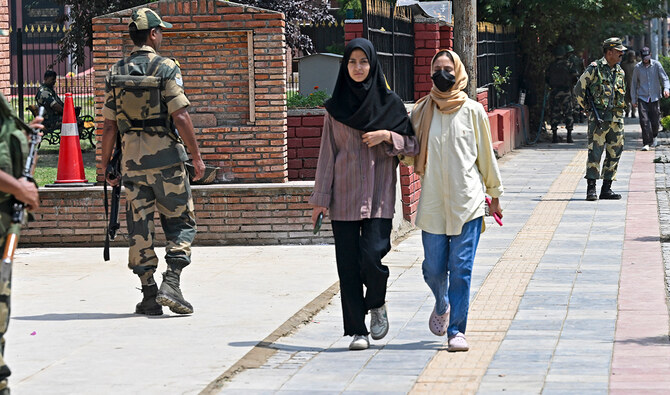

ISLAMABAD: Pakistan Foreign Secretary Muhammad Syrus Sajjad Qazi has informed the Organization of Islamic Cooperation (OIC) about the situation in Indian-administered Kashmir, said an official statement on Friday, noting that New Delhi was trying to strengthen control over the disputed Himalayan region by fostering an “environment of intimidation and fear.”
Qazi led his country’s delegation to the two-day OIC Council of Foreign Ministers (CFM) meeting on August 29-30 in Cameroon, where he discussed Israel’s ongoing military campaign against Palestinians while demanding an immediate ceasefire.
On the sidelines, he also briefed a meeting of the OIC Contact Group on Kashmir, chaired by Secretary General Hissein Brahim Taha, about the situation on the Indian side of Kashmir, which witnessed administrative changes in 2019 when Prime Minister Narendra Modi’s government revoked its special constitutional status, leading to heightened tensions with Pakistan.
The Muslim-majority Kashmir region is divided between nuclear-armed India and Pakistan, with both countries claiming it in its entirety.
“The foreign secretary outlined India’s attempt to consolidate its occupation of Indian-administered Kashmir in violation of the relevant Security Council resolutions including by creating an environment of intimidation and fear,” the foreign office said in a statement.
Qazi urged India to release all political prisoners and lift curbs on political parties, as he referred to some of the measures taken by New Delhi since revoking the region’s special constitutional status.
“The Contact Group also adopted a joint communique unanimously underlining that durable peace and stability in South Asia remain contingent upon the final settlement of the Jammu and Kashmir dispute per UN Security Council resolutions,” the statement said.
New Delhi decided to annul Article 370 of the Indian constitution in 2019, which granted limited autonomy to Kashmiris under the Indian Union. It also struck down Article 35A, which prohibited the purchase of property by people from outside the disputed territory.
Pakistani officials have claimed the latter step was taken to change the region’s demography.
India is now preparing to hold the first regional elections in a decade between September 18 and October 1, allowing the residents of Kashmir to elect their government, also known as a local assembly, instead of remaining under New Delhi’s direct rule.
The vote count will be held on October 4.


