

Pakistan FM discusses regional situation with Saudi counterpart, urges restraint and dialogue

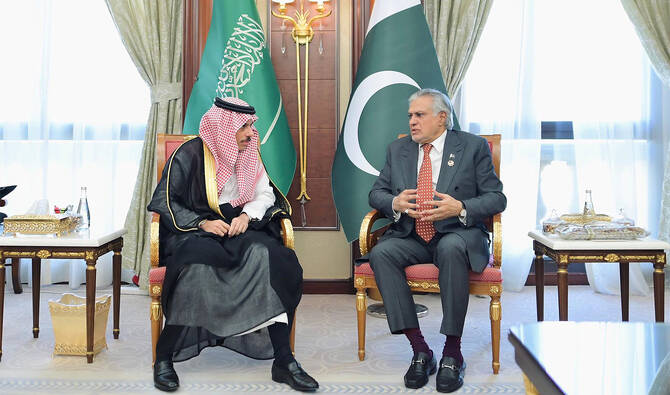
Pakistan's Deputy Prime Minister and Foreign Minister, Muhammad Ishaq Dar (right) meets with the Foreign Minister of Saudi Arabia, Prince Faisal bin Farhan, in Riyadh on October 28, 2025. (PID/File)
Short Url
Updated 03 January 2026
Follow

Pakistan FM discusses regional situation with Saudi counterpart, urges restraint and dialogue

  • This is the second time the two foreign ministers have spoken since the Arab Coalition targeted weapon shipments on Yemen’s Mukalla port
  • Saudi Arabia’s foreign ministry has invited factions in south Yemen to hold a dialogue in Riyadh to ‘discuss just solutions to southern cause’

ISLAMABAD: Pakistan’s foreign minister, Ishaq Dar, discussed the regional situation with his Saudi counterpart, Prince Faisal bin Farhan, and called for restraint and dialogue to resolve issues, the Pakistani foreign office said late Friday, amid tensions prevailing over Yemen.

This is the second time the two foreign ministers have spoken this week since the Saudi Arabia-led Coalition to Support Legitimacy in Yemen carried out a “limited” airstrike on Dec. 30, targeting two shipments of smuggled weapons and military equipment sent from the Emirati port of Fujairah to Mukalla in southern Yemen.

A coalition forces spokesperson said the weapons were meant to support the Southern Transitional Council (STC) forces, backed by the United Arab Emirates (UAE), in Yemen’s Hadramaut and Al-Mahra “with the aim of fueling the conflict.” The UAE has since announced withdrawal of its remaining troops from Yemen, rejecting any actions that could threaten the Kingdom or undermine regional stability.

In their telephonic conversation late Friday, the Pakistani and Saudi foreign ministers discussed the latest situation in the region, according to the Pakistani foreign office.

“FM [Dar] stressed that all concerned in the region must avoid any escalatory move and advised to resolve the issues through dialogue and diplomacy for the sake of regional peace and stability,” it added.

Separately, Saudi Arabia’s foreign ministry invited factions in south Yemen to hold a dialogue in Riyadh to “discuss just solutions to the southern cause.”

The ministry statement said the conference in the Saudi capital had been requested by Rashad Al-Alimi, President of the Yemeni Presidential Leadership Council, and the Kingdom urged all factions to participate “to develop a comprehensive vision” that would fulfill the aspirations of the southern people.

Disregarding previous agreements with the Arab Coalition, the STC separatist group launched a sweeping military campaign early in December, seizing the governorates of Hadramaut along the Saudi border and the eastern governorate of Al-Mahra in Yemen’s border with Oman. It also took control of the strategic PetroMasila oilfields, which account for a massive portion of Yemen’s remaining oil wealth.

The advance has raised the spectre of the return of South Yemen, a separate state from 1967 to 1990, while dealing a hammer-blow to slow-moving peace negotiations with Iran-backed Houthi rebels.

Saudi Arabia said the STC action poses a direct threat to the Kingdom’s national security, and regional stability. The Kingdom has reiterated the only way to bring the southern cause to a resolution is through dialogue.

On Thursday, Pakistan’s foreign office expressed solidarity with Saudi Arabia and reaffirmed Islamabad’s commitment to the Kingdom’s security, amid rising tensions in Yemen.

“Pakistan expresses complete solidarity with the Kingdom of Saudi Arabia and reaffirms its commitment to security of the Kingdom,” Pakistani foreign office spokesperson Tahir Andrabi told reporters at a weekly news briefing.

“Pakistan maintains its firm support for the resolution of Yemen issue through dialogue and diplomacy and hopes that Yemen’s people and regional powers work together toward inclusive and enduring settlement of the issue, safeguarding regional stability.”

Pakistan and Saudi Arabia signed a landmark defense pact in September last year, according to which aggression against one country will be treated as an attack against both. The pact signaled a push by both governments to formalize long-standing military ties into a binding security commitment.


Islamabad says surge in aircraft orders after India standoff could end IMF reliance

Updated 22 min 17 sec ago
Follow

Islamabad says surge in aircraft orders after India standoff could end IMF reliance

  • Pakistani jets came into the limelight after Islamabad claimed to have shot down six Indian aircraft during a standoff in May last year
  • Many countries have since stepped up engagement with Pakistan, while others have proposed learning from PAF’s multi-domain capabilities

ISLAMABAD: Defense Minister Khawaja Asif on Tuesday said Pakistan has witnessed a surge in aircraft orders after a four-day military standoff with India last year and, if materialized, they could end the country’s reliance on the International Monetary Fund (IMF).

The statement came hours after a high-level Bangladeshi defense delegation met Pakistan’s Air Chief Marshal Zaheer Ahmed Baber Sidhu to discuss a potential sale of JF-17 Thunder aircraft, a multi-role fighter jointly developed by China and Pakistan that has become the backbone of the Pakistan Air Force (PAF) over the past decade.

Fighter jets used by Pakistan came into the limelight after Islamabad claimed to have shot down six Indian aircraft, including French-made Rafale jets, during the military conflict with India in May last year. India acknowledged losses in the aerial combat but did not specify a number.

Many countries have since stepped up defense engagement with Pakistan, while delegations from multiple other nations have proposed learning from Pakistan Air Force’s multi-domain air warfare capabilities that successfully advanced Chinese military technology performs against Western hardware.

“Right now, the number of orders we are receiving after reaching this point is significant because our aircraft have been tested,” Defense Minister Asif told a Pakistan’s Geo News channel.

“We are receiving those orders, and it is possible that after six months we may not even need the IMF.”

Pakistan markets the Chinese co-developed JF-17 as a lower-cost multi-role fighter and has positioned itself as a supplier able to offer aircraft, training and maintenance outside Western supply chains.

“I am saying this to you with full confidence,” Asif continued. “If, after six months, all these orders materialize, we will not need the IMF.”

Pakistan has repeatedly turned to the IMF for financial assistance to stabilize its economy. These loans come with strict conditions including fiscal reforms, subsidy cuts and measures to increase revenue that Pakistan must implement to secure disbursements.

In Sept. 2024, the IMF approved a $7 billion bailout for Pakistan under its Extended Fund Facility (EFF) program and a separate $1.4 billion loan under its climate resilience fund in May 2025, aimed at strengthening the country’s economic and climate resilience.

Pakistan has long been striving to expand defense exports by leveraging its decades of counter-insurgency experience and a domestic industry that produces aircraft, armored vehicles, munitions and other equipment.

The South Asian country reached a deal worth over $4 billion to sell military equipment to the Libyan National Army, Reuters report last month, citing Pakistani officials. The deal, one of Pakistan’s largest-ever weapons sales, included the sale of 16 JF-17 fighter jets and 12 Super Mushak trainer aircraft for basic pilot training.