

Saudi Vision 2030 boosts industrial facilities by 60%, official figures reveal

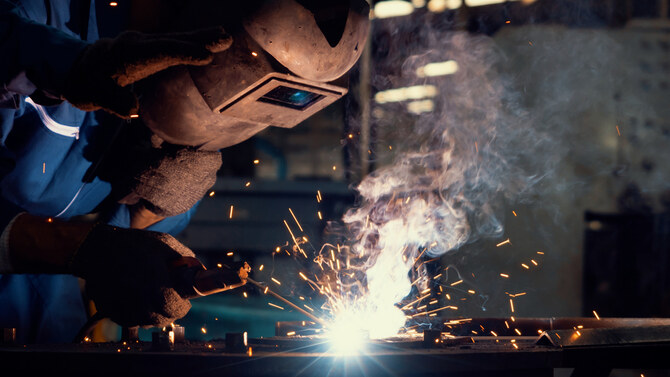
This uptick in manufacturing establishments greatly aligns with the National Industrial Strategy, unveiled by Crown Prince Mohammed bin Salman in October 2022. Shutterstock
Short Url
Updated 23 October 2024
Follow

Saudi Vision 2030 boosts industrial facilities by 60%, official figures reveal

  • Number of industrial establishments in the Kingdom increased from 7,206 in 2016 to 11,549 in 2023
  • Strategy focuses on 12 industrial sub-sectors, targeting more than 800 investment opportunities worth $266.4 billion

RIYADH: Bolstered by Vision 2030, Saudi Arabia’s industrial sector has witnessed a 60 percent growth in facilities since the launch of the national vision. 

The number of industrial establishments in the Kingdom increased from 7,206 in 2016 to 11,549 in 2023, reflecting Saudi Arabia’s efforts to diversify its economy and position itself as a global manufacturing power, according to a statement by the National Industrial Development and Logistics Program on the X platform. 

The report revealed that Riyadh currently leads in the number of facilities, with 4,502 factories, followed by the Eastern Province with 2,618 and Makkah with 2,209. 

Additional regions, including Al-Qassim, Madinah, and Asir, also host significant industrial infrastructure, contributing to the overall national growth. 

This uptick in manufacturing establishments greatly aligns with the National Industrial Strategy, unveiled by Crown Prince Mohammed bin Salman in October 2022, which aims to drive this growth further and expand the sector to approximately 36,000 factories by 2035. 

The strategy focuses on 12 industrial sub-sectors, targeting more than 800 investment opportunities worth SR1 trillion ($266.4 billion), striving toward tripling the industrial gross domestic product. 

According to NIDLP, facilities across the country are pivotal to advancing Vision 2030’s goals, including economic diversification and sustainable development. 

Earlier in February, the Ministry of Industry and Mineral Resources reported a 10 percent annual increase in operational factories in 2023, representing a total investment of approximately SR1.5 trillion. 

The body also noted that 1,379 industrial licenses were issued last year, with investments exceeding SR81 billion, while production began in 1,058 factories during the same period, with financial commitments totaling SR45 billion. 

It stated that the new permits were distributed among 25 industrial activities, led by food products processing with 244, followed by the manufacturing of non-metallic mineral goods with 176, and formed metal with 165. 

A total of 123 licenses were issued to factories engaged in the manufacturing of rubber and plastic products. 

Since the launch of NIDLP in 2019, Saudi Arabia has emerged as a key global player in sectors such as energy, mining, industry, and logistics. 

These industries are critical to the Kingdom’s broader economic diversification efforts, helping create diverse job opportunities and contributing to a sustainable future for younger generations. 

NIDLP leverages the nation’s strategic position as a global trade hub and its wealth of natural resources to foster further industrial growth and logistical efficiency. 


‘A Paperless Event’ – the slogan of Saudi technology at the UN General Assembly for Tourism

Updated 07 November 2025
Follow

‘A Paperless Event’ – the slogan of Saudi technology at the UN General Assembly for Tourism

RIYADH: Papers are absent, and Saudi technology is present to say “a paperless event” at the UN General Assembly meetings for the tourism sector, which will be held in Riyadh, with the participation of more than 100 ministers from around the world, Al-Eqtisadiah reports.

The assembly meetings are set amidst natural green plants cultivated in the Saudi desert, surrounding the roundtable that will bring the ministers together. They will chart their plan and vision for the next 50 years, discuss the use of artificial intelligence in the global tourism sector, and ensure the human element is not marginalized.

Sara Al-Saud, the general supervisor of International Affairs for the Saudi Ministry of Tourism, said that “there is a shortage of an estimated 43 million workers in the global tourism sector.”

She clarified that the topic of AI will be one of the subjects discussed by the over 100 ministers, in addition to shaping the Assembly’s vision for the next 50 years.

She added that the Assembly meetings are expected to witness the signing of memorandums of understanding and agreements during the event, alongside a number of recommendations that will be announced in due course.

For his part, Ahmed Al-Ghamdi, the director-general of International Research and Planning, emphasized that the human element is very important in the tourism sector, and that artificial intelligence significantly helps small and medium enterprises improve their service quality and customer experience.

The Executive Director of UN Tourism, Natalia Bayona, explained that the global tourism sector is the largest employer of youth, with 60 percent of them working with AI. She added that many tourists worldwide use AI to explore tourist destinations.

Consequently, a survey was conducted with member states to ascertain if they have local AI strategies and to identify what support could be offered to develop the mechanism, especially since the tourism sector relies heavily on small and medium enterprises.

Globally, the tourism sector contributed 10 percent to the global gross domestic product in 2024, equivalent to $10.9 trillion, recording a growth rate of 8.5 percent compared to 2023, thereby surpassing pre-COVID-19 pandemic levels.

On the local front for the Saudi tourism sector, unprecedented levels were recorded in terms of visitor numbers, spending volume, job creation, and contribution to the GDP.

The direct and indirect contribution of the tourism sector to the GDP reached 11.5 percent in 2023. The International Monetary Fund predicts that the Saudi tourism sector will achieve a growth rate of 16 percent by 2034.