Saudi Cabinet condemns Israeli comments on Al-Aqsa, seeks end to Gaza humanitarian catastrophe

1 / 5
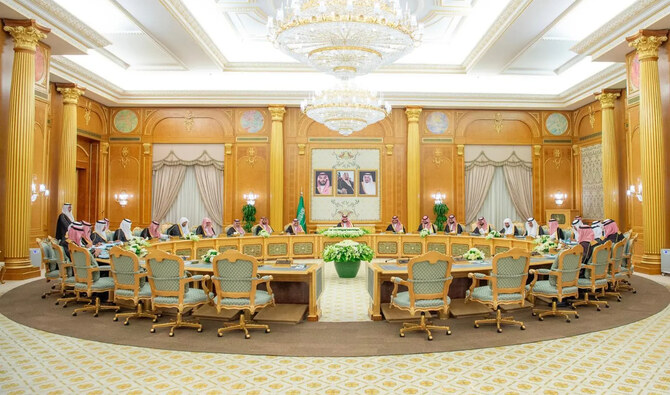
The Cabinet meeting was chaired by Crown Prince Mohammed bin Salman. (SPA)
2 / 5
The Cabinet meeting was chaired by Crown Prince Mohammed bin Salman. (SPA)
3 / 5
The Cabinet meeting was chaired by Crown Prince Mohammed bin Salman. (SPA)
4 / 5
The Cabinet meeting was chaired by Crown Prince Mohammed bin Salman. (SPA)
5 / 5
Crown Prince Mohammed bin Salman received newly-appointed Saudi ambassadors to various countries. (SPA)
Short Url
Updated 28 August 2024
Follow

Saudi Cabinet condemns Israeli comments on Al-Aqsa, seeks end to Gaza humanitarian catastrophe

RIYADH: Saudi Arabia’s Cabinet on Tuesday expressed its absolute rejection of extremist and inflammatory Israeli statements and condemned continuous provocations against the feelings of Muslims around the world.

It called on the international community to put an end to the Palestinian humanitarian catastrophe, and to activate serious mechanisms to hold Israeli officials accountable for the ongoing violations of international laws, norms and resolutions.

On Monday, Israel’s hard-line Security Minister Itamar Ben-Gvir said, in a radio interview, that he would back the establishment of a synagogue at Al-Aqsa mosque and to have Jews pray at the holy site in Jerusalem.

During the weekly Cabinet meeting, which was chaired by Crown Prince Mohammad bin Salman in Riyadh, the ministers tackled results of meetings held in Switzerland aiming to take concrete and immediate steps to alleviate the suffering of the Sudanese people and achieve a permanent halting of hostilities.

Talks on the war in Sudan were co-hosted last week by Saudi Arabia and Switzerland, with the African Union, Egypt, the UAE and the UN completing the so-called Aligned for Advancing Lifesaving and Peace in Sudan Group (ALPS).

The meetings ended Friday without a ceasefire but with progress on securing aid access on two key routes into a country facing one of the world’s worst humanitarian crises.

The Cabinet stressed that the Kingdom will continue to work with its partners in the international community until security and stability return to the African country.

On the domestic front, the ministers hailed the 10.5% increase in non-oil exports in the second quarter of this year, compared to the same period in 2023.

Saudi Arabia’s non-oil exports surged by 10.5 percent year-on-year in the second quarter of 2024, led by outgoing shipments to the UAE and China, official data showed.

According to the General Authority for Statistics, of the SR51.16 billion ($13.63 billion) registered by the sector in the three months to the end of June, non-oil goods worth SR15.07 billion were sent to the Kingdom’s Gulf neighbor, with SR7.08 billion going to the Asian powerhouse.

The Cabinet also praised the success of the first Esports World Cup, which embodies the efforts made to enhance the Kingdom’s position as a global destination for major sporting events and activities.

On behalf of King Salman and following the meeting, the Crown Prince received newly-appointed Saudi ambassadors to various countries, who took oath of office.


Saudi Arabia, Estonia strengthen cyber defense cooperation

Updated 09 February 2026
Follow

Saudi Arabia, Estonia strengthen cyber defense cooperation

  • Renowned for its leadership in digital governance, Estonia sees cybersecurity as central to its partnership potential with Saudi Arabia, building on years of regional engagement through its technology firms

RIYADH: Estonia aims to deepen defense, cybersecurity, and artificial intelligence cooperation with Saudi Arabia as both nations look to advance technology‑driven defense and cybersecurity capabilities.

Hanno Pevkur, Estonia’s minister of defense, told Arab News at the World Defense Show in Riyadh on Monday that Estonia’s defense industry is eager to contribute to the Kingdom’s fast‑growing defense ecosystem.

“In the modern world, cooperation built on trust and technology is the best defense,” he said. “It is important for us to be here because we clearly see there is a possibility to increase cooperation, not only bilaterally between Saudi Arabia and Estonia, but across the region.”

At Estonia’s pavilion, a cooperation agreement was signed between an Estonian company and a Saudi firm during the show, he noted.

Pevkur also said Estonia’s defense sector has expanded rapidly in recent years, driven by technological innovation and partnership.

“Our defense industry is growing very rapidly, and we continue to see strong momentum,” he said.

He said Estonia’s strengths lie in digital and smart‑system integration rather than large‑scale weapons production.

“We will not build airplanes or tanks, but what we can do is integrate robotics, automation and drones to make existing systems smarter,” he said.

The minister said effective defense collaboration must link businesses and governments to achieve meaningful results.

“When we want to have real cooperation, we need it on all levels,” he said. “The biggest client for any defense company is the government, so we must treat this as one ecosystem where the public and private sectors work hand in hand.”

Renowned for its leadership in digital governance, Estonia sees cybersecurity as central to its partnership potential with Saudi Arabia, building on years of regional engagement through its technology firms.

Pevkur said several Estonian companies, including Nortal, have already assisted Gulf governments in developing open IT and digital‑service systems.

“As the most digitalized nation in the world, almost every service in Estonia can be done online, except getting married,” he said. “But with such digitalization, we also need strong cyberdefense.”

He said data protection and digital resilience are treated as matters of national sovereignty in Tallinn, the capital of Estonia.

“Data is what we own. When someone steals that data, it becomes a serious threat,” he added. “That is why cyberdefense is not just about technology, it is about trust, sovereignty and protection.”

Pevkur said Saudi Arabia’s advances in AI offer promising opportunities for collaboration.

“I know that Saudi Arabia is doing great work when it comes to AI,” he said. “For us, as a small country with limited human resources, AI is essential not just for defense but for everyday life.”

Pevkur added that Estonia has launched a national AI strategy to promote responsible development and closer coordination between government and industry. One Estonian company, he said, has developed a system that allows a single operator to control hundreds of drones through AI.

“It is quite easy to put a weapon into the hands of a robot, but we also need to define who is accountable for its actions,” he said.

“The big question for the future is whether we can allow a war to be fought entirely by AI, or if humans must always make the final ethical decisions.”

He said in his conclusion that governments must reach a common understanding on how AI will be used and regulated on the battlefield.