

Pakistan denies delay in opening of China-funded Gwadar airport over security concerns

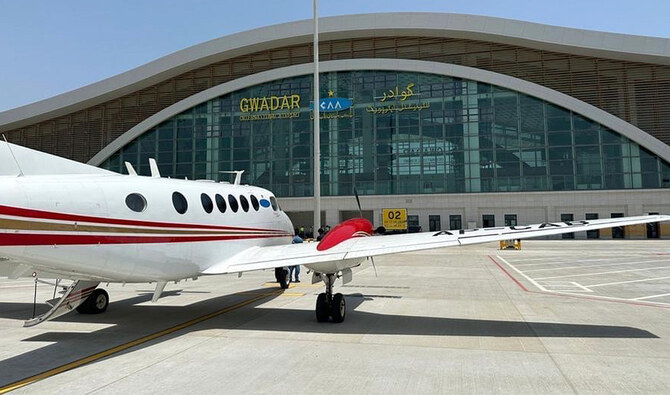
A calibration aircraft lands on the runway at the New Gwadar International Airport, in Gwadar, Pakistan on June 4, 2024. (Pakistan Civil Aviation Authority)
Short Url
Updated 27 August 2024
Follow

Pakistan denies delay in opening of China-funded Gwadar airport over security concerns

  • The $250 million New Gwadar International Airport was due to be inaugurated on Pakistan’s Independence Day on August 14
  • But the planned opening was halted reportedly over security concerns after widespread protests hit Balochistan this month

ISLAMABAD: Pakistan will inaugurate a China-funded airport in its southwestern Balochistan province “very soon,” the Balochistan chief minister said on Monday, denying reports of a delay in its opening over security fears.

The $250 million New Gwadar International Airport (NGIA), which lies close to a port at the center of the $50 billion China-Pakistan Economic Corridor (CPEC), was due to be inaugurated on August 14.

But the planned opening on Pakistan’s Independence Day was halted reportedly over security concerns after widespread protests by rights groups brought the southwestern Gwadar city to a standstill this month.

Speaking at a press conference Monday night, Balochistan CM Sarfraz Bugti denied reports of the postponement of the airport’s opening due to security concerns and said it was facing some “operational issues.”

“Absolutely, it is not like that. There are operational issues,” he told a reporter, when asked about the delay. “It is now close to completion. A test flight has been conducted and the prime minister will visit very soon and inaugurate it.”

The statement came hours after militants choked key highways as they launched coordinated attacks in several districts across the southwestern Pakistani province, killing 53 people.

Balochistan, which borders Iran and Afghanistan, has been the site of a decades-long separatist insurgency by ethnic Baloch militants, who say they are fighting what they see as the unfair exploitation of the province’s wealth by the federation. The Pakistani state denies the allegations.

Beijing has pledged over $60 billion for infrastructure projects in Pakistan under the CPEC framework which is central to its initiative to rebuild a new “Silk Road” through land routes and sea lanes to connect with markets in the Middle East, Africa and Europe.

But the undertaking has been hit by Pakistan struggling to keep up its financial obligations as well as militant attacks on Chinese nationals in Pakistan.

In recent months, China has publicly raised with Pakistan the issue of the security of its workers and interests, especially since a March suicide attack in which five Chinese workers and their local driver were killed in Pakistan’s northwest.


Pakistan to announce austerity plan on Monday amid rising fuel prices due to Middle East conflict

Updated 7 sec ago
Follow

Pakistan to announce austerity plan on Monday amid rising fuel prices due to Middle East conflict

  • The development follows an increase of Rs55 ($0.20) per liter in prices of petrol and diesel in Pakistan this week
  • PM Shehbaz Sharif promises ‘maximum relief’ to people as soon as ‘this difficult phase passes’ and economy stabilizes

ISLAMABAD: Pakistan is set to unveil an austerity plan tomorrow, Monday, as surging global oil prices, driven by United States and Israeli strikes on Iran, mount pressure on Prime Minister Shehbaz Sharif’s government to curb spending and stabilize the economy, the PM’s office said on Sunday.

The development follows an increase of Rs55 ($0.20) per liter in the prices of petrol and diesel in Pakistan this week as the Strait of Hormuz, which supplies a fifth of the global oil consumption, faces disruptions due to US-Israeli strikes on Iran and Tehran’s counter attacks on US interests in the Gulf region.

Pakistan’s Petroleum Division was directed to submit daily stock reports, while the country’s Oil and Gas Regulatory Authority (OGRA) was tasked with maintaining strict market oversight, officials said this week, as oil rose above $90 a barrel globally, the highest in years.

Sharif on Sunday presided over a meeting to review measures to stabilize the economy amid the Middle East conflict, with officials saying global supply disruptions and price fluctuations may have an impact on Pakistan, according to the prime minister’s office.

“In view of the recent international situation, timely implementation of measures is essential for the country’s economic stability,” Sharif was quoted as saying at the meeting. “The government is constantly monitoring the situation and all necessary decisions will be taken to provide all possible stability to the national economy.”

Earlier in the day, Pakistan’s Finance Minister said that Islamabad was preparing alternative plans to manage the financial impact of rising oil prices.

Speaking at the meeting, Sharif said the austerity measures must protect the interest of the people.

“All government employees and ministers will have to adopt austerity,” he said. “In the current difficult times, it is important to ensure wise use of national resources and as soon as this difficult phase passes and the economy becomes more stable, the government will provide maximum relief to the people.”

Instructions regarding austerity and simplicity will not be applicable to the industry and agriculture sectors so that the country’s production, exports and food security are not affected, according to Sharif’s office.

Several suggestions and recommendations based on austerity and simplicity were presented at the meeting, which were reviewed in detail by participants.

“The briefing was informed that the country has adequate reserves of diesel, petrol and other petroleum products and the government has made advance arrangements to deal with any emergency,” Sharif’s office said.