SOLINGEN, Germany: German Chancellor Olaf Scholz said Monday the government would tighten weapons controls and speed up deportations after a suspected Islamist knife attack in the western city of Solingen.
Friday night’s deadly stabbing at a street festival has reignited a debate over immigration in the country and put extra pressure on Scholz ahead of key regional elections set for Sunday.
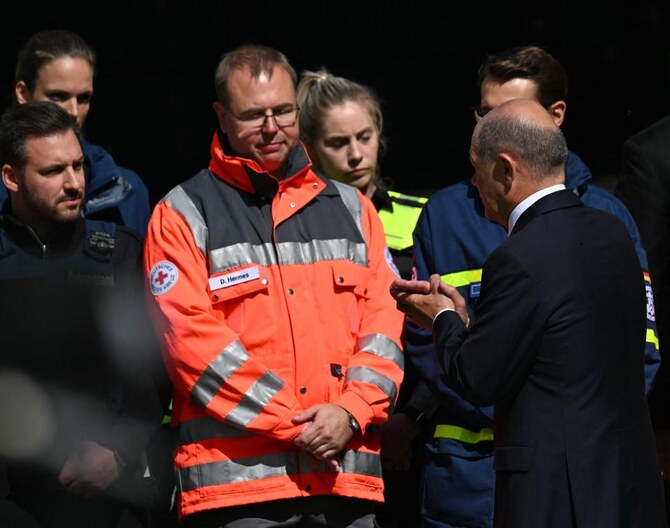
“This was terrorism, terrorism against us all,” Scholz said on a visit to Solingen, where he laid flowers at a memorial to the victims.
A 26-year-old Syrian with suspected links to the Daesh group is alleged to have carried out the attack, which left three people dead and eight more wounded.
Scholz said he was “angry... at the Islamists who threaten our peaceful coexistence.”
“We will now have to tighten up the weapons regulations... in particular with regard to the use of knives,” Scholz said.
Stronger weapons controls would come “very quickly,” Scholz said.
Germany would also have to “do everything we can to ensure that those who cannot and must not stay here in Germany are repatriated and deported,” Scholz said.
The suspect, named as Issa Al H., was able to evade the police after the attack before reportedly handing himself in to law enforcement on Saturday evening.
The Syrian was detained on suspicion of murder, attempted murder and belonging to a “terrorist group.”
The Daesh group on Saturday said one of its members had carried out the attack in an act of “revenge.”
The group subsequently published a video via the jihadists’ Amaq news agency purporting to show the Solingen attack, in which the veiled man said he intended to carry out reprisals for “massacres” in the Middle East and beyond.
The claim could not be immediately verified.
The suspected attacker has raised concerns in Germany for the seeming ease with which he avoided authorities attempts to remove him.
According to the Bild and Spiegel news outlets, the suspect arrived in Germany in December 2022 and had a protected immigration status often given to those fleeing war-torn Syria.
He was meant to have been deported to Bulgaria, where he had first arrived in the European Union, but he went missing.
The suspect was not known to German security services as a dangerous extremist, according to officials.
According to federal police figures, almost 52,976 people were supposed to be deported or expelled from Germany last year.
Successful deportations however only took place in 21,206 instances — less than half of the total planned — often because the individuals concerned were “not handed over” to police.
The attack spurred a new debate around immigration in the EU’s most populous country ahead of regional elections next weekend in Saxony and Thuringia, where the far-right Alternative for Germany (AfD) is set to make gains.
The attack would strengthen the perception that the government was “overwhelmed,” Ursula Muench, the director of the Academy for Political Education, told AFP.
The AfD has accused successive governments of contributing to “chaos” by allowing in too many immigrants, and called for a stop to new entries.
Friedrich Merz, the leader of the CDU, Germany’s main opposition party, meanwhile urged the government to stop taking in refugees from Syria and Afghanistan.
The government — a fraught coalition between Scholz’s Social Democrats, the Greens and the pro-business FDP — had already announced moves to toughen immigration rules.
Following an attack by a 25-year-old Afghan at an anti-Islam rally in Mannheim in May, the government said it would look to restart deportations directly to Afghanistan and Syria after years in which they were halted.
German security services have been on high alert for Islamist attacks since the Gaza war erupted on October 7 with the Hamas attacks on Israel.
Germany has been hit by several such attacks in recent years, with the most deadly being a truck rampage at a Berlin Christmas market in 2016 that killed 12 people.


![]()

Scholz promises new weapons controls after Germany knife attack
Short Url
https://arab.news/6v8be
Scholz promises new weapons controls after Germany knife attack
- A 26-year-old Syrian with suspected links to the Daesh group is alleged to have carried out the attack, which left three people dead and eight more wounded
- Germany has been hit by several such attacks in recent years, with the most deadly being a truck rampage at a Berlin Christmas market in 2016 that killed 12 people


Latest updates




© 2026 SAUDI RESEARCH & PUBLISHING COMPANY, All Rights Reserved And subject to Terms of Use Agreement.