

Pakistan warns heavy rains may trigger floods from today

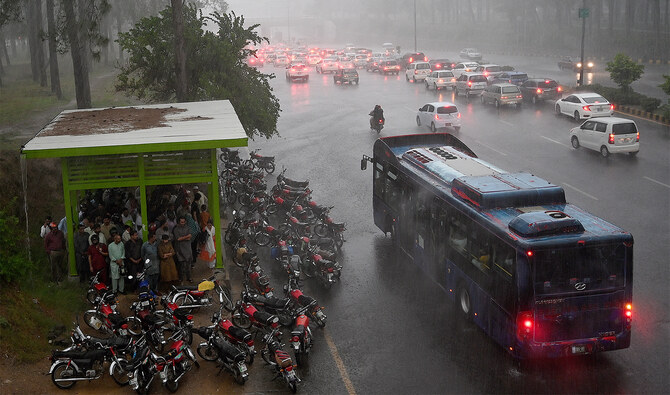
Commuters drive along a road amid heavy monsoon rains in Islamabad on July 10, 2024. (AFP/File)
Short Url
Updated 26 August 2024
Follow

Pakistan warns heavy rains may trigger floods from today

  • Torrential rains in Pakistan have killed 243 people and injured 447 since July 1, official data shows 
  • Pakistan is recognized as one of the most vulnerable countries to climate change effects in the world

ISLAMABAD: Heavy rains from Aug. 26-30 could trigger flash floods in the low-lying areas of Sindh, southern Punjab and Balochistan provinces, the Pakistan Meteorological Department (PMD) warned on Monday, as monsoon downpours have already killed 243 people and injured 447 others since July 1 in the country. 

Heavy monsoon rains since July have triggered floods and landslides in many parts of the country, notably Pakistan’s Punjab and northwestern Khyber Pakhtunkhwa (KP) provinces, which have reported the highest number of casualties. Since July 1, Punjab has reported 92 casualties and 231 injured from rain-related incidents while KP has reported 74 deaths and 128 injuries. Sindh has recorded 48 deaths and 57 injuries while Balochistan has reported 21 deaths and 13 injuries since July 1 due to rain-related incidents. 

“There is a risk of flooding in low-lying areas of Sindh, south Punjab and Balochistan due to torrential rains from Aug. 26-30,” the PMD said in a statement. 

It warned that the hill streams of Dera Ghazi Khan, Dadu, Kalat, Khuzdar, Jafarabad, Sibi, Nasirabad, Barkhan, Loralai, Awaran, Panjgur, Washak, Mastung and Lasbela could experience flooding during these days. 

Whereas the northern areas of Murree, Galiyat, Mansehra, Kohistan, Chitral, Dir, Swat, Shangla, Buner, Kashmir and Gilgit-Baltistan (GB) may experience landslides due to heavy rains, the Met office said. 

Since the onset of monsoon rains in July, Pakistan’s National Disaster Management Authority has warned tourists against traveling to areas susceptible to floods. Pakistan’s top disaster management body has also advised people to stay informed and download the NDMA’s disaster alert mobile app for timely alerts and weather reports.

Pakistan is recognized as one of the most vulnerable countries to climate change effects in the world. This year, the South Asian country recorded its “wettest April since 1961,” with 59.3 millimeters of rainfall while some areas of the country faced a heat wave in May and June. 

In 2022, unusually heavy rains triggered flash floods in many parts of the country, killing over 1,700 people, inflicting losses of around $30 billion, and affecting at least 30 million people.

Scientists have attributed Pakistan’s erratic weather patterns to climate change effects and called on countries around the world to take urgent steps to tackle the crisis. 


73% of foreign firms in Pakistan see it as a viable investment destination — survey

Updated 13 sec ago
Follow

73% of foreign firms in Pakistan see it as a viable investment destination — survey

  • OICCI survey highlights improved investor optimism since 2023, when it stood at 61%
  • Regulatory unpredictability, high costs continue to keep foreign investors cautious

ISLAMABAD: Seventy-three percent of overseas investors operating in Pakistan now recommend the country as a viable destination for direct investment, up from 61% in 2023, according to a survey of more than 200 multinational companies released on Friday, signaling a measurable improvement in investor sentiment following Pakistan’s 2022–23 foreign exchange crisis.

The 2025 Perception and Investment Survey, conducted by the Overseas Investors Chamber of Commerce and Industry (OICCI), which represents multinational firms in the country, found that improving macroeconomic indicators and recent policy reforms have begun to restore confidence, though investors remain cautious about regulatory unpredictability and rising business costs.

“The 2025 Perception and Investment Survey ... provides a cautiously optimistic snapshot of investor sentiment in

Pakistan,” the report said, noting that “improvements in macroeconomic indicators and recent policy reform initiatives have begun to rebuild confidence among foreign investors.”

The survey pointed to relative exchange-rate stability after a period of steep rupee depreciation, alongside credit rating upgrades by international agencies.

“73% of OICCI members now recommend Pakistan as a viable FDI destination, compared to 61 percent two years earlier,” it added.

Despite the improved macro picture, the survey warned that structural and regulatory challenges continue to weigh on investment decisions. 

“The broader regulatory landscape remains complex and unpredictable,” it said, highlighting delays in tax refunds, inconsistent enforcement and weak coordination between federal and provincial authorities.

Foreign direct investment, while showing some positive movement, “remains concentrated in cautious brackets,” with most investors opting for modest commitments despite a decline in the proportion of firms planning no future investment.

Rising costs were a major concern, with nearly all respondents reporting increases in energy prices, wages and raw material costs. Political instability, sudden regulatory changes and an unclear fiscal roadmap were listed among the top investor apprehensions.

The survey warned that despite the positive outlook among multinationals operating in Pakistan, international perception of the country has improved only marginally, adding that “negative global coverage continues to influence investment decisions significantly,” and underscoring the need for a more proactive international communication strategy.