

Saudi Real Estate Refinance Co., BlackRock to develop Kingdom’s property finance market

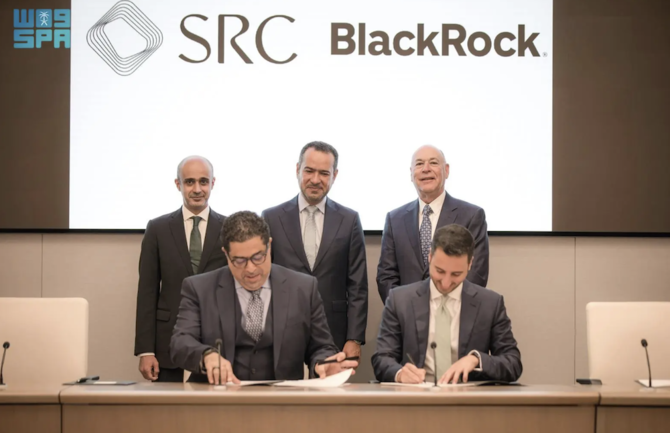
The deal was signed by SRC CEO Majid Al-Abduljabbar and General Manager of BlackRock in the Middle and CEO of BlackRock Saudi Arabia Yazeed Al-Mubarak. SPA
Short Url
Updated 25 August 2024
Follow

Saudi Real Estate Refinance Co., BlackRock to develop Kingdom’s property finance market

  • Signing came during visit by Saudi Minister of Municipalities and Housing Majid Al-Hogail to New York
  • Kingdom signed deal with K. Hovnanian Homes ME to develop 500,000 housing units in the US

RIYADH: The Saudi real estate finance market will be supported by a deal between a Public Investment Fund subsidiary and US investment giant BlackRock.

The Saudi Real Estate Refinance Co. signed the memorandum of understanding with BlackRock in New York City on Saturday, the Saudi Press Agency reported.

It came during a visit by Saudi Minister of Municipalities and Housing Majid Al-Hogail.

The deal seeks to develop the real estate finance market in Saudi Arabia and increase the share of businesses in the real estate sector capital markets, the SPA said.

The agreement was signed by SRC CEO Majid Fahd Al-Abduljabbar and Yazeed Al-Mubarak, general manager of BlackRock Middle East and CEO of BlackRock Saudi Arabia.

BlackRock President Robert Kapito also attended the signing ceremony.

Al-Hogail is in the US to discuss ways to boost Saudi-US partnerships in urban development, construction, building, and real estate finance.

The ministry signed a separate memorandum of understanding with K. Hovnanian Homes ME to develop 500,000 housing units in the US.

Al-Hogail said the deal came from a belief in the “importance of attracting global expertise to support our journey in the real estate development sector.

“Through this partnership, we aim to benefit from successful experiences and expertise to build more integrated residential communities that are consistent with our continuous efforts to enhance the real estate supply with the highest standards, best practices and technologies, and to meet the aspirations of Saudi families,” he added in a post on his X account.


Arab food and beverage sector draws $22bn in foreign investment over 2 decades: Dhaman 

Updated 28 December 2025
Follow

Arab food and beverage sector draws $22bn in foreign investment over 2 decades: Dhaman 

JEDDAH: Foreign investors committed about $22 billion to the Arab region’s food and beverage sector over the past two decades, backing 516 projects that generated roughly 93,000 jobs, according to a new sectoral report. 

In its third food and beverage industry study for 2025, the Arab Investment and Export Credit Guarantee Corp., known as Dhaman, said the bulk of investment flowed to a handful of markets. Egypt, Saudi Arabia, the UAE, Morocco and Qatar attracted 421 projects — about 82 percent of the total — with capital expenditure exceeding $17 billion, or nearly four-fifths of overall investment. 

Projects in those five countries accounted for around 71,000 jobs, representing 76 percent of total employment created by foreign direct investment in the sector over the 2003–2024 period, the report said, according to figures carried by the Kuwait News Agency. 

“The US has been the region's top food and beverage investor over the past 22 years with 74 projects or 14 projects of the total, and Capex of approximately $4 billion or 18 percent of the total, creating more than 14,000 jobs,” KUNA reported. 

Investment was also concentrated among a small group of multinational players. The sector’s top 10 foreign investors accounted for roughly 15 percent of projects, 32 percent of capital expenditure and 29 percent of newly created jobs.  

Swiss food group Nestlé led in project count with 14 initiatives, while Ukrainian agribusiness firm NIBULON topped capital spending and job creation, investing $2 billion and generating around 6,000 jobs. 

At the inter-Arab investment level, the report noted that 12 Arab countries invested in 108 projects, accounting for about 21 percent of total FDI projects in the sector over the past 22 years. These initiatives, carried out by 65 companies, involved $6.5 billion in capital expenditure, representing 30 percent of total FDI, and generated nearly 28,000 jobs. 

The UAE led inter-Arab investments, accounting for 45 percent of total projects and 58 percent of total capital expenditure, the report added, according to KUNA. 

The report also noted that the UAE, Saudi Arabia, Egypt, and Qatar topped the Arab ranking as the most attractive countries for investment in the sector in 2024, followed by Oman, Bahrain, Algeria, Morocco, and Kuwait. 

Looking ahead, Dhaman expects consumer demand to continue rising. Food and non-alcoholic beverage sales across 16 Arab countries are projected to increase 8.6 percent to more than $430 billion by the end of 2025, equivalent to 4.2 percent of global sales, before exceeding $560 billion by 2029. 

Sales are expected to remain highly concentrated geographically, with Egypt, Saudi Arabia, Algeria, the UAE and Iraq accounting for about 77 percent of the regional total. By product category, meat and poultry are forecast to lead with sales of about $106 billion, followed by cereals, pasta and baked goods at roughly $63 billion. 

Average annual per capita spending on food and non-alcoholic beverages in the region is projected to rise 7.2 percent to more than $1,845 by the end of 2025, approaching the global average, and to reach about $2,255 by 2029. Household spending on these products is expected to represent 25.8 percent of total expenditure in 13 Arab countries, above the global average of 24.2 percent. 

Arab external trade in food and beverages grew more than 15 percent in 2024 to $195 billion, with exports rising 18 percent to $56 billion and imports increasing 14 percent to $139 billion. Brazil was the largest foreign supplier to the region, exporting $16.5 billion worth of products, while Saudi Arabia ranked as the top Arab exporter at $6.6 billion.